 Vietnamnet.vn

 Podcast



However, this also comes with enormous congestion and logistics pressure, as transporting one container by road currently costs nearly five times more than by waterway.
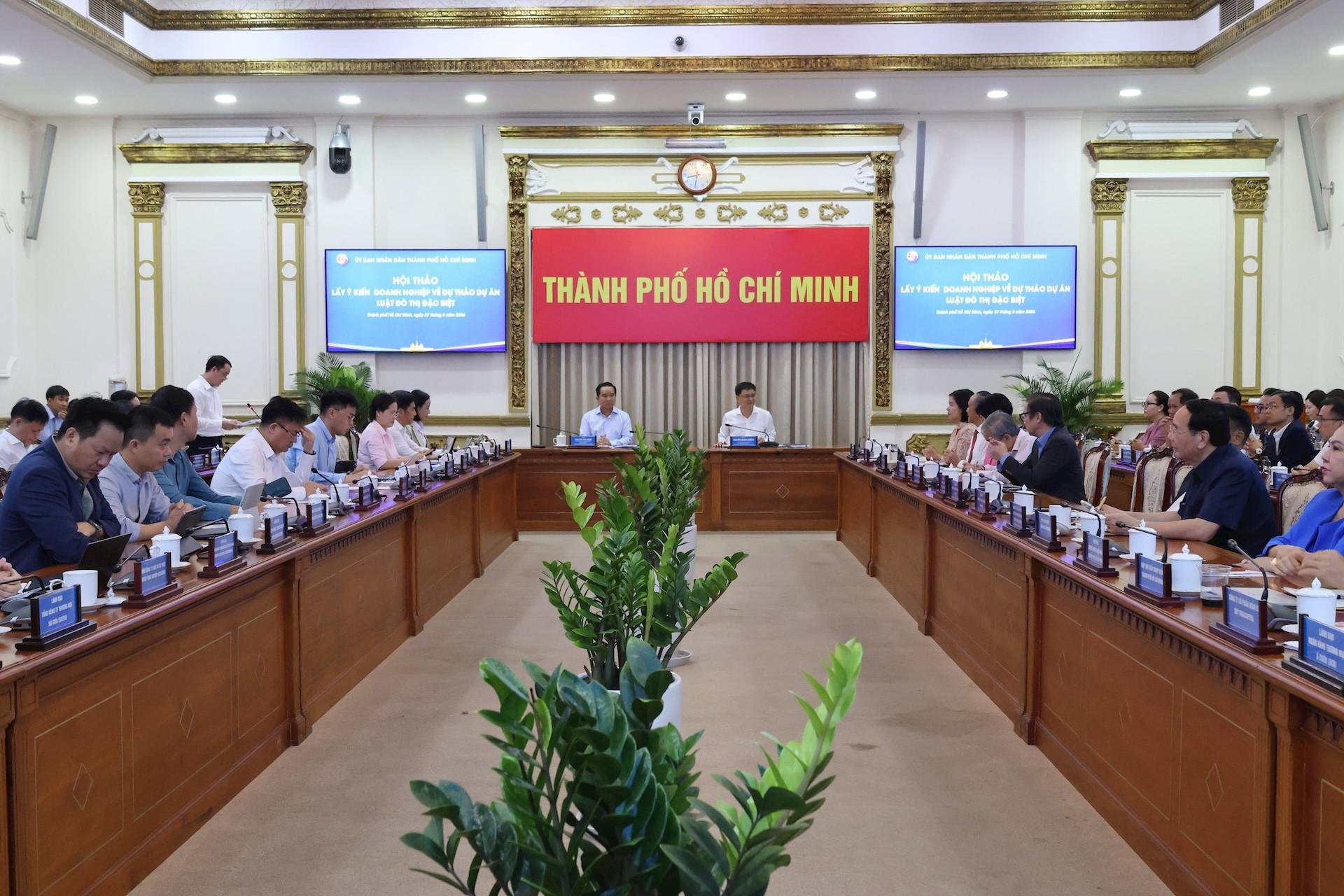
At a workshop held to collect business feedback on the Draft Law on Special Cities on May 27, Pham Quoc Long, deputy general director of Gemadept Corporation, noted that the cargo going through HCMC’s seaport system (which includes the legacy Cai Mep - Ba Ria Vung Tau port cluster) reached 24 million TEUs in 2025, ranking eighth globally.
With a cargo growth rate of 12–15 percent annually, throughput is expected to hit roughly 34–45 million TEUs by 2030. If so, HCMC will ascend to fourth or fifth place worldwide in terms of port cargo volume. However, that figure will exert massive pressure on transport infrastructure, demanding that the city formulate long-term solutions.
According to Long, HCMC needs to aggressively promote inland waterway transport to slice logistics costs and alleviate traffic pressure.
As an example, he cited that the road transport fee for a 20-foot container from HCMC to Cai Mep Port costs VND4 million, whereas waterway transport costs a mere VND700,000, less than one-fifth of the road rate. Moreover, a single barge can carry up to 300 containers, significantly reducing congestion compared to moving the same number of containers by road.
The Gemadept representative proposed that the city prioritize upgrading bridge clearance heights on major waterways to at least 7m in line with planning targets, allowing barges carrying 3-4 layers of containers to move safely and continuously. This would directly help reduce road traffic pressure, lower emissions and cut logistics costs.
At the same time, Long suggested adding mechanisms to the draft law for planning and developing inland waterway terminals, ICDs, depots and satellite logistics centers in HCMC and the former Binh Duong area.
“In terms of benefits, investment in inland waterway transport does not require major spending because businesses have already invested in barges. Each ICD only needs around 10ha and also does not require large capital investment. However, the city currently lacks land funds for inland waterway terminals,” he said.
Ngo Chi Dung, chair of Tam Anh Hospital System, said that healthcare businesses still lack experience in accessing land projects. However, without stable land funds, it would be difficult for businesses to commit to large-scale, long-term healthcare investment.
Currently, Tam Anh’s healthcare system relies on acquiring hospitals and projects from real estate firms or leasing premises already used for healthcare purposes. However, one major issue is that the remaining land-use duration is often limited, with some projects having only a little more than 10 years left.
Dung said if a company invests in a hospital with advanced technology and human resources but only has a short land-use period, businesses would not dare invest and banks would also hesitate to provide loans.
The company plans to invest nearly $1 billion in HCMC over the next five years. He proposed that healthcare projects with investment capital exceeding VND6 trillion, in which enterprises self-invest in land acquisition, would automatically receive a 50-year extension for land-use rights for healthcare construction so that businesses can invest with confidence.
Nguyen Thai Hoai Anh, deputy general director of Sun Group, proposed that HCMC add special mechanisms for urban, housing and commercial-service complex projects under the list of strategic investment attraction projects into the Law on Special Urban Areas.
She explained that these would be similar to a draft government decree on special policies for reclaimed coastal urban projects in Da Nang. Under the proposal, projects would be allowed to pilot mechanisms for selling commercial housing to foreigners, with foreign ownership capped at no more than 50 percent of total commercial housing units in a project.
The policy is intended to increase the attractiveness of projects implemented by strategic investors while expanding the international customer base and attracting capital flows and consumption to HCMC.
At the workshop, HCMC Mayor Nguyen Van Duoc said the city’s growth has slowed after many consecutive terms of achieving double-digit growth.
Growth reached 12-16 percent during the 1991-1995 period, 10-11 percent during 1996-2000, 10.99 percent during 2011-2015, and 11.18 percent during 2016-2020. However, since 2020, growth has fluctuated at around 7 percent.
The Law on Special Urban Areas is expected to create more confidence for businesses and investors while opening new room for the city to achieve faster and more sustainable growth in the next phase.
Tran Thuong
.svg)
