 Vietnamnet.vn

 Podcast



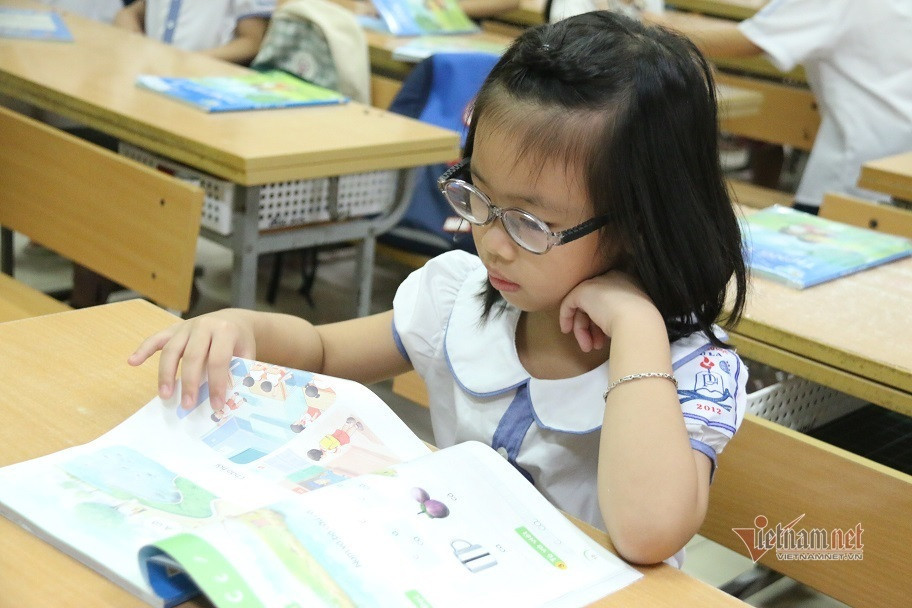
The Politburo’s Resolution 71 on breakthroughs in education and training development request to review and evaluate the implementation of the new general education program; ensure the provision of one unified set of textbooks nationwide, and strive to provide textbooks for free by 2030.
Before 2020, one common set of textbooks was used for all schools nationwide. At the end of 2018, the Ministry of Education and Training (MOET) issued the 2018 general education program, with the principle ‘one program, many textbooks’.
From the 2020‑2021 school year, new textbooks were put into use for grade 1. At that time, there were five textbook sets approved and circulated nationwide, including ‘Chan Troi Sang Tao’ (Creative Horizon), ‘Ket Noi Tri Thuc Voi Cuoc Song’ (Connecting knowledge with life), “Cung Hoc De Phat Trien Nang Luc’ (Learn together to develop capacity), “Vi Su Binh Dang Va Dan Chu Trong Giao Duc’ (For equality and democracy in education) and Canh Dieu (The Kite)
In 2021, only three sets of textbooks were approved: Canh Dieu, Ket Noi Tri Thuc Va Cuoc Song and Chan Troi Sang Tao. The three textbook sets are still in use, among which Chan Troi Sang Tao has version 1 and version 2.
Associate Prof Nguyen Kim Hong, former principal of the HCMC University of Education, noted that Resolutions 29 and 88 on innovation of curriculum and textbooks brought a major change in Vietnam’s general education. Among them, the greatest innovation was changing the approach to teaching and learning toward developing capacities of both teacher and learner.
During the renewal process, Vietnam compiled many textbook sets for each subject; English in particular has had the most learning materials made.
However, there have been debates about the existence of many textbook sets. Supporters say teachers and students should have more choices of teaching and learning materials for themselves. Opponents argue that the existence of many textbooks doesn’t work because managers choose textbooks to use and not teachers or students.
Textbook authors need to be honest and assess how much difference there is between the textbook sets, and whether it is worth choosing this set versus another. Using many textbook sets leads to more expenses.
Hong believes the policy of using one textbook set nationwide, and at the same time the state providing textbooks for all students as stated in Resolution 71, is appropriate.
This helps to save education costs, because there is very little difference among the current textbook sets in each learning subject.
“If there is one textbook set used commonly in schools for each grade nationwide, the cost of authoring materials and printing will be lower,” Hong said.
Opponents say that if there is only one book, teachers cannot be creative because they don’t have choices. However, Hong argued the 2018 new general education program has already unified the overall curriculum and subject curricula, in which the subject curricula specify the outcomes required for each lesson, each topic, and each new content.
Meanwhile, textbooks are not the only materials serving teaching and learning in schools.
One good new set of textbooks needed
Nguyen Van Ngai, former deputy director of the HCMC Education and Training Department, said there have long been opinions that the Ministry of Education and Training should compile one textbook set.
The Politburo’s Resolution 71 mentions the provision of one unified textbook set, so the current issue is how to compile the new textbook set that has the best quality.
He believes it is necessary to evaluate the strengths and weaknesses of previous textbook sets so that the new textbook set can eliminate limitations.
According to Hong, in many developed countries, teachers join the curriculum development team. Afterwards, they design their own teaching framework for subjects in their school, evaluated and funded based on quality.
Currently, Vietnam has multiple approved textbook sets introduced in schools which can be seen as valuable knowledge sources, providing experience for those compiling books under resolution 71 to reference.
"Thus, new authors, when 'standing on the shoulders of giants,' will have more experience in writing textbooks in the spirit of Resolution 71. By respecting previous compilers, they will create success," Hong said.
Currently, Vietnam has multiple approved textbook sets introduced in schools which can be seen as valuable knowledge sources, providing experience for those compiling books under resolution 71 to reference.
"Thus, new authors, when 'standing on the shoulders of giants,' will have more experience in writing textbooks in the spirit of Resolution 71. By respecting previous compilers, they will create success," Hong said.
Thanh Hung
.svg)
