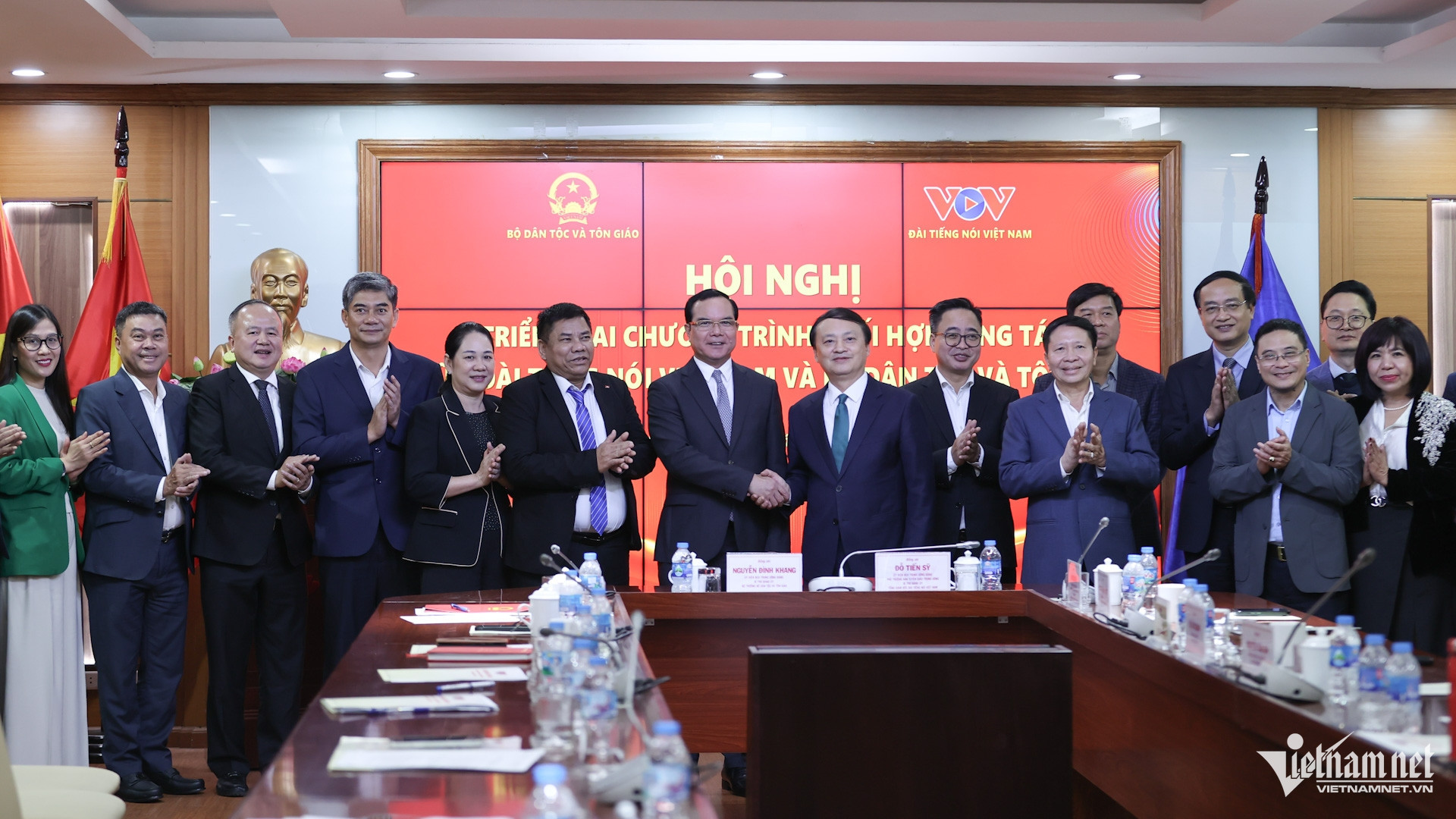
The Ministry of Ethnic and Religious Affairs and Voice of Vietnam (VOV) have signed a cooperation programme for 2026-2030 to improve policy communication and make essential information more accessible to local communities.
On November 25, a conference to launch the 2026-2030 cooperation programme between the Ministry of Ethnic and Religious Affairs and Voice of Vietnam (VOV) was held in Hanoi.
Minister of Ethnic and Religious Affairs Nguyen Dinh Khang and VOV General Director Do Tien Sy co-chaired the conference.
At the event, the two agencies agreed on cooperation priorities for the next five years, focusing on maintaining effective existing initiatives while adopting innovative approaches to ensure that policy information reaches citizens promptly and is accessible and relevant to different localities and audiences.
Innovating policy communication for local communities
The Minister of Ethnic and Religious Affairs and the General Director of Voice of Vietnam sign the 2026-2030 cooperation programme. Photo: Le Anh Dung
Speaking at the signing ceremony, Minister Nguyen Dinh Khang said cooperation between the two agencies during the 2021-2025 period had helped communicate the Party’s guidelines and the State’s policies and laws to local communities.
Communication activities have also contributed to promoting Vietnam’s image, people and diverse ethnic cultural identities, strengthening public trust and social consensus, and countering misinformation and distortions that exploit ethnic and religious issues to undermine national unity.
The minister acknowledged the contributions of VOV and its officials, reporters, editors and radio presenters in maintaining a strong presence at the grassroots level, visiting villages and listening to local communities.
Authentic stories drawn from everyday life have helped make policy information more relatable and practical for audiences.
According to Khang, the 2026-2030 period presents increasingly demanding requirements for ethnic and religious affairs and public communication.
Cooperation priorities must therefore be translated into annual action plans with clearly defined themes, practical tasks, implementation schedules and responsibilities.
The designated coordinating units of both agencies should proactively provide recommendations to ensure that these plans are feasible and responsive to practical needs.
One key priority is improving the quality of programmes covering ethnic policies, beliefs and religions, national unity and cultural preservation.
The minister called for greater attention to showcasing and replicating exemplary practices in economic development, cultural preservation and promotion, as well as positive religious and spiritual values.
Through individual stories, media coverage should demonstrate how policies are implemented in everyday life and highlight the concrete contributions of individuals and communities.
Khang emphasised the importance of expanding communication in ethnic minority languages.
Radio programmes, podcasts, reports in ethnic minority languages and audio content for grassroots communication will help make information more accessible, particularly in remote and isolated areas.
Language choices and presentation formats should be tailored to the characteristics of each community.
Communication activities should also adopt a multiplatform approach. VOV has been encouraged to increase the production of short videos, podcasts, infographics and documentaries while making effective use of its digital platforms.
These formats will broaden access to information and bring stories about ethnic minority communities, mountainous regions and religious life to more diverse audiences.
To ensure coordinated implementation, Khang proposed maintaining regular cooperation mechanisms, conducting annual progress reviews and carrying out a comprehensive evaluation in 2030.
The minister expressed confidence that, drawing on the traditions, experience and strengths of both agencies, the cooperation programme would be implemented proactively and creatively.
It is expected to help bring policies closer to local communities, accurately reflect citizens’ concerns and aspirations, and strengthen national unity.
Reflecting grassroots achievements and challenges
Leaders of the two agencies attend the signing ceremony for the 2026-2030 cooperation programme. Photo: Le Anh DungRepresentatives of units under the two agencies attend the signing ceremony. Photo: Le Anh Dung
Speaking at the conference, VOV General Director Do Tien Sy said that during the five-year implementation of the previous cooperation programme, VOV had produced 3,360 Vietnamese-language programmes containing 10,080 news reports and articles broadcast on VOV1 and VOV2.
It also produced 23,400 radio programmes in 13 ethnic minority languages, featuring more than 70,000 news reports and articles on VOV4.
Ethnic minority-language broadcasting plays an important role in providing information, explaining policies and connecting residents in remote, isolated and border areas with national development policies.
Looking ahead to the new cooperation period, Sy said policy communication should help citizens understand their rights and obligations, as well as how to access and benefit from policies in practice.
The media should reflect both positive developments and existing difficulties and shortcomings, bringing grassroots perspectives to regulatory authorities so that emerging issues can be identified and addressed promptly.
He called for continued efforts to leverage VOV’s strengths in multimedia and multilingual communication while promoting cultural preservation in connection with livelihoods and community life.
Attention should also be paid to strengthening the role of local communities, artisans and heritage custodians.
The two agencies should clearly designate coordinating units and responsibilities, maintain two-way information exchanges and develop specific annual cooperation plans.
The 2026-2030 cooperation programme is expected to continue bringing policies closer to local communities and accurately reflecting citizens’ concerns and aspirations.
Through these efforts, the programme aims to strengthen public trust and national unity while promoting development in ethnic minority areas and regions with large religious communities.
 Vietnamnet.vn

 Podcast