 Vietnamnet.vn

 Podcast



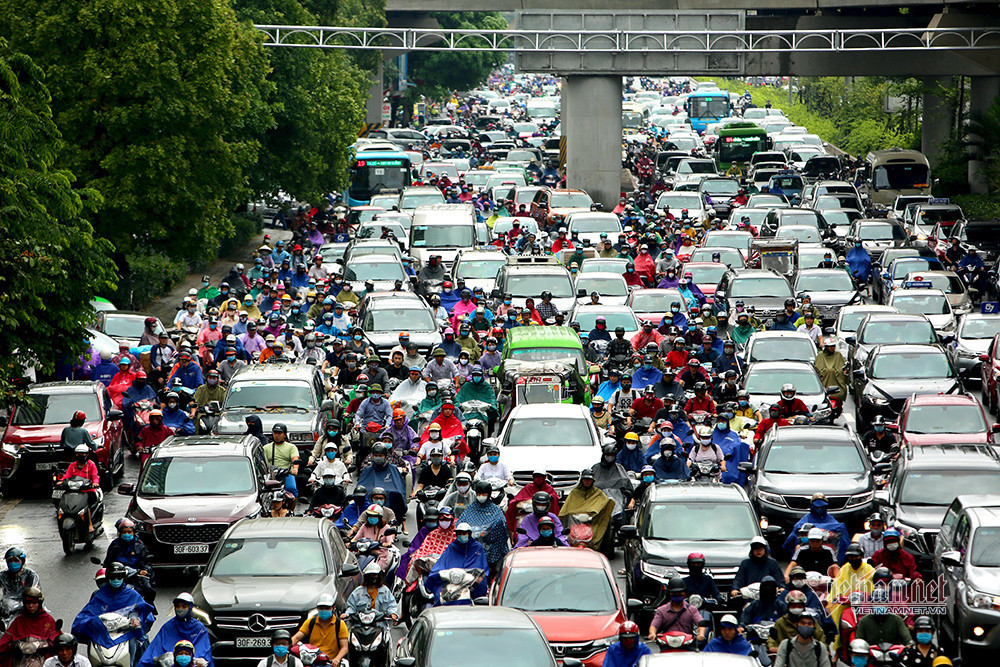
MOIT has proposed that from January 1, 2026, all gasoline produced, blended and sold for use in vehicles with gasoline engines nationwide will be E10.
However, the ministry acknowledged that while E5RON92 gasoline has been sold nationwide, its consumption has been declining, from over 40 percent of total domestic gasoline consumption in 2018-2019 to about 20 percent from 2023 to the present.
One reason is the lingering skepticism among some consumer groups about its impact on engines.
This problem had also occurred in other countries, but E10 is now seen as a common type of gasoline and is used on a large scale.
In the Philippines, the average number of cars per capita is lower than in Vietnam, estimated at under 50 cars per 1,000 people in 2019 (the Philippines has more motorcycles and jeepneys than private cars). The average age of cars is about 11-12 years, similar to Vietnam and Thailand, showing that a high number of vehicles were manufactured in 2000s.
This Southeast Asian nation implemented an ethanol gasoline program with RA 9367, known as the Biofuels Act of 2006, starting with E5 and then with E10 nationwide, starting in April 2023. Under the act, all gasoline sold, regardless of octane rating, had to contain 10 percent ethanol.
While Vietnam currently has multiple gasoline types (E5 RON92 and RON95), in the Philippines E10 has become the default fuel for all users. This means that if a vehicle is not compatible with E10, there are virtually no viable alternatives.
Thus, ensuring vehicle compatibility was a key concern when the mandate was issued.
After consulting automakers and reviewing international data, the Philippines' Department of Energy (DOE) officially stated that using gasoline with 10 percent ethanol is safe for all gasoline engines, alleviating consumer concerns. And automakers confirmed that their models from the mid-1990s onward could handle E10.
The question was how to deal with old vehicles incompatible with E10.
Some mechanics recommended more frequent fuel filter replacements or using additive substitutes for vehicles older than 1995. However, no widespread issues have been reported since E10 implementation. The Philippine market has accepted E10 as regular gasoline, and drivers have used it for over a decade without incidents.
Many cars in the Philippines are used imports, mainly from Japan and other countries. In Japan, E10 is not widely used. However, since the 1990s, Japanese automakers have designed vehicles to handle up to 10 percent ethanol to meet export demands in E10-using markets.
This benefits the Philippines as even used imported vehicles are unaffected by the change.
In Vietnam, MOIT and manufacturers have stated that most motorcycles can use E10 biofuel without technical issues.
In a document sent to the MOIT’s Domestic Market Management and Development Agency on August 22, the Vietnam Association of Motorcycle Manufacturers (VAMM) reported that most current motorcycle models can use E10 biofuel without requiring technical modifications.
The conclusion was drawn after analyzing reports from the largest manufacturers, including Honda, Yamaha, Piaggio, SYM and Suzuki.
Honda, Yamaha, Piaggio, and SYM confirmed that all their motorcycle models are compatible with E10.
Suzuki stated that most of its products are compatible, except for some older models, including Viva 110 (2000), Smash (2003), Smash Revo (2006), Shogun (2004), Amity (2006), AN125 (1995), GN125 (1996), Hayate (2007), EN150 (2012), GZ150 (2012), UA125 (2012), and GD110 (2016), which still require further verification.
According to VAMM, expanding the use of E10 is the right direction to reduce emissions and protect the environment, but the fuel quality must align with vehicle emission standards.
"VAMM proposes blending E10 gasoline to meet standards consistent with the motorcycle emission roadmap to ensure optimal vehicle performance," the association said.
However, many people are still doubtful about E10. “Mixing ethanol with gasoline can negatively impact engine performance. Vietnam's humid climate causes ethanol-blended gasoline to absorb water more readily, which could lead to faster engine damage,” The Phu Do, a VietNamNet reader, wrote.
Vu Binh, another reader, also believes that using E5 and E10 reduces engine performance and shortens vehicle lifespan.
Meanwhile, reader Do Duc Thanh noted that Chevrolet Captiva 2017, manufactured in Vietnam, states clearly in its manual to only use unleaded gasoline and not use ethanol-blended gasoline.
Hyundai i10, manufactured in 2020 in Vietnam, also specifies in its user manual to only use unleaded gasoline.
Toyota Corolla Cross and Yaris Cross, in their manuals for vehicles sold before 2025, clearly state to only use unleaded gasoline. Toyota recently has updated its electronic manual on the Toyota website, adding that E10 is usable.
Tam An
.svg)
