 Vietnamnet.vn

 Podcast



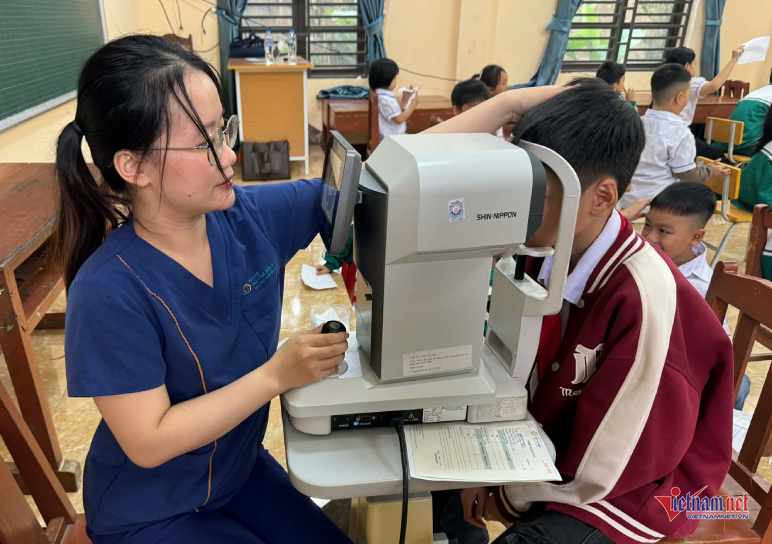
The issue was discussed on November 10 at Dao Xa Primary School (Tan Khanh Commune, Thai Nguyen Province) at Hanoi Eye Hospital 2 during a community program titled “Preserve Vision – Spread Love.”
Among 374 students examined, doctors found 108 children (29.3 percent) with refractive errors, including 26 with myopia of over two diopters. Notably, 92 of them had never worn glasses or were having their eyes checked for the first time.
In one case, a student accompanied by grandparents was prescribed glasses but the family hesitated, fearing they would make the child’s eyes look dull or less attractive. However, doctors said that wearing properly prescribed glasses does not weaken the eyes, but helps prevent myopia from progressing.
Some parents avoid glasses because they worry their child’s myopia will worsen. In reality, if left uncorrected, the eyeball axis will elongate to capture images, and every 1mm increase in axial elongation can add 2–3 diopters of myopia. Conversely, with accurate prescription glasses, children can maintain stable vision and avoid long-term complications.
During the screening, a student N.T.D. from class 5C was detected with right eye myopia of 10 diopters, astigmatism of 2 diopters, astigmatism axis at 180 degrees, and intermittent exotropia. This is a very high level of myopia-astigmatism, causing blurry and distorted images.
Notably, D. still thought he could see clearly and study and watch TV normally. The doctor explained that in D.'s case, the left eye has 10/10 vision, so when both eyes are open, the brain automatically "ignores" the blurry image from the right eye and only uses the clear image from the left eye. This phenomenon is called visual suppression.
When the brain does not receive signals from the weak eye, that eye's vision will gradually decrease, leading to hidden amblyopia. Even if the child later wears glasses with the correct degree, full vision recovery is very difficult. D.'s family was told to take the child for in-depth examination to adjust and treat in time.
Rapid rise in refractive errors
According to Dr. Hoang Thanh Nga, the rate of myopia and other refractive errors in children is increasing rapidly, not only in cities but also in rural areas. Many students go undiagnosed, leading to amblyopia or strabismus, both of which can have long-term effects on vision.
The factors contributing to refractive errors in students include: high study intensity, incorrect sitting posture; lack of study light; using electronic devices too much for long periods. If previously refractive errors in students mainly appeared in cities, now rural students are also suffering more and more.
Vo Thu
.svg)
