 Vietnamnet.vn

 Podcast



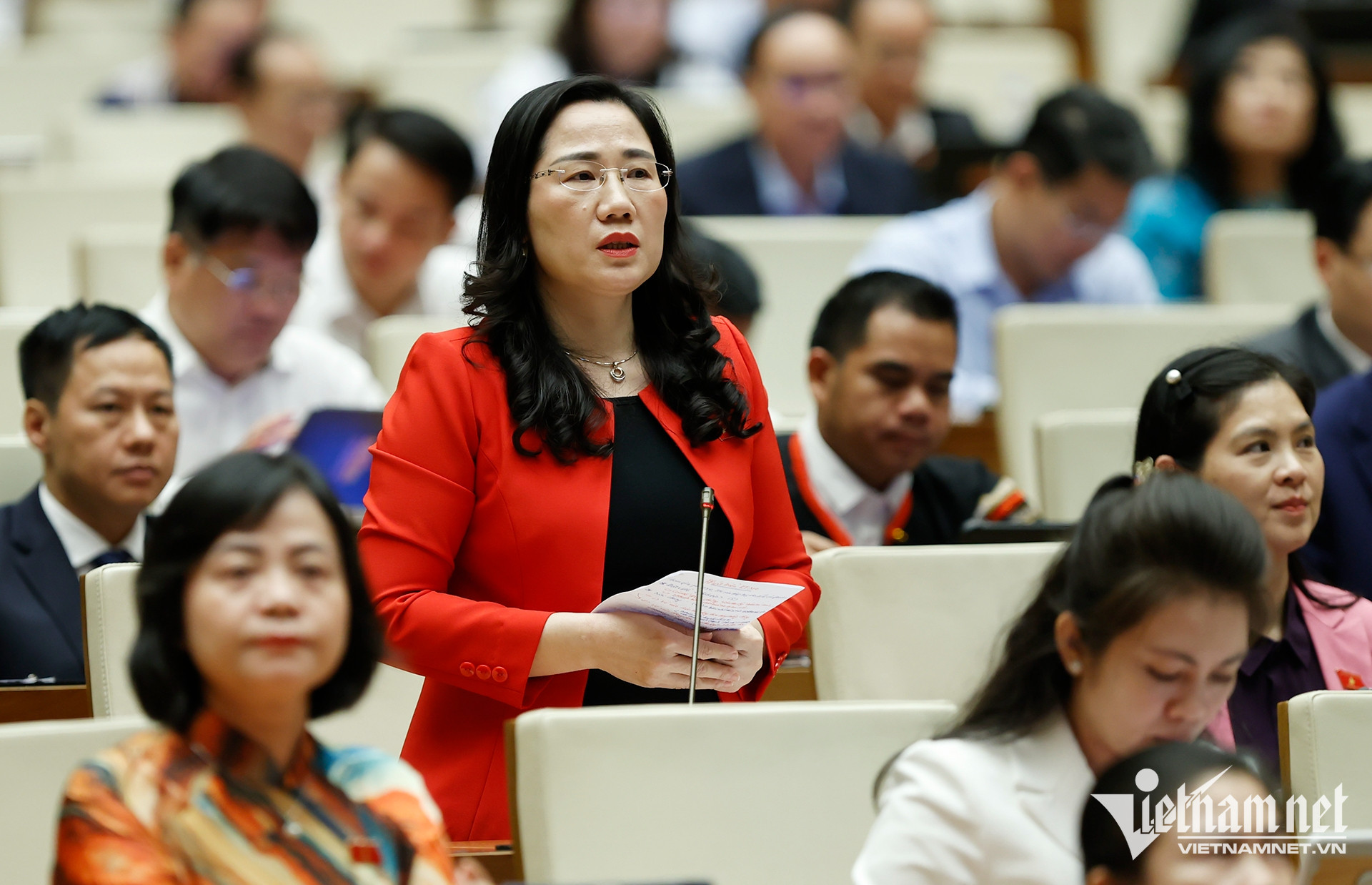
The National Assembly on April 20 discussed the Government's report assessing the results of the socio-economic development plan for the 2021-2025 period and orientations for 2026-2030.
In terms of education, delegate Nguyen Thi Thuy (Thai Nguyen delegation) said the policies aimed at benefits for citizens in various sectors, including education, have been implemented well.
She cited the Politburo’s Resolution 71 on breakthrough development in education and training, which includes major strategic policies such as tuition fee waivers from preschool through grade 12 at public schools from 2025, along with free textbooks.
The delegate observed that the Ministry of Education and Training (MOET) and the education sector have been very dedicated to implementing the Party and State's education reform policies.
School-company partnerships
However, Nguyen Thi Thuy raised concerns regarding two issues. First, she addressed the arrangement of school–company partnership programs (externally provided programs integrated into school schedules).
Recording feedback from parents, she said that while the State fully waives tuition and supports school lunches, the heaviest burden on parents is the pay for these partner programs.
In reality, such programs are running many localities. Schools sign contracts with companies to teach supplementary subjects such as advanced English, international informatics, AI, life skills, etc.
Thuy noted that allowing children to study certain supplementary subjects is a real demand from parents. However, organizing partner programs too densely, as reported by the press recently, poses a risk of overlapping teaching content. The quality of these supplementary subjects has not been verified or evaluated.
The most frustrating issue reflected by many parents is that some schools interleave partner programs with formal curriculum hours, making it inevitable for parents to let their children participate.
If they do not register the programs, their children must be separated for independent activities, making them feel different or inferior from their peers.
Recalling the statement by Party General Secretary and President To Lam—who demanded that "schools must not turn into money-collecting services" and required why schools organize many other activities to collect more money when tuition is waived— Thuy proposed strictly banning the interleaving of integrated programs with formal curriculum hours.
She also requested that MOET inspect the aforementioned matters. If integrated learning continues, it must ensure the nature of a public school: financial transparency and cost-sharing with parents.
“We must avoid the situation where a school is public in name but operates like a private one, and parents have to shoulder a very large cost,” the delegate said.
In the long term, the delegate proposed that MOET should research plans for training, recruitment, fostering, and coordinating teachers within regions and localities to meet the demand for teaching these subjects. If so, students will not have to attend extra classes.
Tertiary education
The second issue raised by the delegate was the change in university admission regulations. Parents and students are anxious as every exam season brings changes to the regulations.
“The changes to these regulations often take place when the exam season is near,” the delegate cited, noting that for the 2025 exam season, the Ministry issued regulations on March 19. For this year's exam season, the Ministry issued them on February 15, taking effect immediately upon signing, meaning only about three months before the exam date.
Thuy stressed that for students, reviewing knowledge to pass the "2-in-1" exam and enter university is already a huge pressure. However, in recent years, they did not know if the university admission regulations would change. This impacts the preparation of parents and students for the exam.
"Many children even have to have study plans starting from grade 10," Thuy said.
However, the delegate emphasized that the field of education is not like a construction project that is handed over upon completion; rather, education reform is a process of adjustment and perfection. The delegate hopes that MOET will research an appropriate date for major issues so that parents and students can prepare.
The delegate argued that the Ministry could have issued all the 2025 regulations earlier since the new general education program has been implemented since 2018.
Tran Thuong
.svg)
