 Vietnamnet.vn

 Podcast



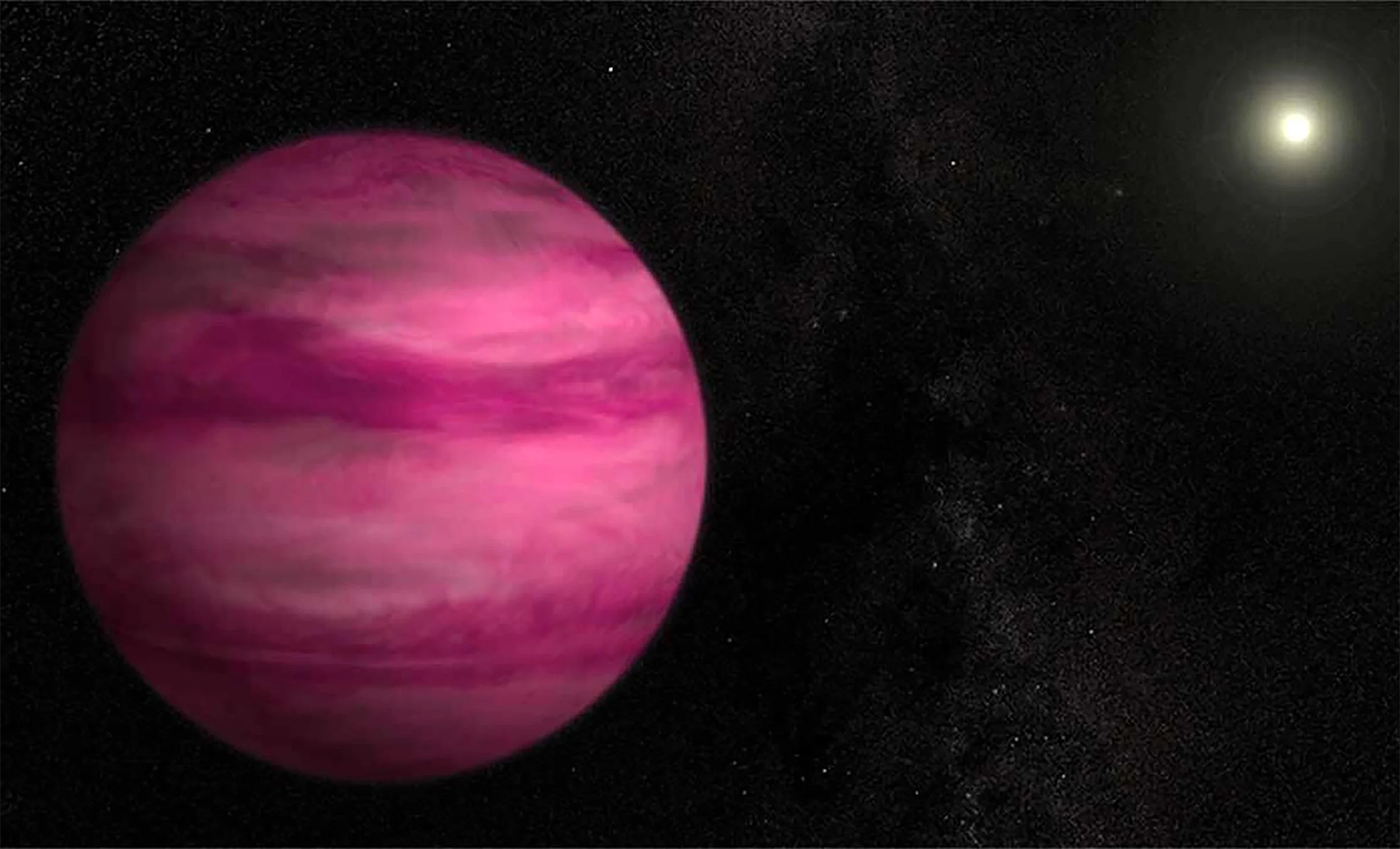
The study, led by astronomers at Northwestern University in the United States, found that the object's atmosphere contains an unusual mix of chemical compounds along with salt clouds that have never before been directly observed.
The discovery not only helps explain the long-standing mystery behind the object's distinctive pink appearance but also opens an entirely new avenue for studying cold, faint worlds that are difficult or impossible to observe from ground-based telescopes.
The findings were published in The Astronomical Journal.
The 'pink planet' that baffled scientists for years
Lead author Dr. Aneesh Baburaj of Northwestern University's Center for Interdisciplinary Exploration and Research in Astrophysics (CIERA) said GJ 504b, nicknamed the "pink planet," is the coldest planetary-mass companion ever discovered through ground-based telescopes.
According to Baburaj, research teams around the world had spent years trying to analyze the light emitted by the object but repeatedly failed because it is simply too faint.
"When James Webb obtained the first spectrum of GJ 504b, we immediately realized there was something very unusual about it. The deeper we analyzed the data, the more we recognized that this is a world unlike any object we had previously studied," Baburaj said.
He collaborated with researchers from the Space Telescope Science Institute (STScI), including Marshall Perrin, who designed the James Webb observing program for GJ 504b.
GJ 504b was first discovered in 2013. It orbits a Sun-like star located approximately 57 light-years from Earth.
Despite its popular nickname, astronomers still cannot say with certainty whether GJ 504b is truly a planet.
With a mass roughly 25 times that of Jupiter, the object lies near the boundary between a giant gas planet and a brown dwarf - an object too small to sustain hydrogen fusion like a true star, yet too massive to be considered an ordinary planet. As a result, researchers classify it as a planetary-mass companion.
One of GJ 504b's most remarkable characteristics is its relatively low temperature. While most directly imaged exoplanets have temperatures ranging from around 540°C to well above 1,090°C, GJ 504b measures only about 290°C - comparable to the temperature inside a working kitchen oven.
According to the research team, this comparatively cool temperature reflects the object's considerable age. Models indicate GJ 504b is between 2.5 billion and 4 billion years old. Like other gas giants, it was extremely hot after its formation before gradually cooling over billions of years.
To study GJ 504b, the team relied on James Webb's highly sensitive infrared instruments together with advanced data-processing algorithms capable of removing the overwhelming glare from its much brighter host star.
This allowed researchers to isolate the object's light spectrum. By separating light into different wavelengths, spectroscopy enables scientists to identify atmospheric chemical compositions because each element and molecule leaves its own distinctive spectral fingerprint.
Baburaj said astronomers previously had to spend an entire night using some of the world's largest telescopes without successfully obtaining a spectrum of GJ 504b.
"With James Webb, the entire observation took only about two hours, and we succeeded," he said.
Salt clouds complete the missing piece of the puzzle
The resulting spectrum revealed water vapor, methane, carbon dioxide, ammonia and several other molecules within GJ 504b's atmosphere.
However, when researchers compared the observations with existing atmospheric models, they found the data could not be explained by atmospheric gases alone.
The breakthrough came when the team incorporated different cloud compositions into their simulations.
After numerous tests, clouds composed of inorganic salts produced results that matched the James Webb observations almost perfectly.
According to the researchers, these salt clouds act like a veil, preventing telescopes from seeing deeper atmospheric layers and altering the light signals detected by JWST.
"When we added salt clouds to the models, the signatures of molecules hidden deeper in the atmosphere weakened exactly as the observations predicted. At that point, everything became physically consistent," Baburaj explained.
The findings also provide the first direct evidence supporting a hypothesis proposed more than 15 years ago that extremely cold worlds could host clouds composed of mineral salts.
Even so, the object's origin remains an important unanswered question. Current observations are still insufficient to determine whether GJ 504b formed like a giant gas planet or through a process more similar to the birth of a very low-mass star.
According to Baburaj, the observational approach demonstrated in this study will enable astronomers to investigate many more cold and faint worlds in the years ahead.
Hai Phong
.svg)
