 Vietnamnet.vn

 Podcast



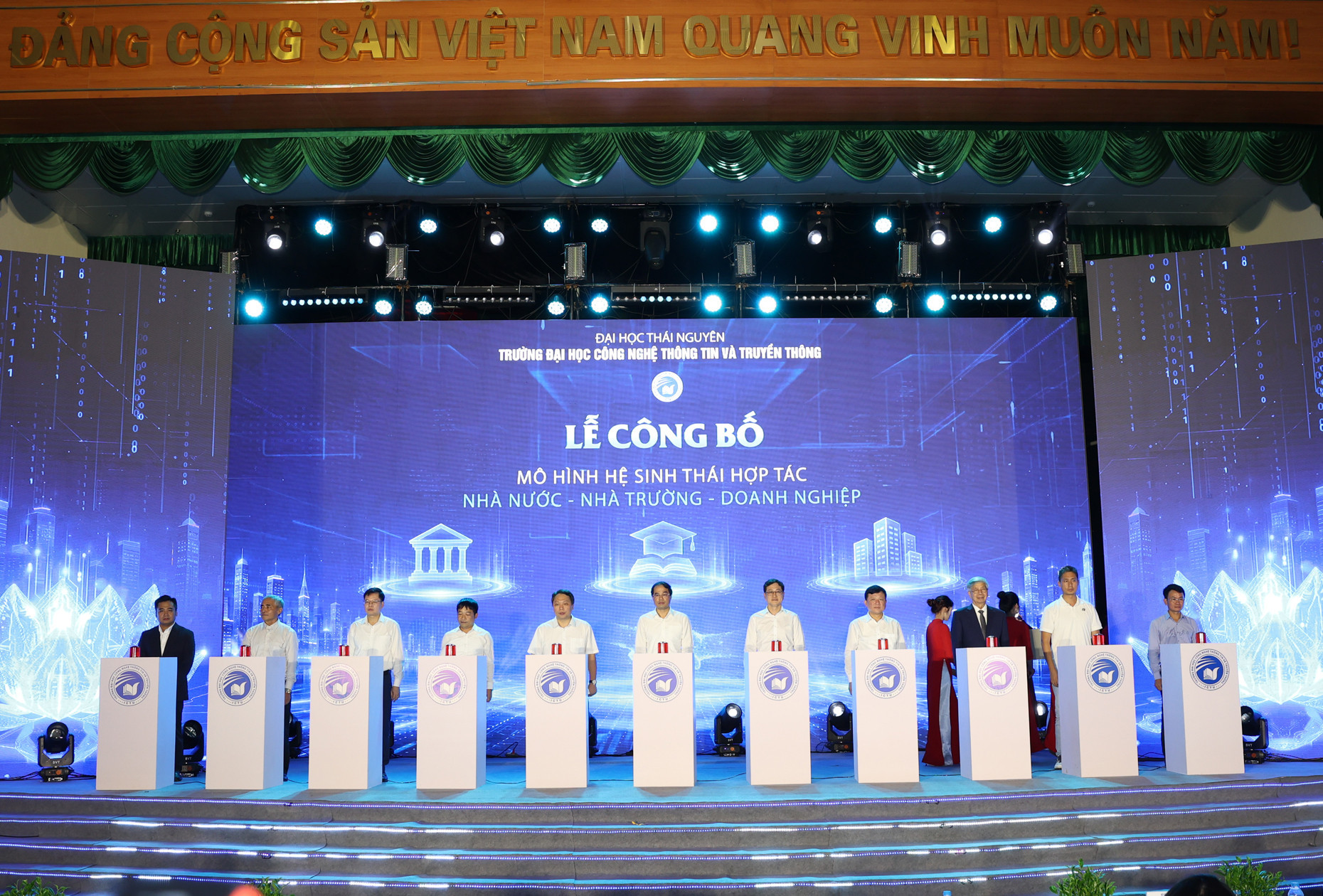
On July 4, ICTU Thai Nguyen organized an announcement ceremony for the State - University - Enterprise Collaboration Ecosystem, serving training, scientific research, innovation, digital transformation, and cultural development within the higher education environment.
This event marks a vigorous implementation of the Politburo’s strategic resolutions, including Resolution 57 on breakthroughs in national science, technology, innovation, and digital transformation development; Resolution 71 on breakthroughs in education and training development; and Resolution 80 on the development of Vietnamese culture.
According to ICTU, rather than stopping at MOUs or short-term internship programs, the university has decided to build an ecosystem where government agencies, businesses, lecturers, scientists and students jointly participate in education, research, product development and technology transfer.
“If students find it difficult to get close to businesses, then bring businesses closer to students. If the gap between classrooms and the real world is a barrier, then create an environment where that gap no longer exists. If real-world challenges have yet to enter the classroom, then bring those challenges into every lesson, every laboratory and every research project. That is why ICTU established its Government–University–Business Partnership Ecosystem,” Phung Trung Nghia, university president, said.
A key feature of the model is the shift from the mindset of “signing cooperation agreements” to “operating together.” Under the model, the government provides strategic direction and policy coordination, and the university organizes education and research. At the same time, businesses participate directly in education, research, product development, recruitment and technology transfer.
One of the project's flagship components is a nearly 2,500 sqm enterprise collaboration space located on campus. Companies can establish R&D offices and conduct training, internships and recruitment activities, while collaborating with faculty members and students on research projects.
To date, 80 percent of the facility has been reserved by businesses. Numerous joint programs in education, research, innovation and product development are already underway on campus.
The ecosystem includes major companies in digital technology, high-tech manufacturing, digital finance and cultural industries, including Samsung Vietnam, Viettel Software, VinFast, Foxconn and MISA.
According to ICTU, this approach enables real business challenges to be brought into the university environment to be solved, while giving the university's research ideas and talent the opportunity to be transformed into products, services and technology solutions that contribute to socio-economic development.
Nguyen Huy Dung, deputy minister of the Ministry of Culture, Sports and Tourism and former Chair of Thai Nguyen, emphasized the effectiveness of the "3+1" cooperation model involving the government, universities and businesses, while the ‘+1’ is international cooperation.
“We must honestly acknowledge that our basic science, technology and applied science still have a long way to go to catch up with global standards. International cooperation is therefore critically important. The future of a nation begins in its schools. The future of Thai Nguyen University, and of Vietnam itself, will also begin in our schools” Dung said.
Students work with businesses from first year
Beyond research, the partnership ecosystem is also expected to reform the education model by aligning it more closely with labor market demand.
Instead of interacting with businesses only during internships or recruitment, students are involved in real-world projects, exposed to emerging technologies and immersed in professional working environments throughout their studies.
ICTU said it has already launched several training partnerships with leading corporations. The Samsung Innovation Campus has trained 394 students in AI, big data, IoT and semiconductor technology.
Foxconn has partnered with the university to provide training, internships and recruit approximately 200 students through its future talent program. Viettel Software has introduced internship and enterprise project programs for around 200 students, with 32 students currently working directly on real software development projects.
The university has also partnered with VinFast, Luxshare ICT, CodeGym and a network of more than 340 enterprises to jointly develop curricula, supervise internships, conduct applied research and recruit graduates.
In addition, many science and technology products developed by ICTU faculty members and students have already been deployed in practice, including the iBLS smart learning system, the Intelligent Business Network (IBN) platform, the ICTUBot AI chatbot, the E-Car Factory virtual reality system, the Hub Dova Art platform and the "e-Partner" model supporting digital transformation for businesses.
Viettel has also established a laboratory on campus, enabling students to gain hands-on experience. Many students have subsequently been recruited by Viettel after completing their internships.
Thai Khang
.svg)
