 Vietnamnet.vn

 Podcast



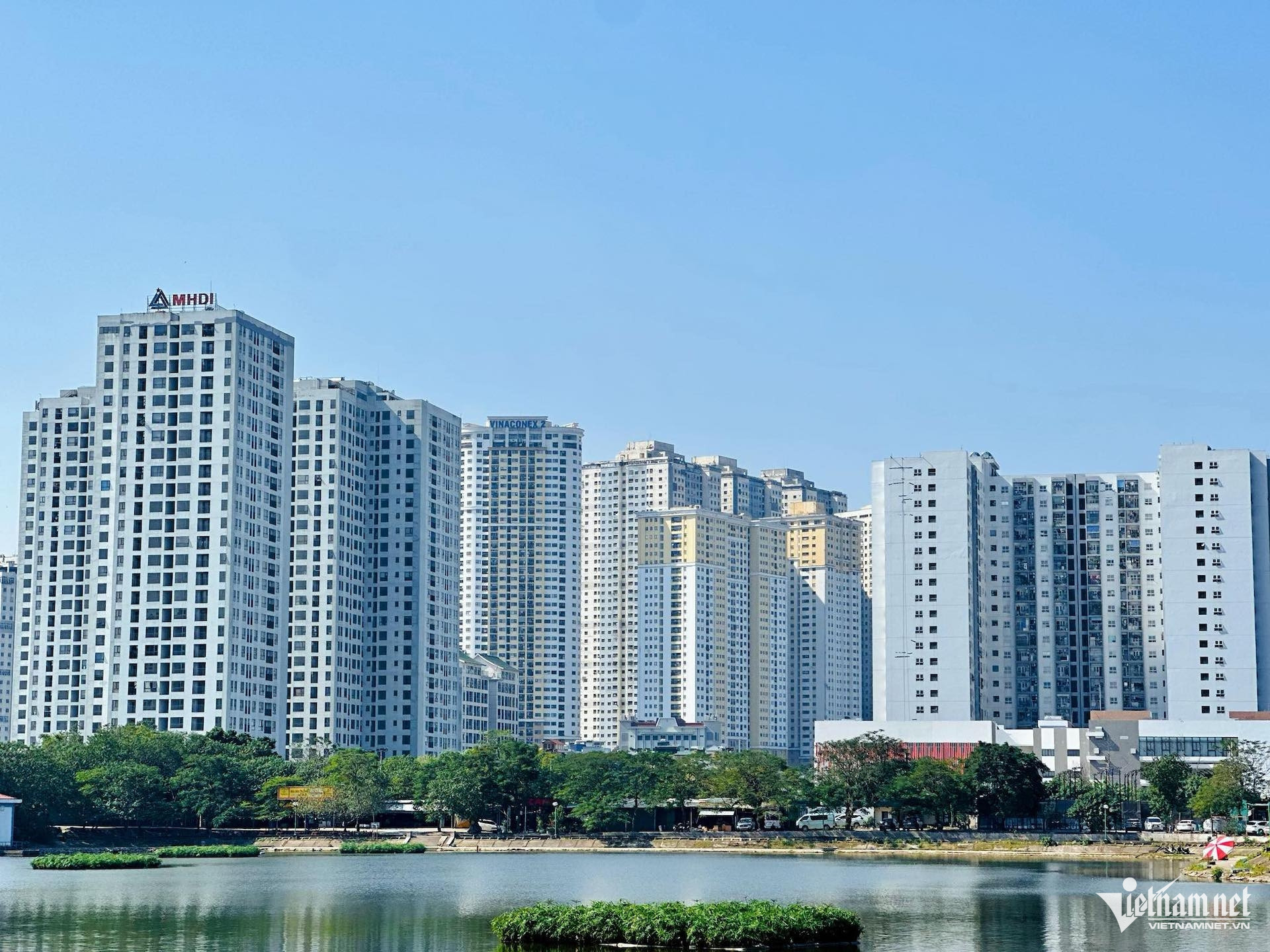
The issues lie not only in prices, but also in long-standing inadequacies in market structure, supply, and investment behavior.
Nguyen Vu Cao, Chair of Khang Land, said the product structure in the real estate market is heavily skewed toward the high-end segment. Capital and legal bottlenecks have persisted for years with unresolved issues, resulting in a lack of affordable housing supply.
These problems do not exist in isolation but are intertwined, causing the market to drift away from actual housing needs while house prices are pushed to very high levels.
The Ministry of Construction reported that in the first quarter of 2026, real estate prices in Hanoi, HCMC, Da Nang, Khanh Hoa, and Dong Nai continued to edge up by 1-2 percent. Although the pace of increase has slowed, prices remain at high levels after years of continuous growth.
In the apartment segment, the trend is more evident. In 2025, primary prices in Hanoi averaged about VND100 million per sqm, up 40 percent year-on-year. In HCMC, the average reached VND111 million per sqm, up 23 percent.
Beyond rising prices, supply structure remains a major bottleneck. According to the Vietnam Association of Realtors’ Institute of Real Estate Market Research (VARS IRE), around 85 percent of new apartment supply in Hanoi and HCMC is priced above VND80 million per sqm, concentrated in mid-high and high-end segments.
Notably, the ultra-high-end segment has surged. In 2025, about 25 percent of new supply, or more than 20,000 units, was priced above VND100 million per sqm, nearly 10 times higher than the previous year.
Even social housing prices have continued to rise, establishing new price benchmarks. In Hanoi, the highest level now exceeds VND32 million per sqm.
Cao said when the market is driven by price expectations and speculative hoarding, it drifts further away from real value.
From a legal and structural perspective, lawyer Truong Anh Tu, Chair of TAT Law Firm, said the core issue lies not only in price levels or income ratios but in the development structure itself.
“The market is operating on a ‘sell what is available’ basis rather than ‘develop what society needs,’ resulting in an oversupply of high-end products but a severe shortage of affordable housing,” he said. “The market does not lack products; it lacks the right ones.”
Solutions
Economist Vu Dinh Anh, former deputy head of the Price and Market Research Institute under the Ministry of Finance, said the root problem lies in how real estate is perceived in the economy.
Real estate is a component of the economy, serving not only as an investment channel but also as a production sector. In reality, real estate in the last 5-10 years is vastly different from real estate 10-15 years ago.
These are massive physical assets, and projects now are no longer single developments but mega-projects covering thousands of hectares with scales of trillions of dong, he said.
“If this role is not correctly recognized, the policies will only resolve the symptoms without touching the root of the problem,” Anh added.
Experts believe the Vietnamese real estate market is facing a requirement for restructuring during the Government's new term. The focus is not just on increasing supply, but on rebalancing the product structure to bring the market back to serving real residential needs.
One important direction is developing affordable housing, a product group for middle-income earners who do not qualify for social housing but cannot afford luxury homes. This is seen as the "missing piece" to rebalance the market.
However, for this segment to develop, a strong policy is needed, ranging from land and credit incentives to legal reforms. Otherwise, businesses will find it difficult to develop projects when profits are not as attractive as the high-end segment.
Legal reform remains the key. When project approval processes are shortened and overlapping obstacles are removed, supply will improve, cooling down prices.
A highly anticipated highlight is the construction of a national real estate identification system. When each asset has its own "ID," all information regarding legality, transactions, taxes, etc., will be transparent. This will not only help limit fraud but also allow the market to operate based on real value instead of expectations.
From a business perspective, according to Cao, the market is forcing developers to change. From chasing short-term profits, they must shift to meeting real residential needs, optimizing costs, and improving product quality.
Hong Khanh
.svg)
