 Vietnamnet.vn

 Podcast



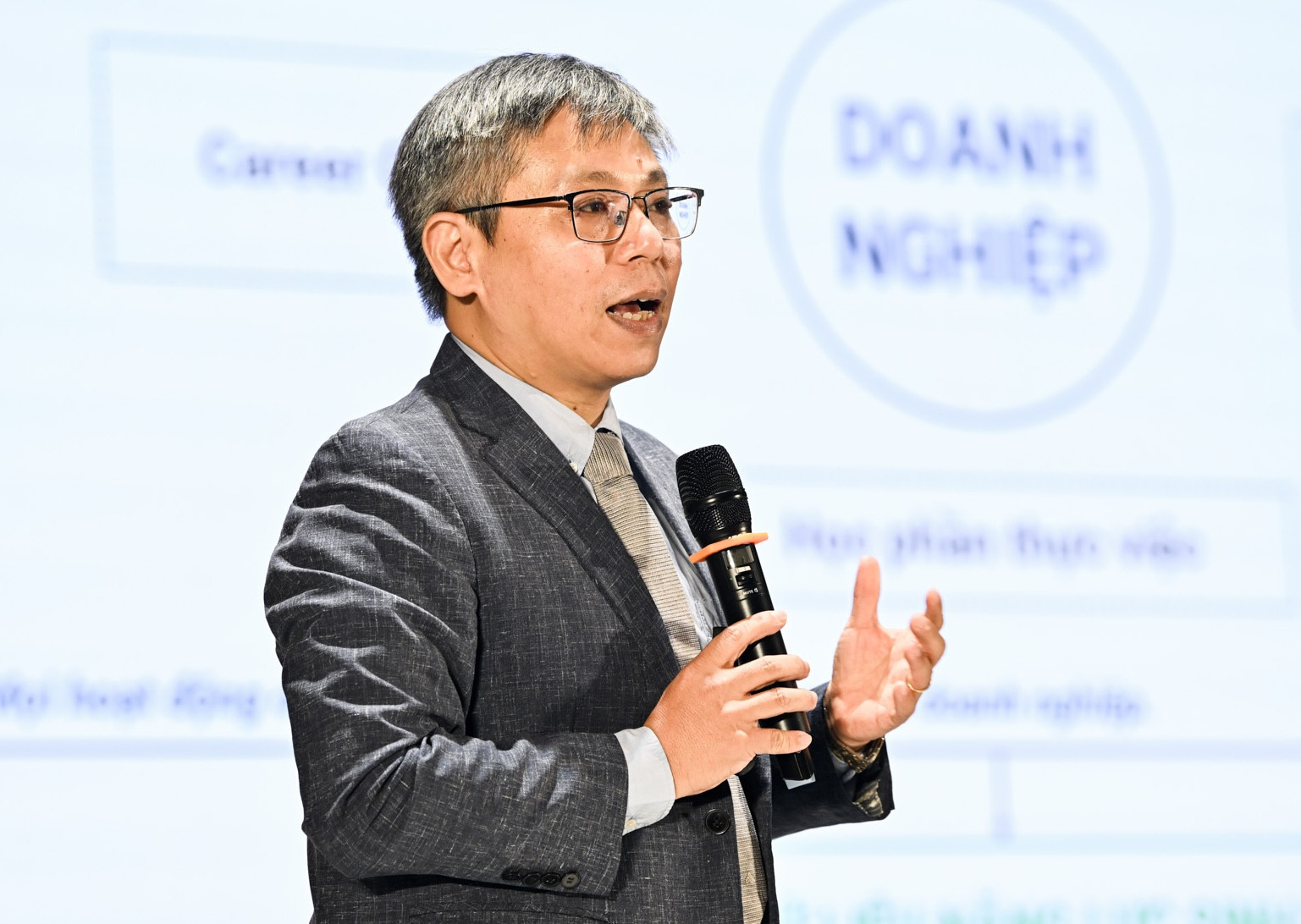
At a workshop discussing cooperation between universities and enterprises in training to provide elite workforce for the economy, recently organized by Hanoi University of Science and Technology (HUST), Associate Prof Dr Le Hieu Hoc, dean of the School of Education Science and Technology, cited the Politburo’s Resolution 57 that says developing high-quality human resources associated with science, technology, and innovation is a decisive factor in national competitiveness.
This demands that higher education not only trains students to "know" but also enables them to "execute tasks."
Hoc said that while universities are confident in teaching well, they often lack case studies for students to practice on. Meanwhile, students absorb plenty of theory but rarely get to work on actual jobs. On the corporate side, enterprises need job-ready individuals but have not participated in the training process from the outset.
From this perspective, he argued that the "hands on – real world training" model is a low-risk solution following a "train first, select later" approach, rather than hiring candidates only to retrain them from scratch.
Under this framework, businesses will directly submit actual problems that require solutions. Students will work in project groups throughout the semester under the simultaneous guidance of both university lecturers and corporate experts. At the end of the term, these groups will report and present their findings before an evaluation panel that includes business representatives.
"Every training activity begins with a business problem," Hoc said.
The model is built upon four core components.
First is the "real work" module, where each specialized course is linked to a professional situation or a practical business problem. Around 30 to 40 percent of the course duration will be dedicated to resolving these real projects.
Student assessment will also change. Lecturers will grade professional competence and the design process, whereas businesses will evaluate practical applicability, final products, collaboration skills, and work ethic. Students will concurrently complete a self-assessment of their learning journey.
Second is the "real deployment" module, which aims to construct a learning environment identical to an actual enterprise. Here, students must tackle real problems to develop teamwork, design thinking, problem-solving, and project presentation skills.
Third is the supervised and evaluated internship module designed for third- and fourth-year students. Far from being just a short-term corporate experience, the internship program is designed as an official core component of the curriculum, helping students develop professional capabilities in alignment with program output standards.
Fourth is international project-based learning. Through cross-border projects or virtual internship programs with global enterprises, students gain opportunities to develop global competencies such as intercultural communication, creative thinking, and problem-solving in multinational environments.
According to Hoc, this model delivers clear wins not just for students but for corporations as well. Instead of waiting for candidates to graduate before recruiting, enterprises can access potential talent pools early on, fast-test new concepts, and help adjust the educational curriculum to ensure graduates meet actual market demands.
Three-party alliance
Echoing this stance, Dr. To Hong Nam, deputy director general of the Department of Information and Communications Technology under the Ministry of Education and Training, said that Resolution 57 has set forth requirements to amplify the role of science, technology, and innovation, particularly within education.
According to Nam, one of the central tasks is to promote a close, tight coordination among the three parties consisting of the State, the School, and the Enterprise.
"The ‘hands on – real-world training’ model does not just allow businesses to participate deeply in the training process; it also helps universities construct curricula closer to reality, paving the way for students to join practical projects right during their studies," Nam said.
Furthermore, businesses get the opportunity to secure a stable, high-quality human resource pipeline, introduce their own products and solutions into educational environments, and present actual problems for universities and students to research and resolve together.
According to the leader from the Ministry of Education and Training, regulatory authorities will continue to accompany universities and businesses to forge a sustainable, cohesive relationship, building a future workforce capable of meeting the development demands of society and the digital economy.
Le Huyen
.svg)
