 Vietnamnet.vn

 Podcast



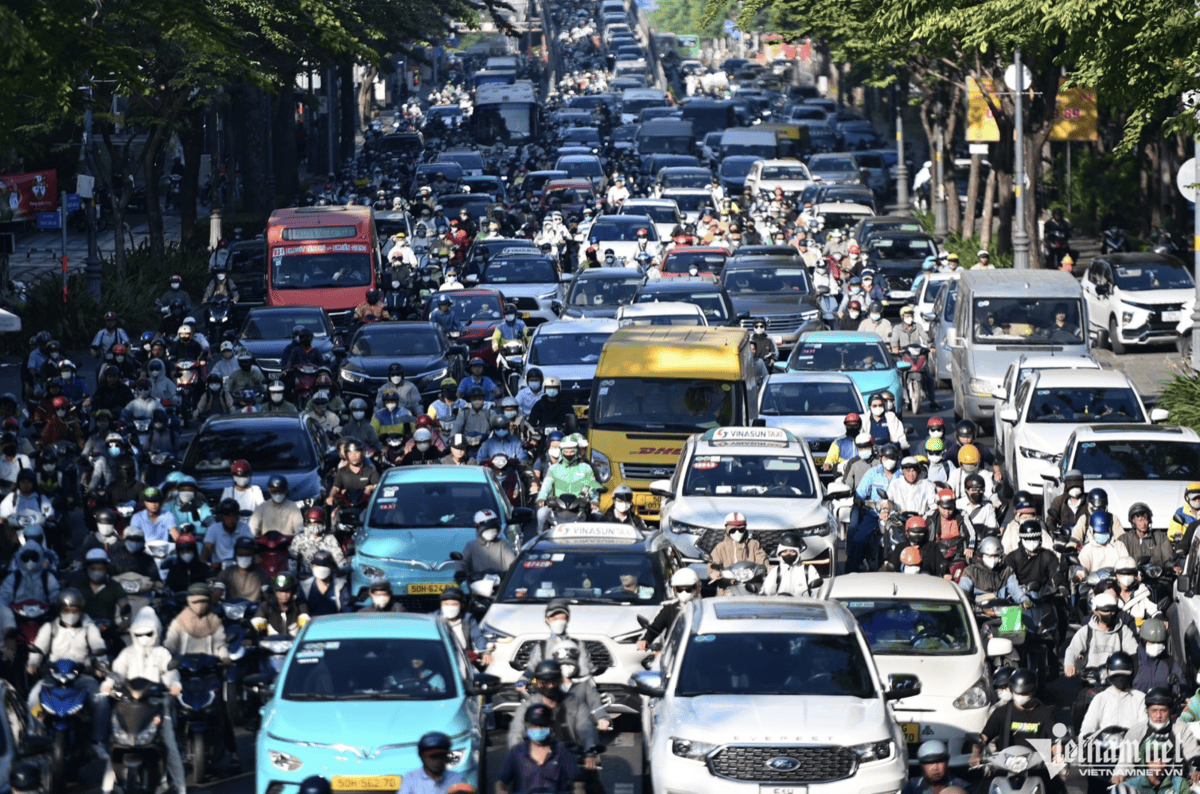
At the seminar on “Mitigating pollution from diesel vehicle emissions: Status and solutions in Vietnam’s major cities” held on October 27, Nguyen Huu Luong, a senior expert at Vietnam Petroleum Institute, said that air pollution in major cities mainly stems from transport vehicles.
He cited Beijing (China), where gasoline and diesel vehicles contribute 95.78 percent of transport emissions, with heavy-duty diesel trucks generating 54 percent. In London (UK), transport emits 28.4 million tons CO2e, with road transport contributing 89 percent.
The expert emphasized diesel vehicles as culprits of NOx and PM (fine dust) emissions. Statistics show in China, diesel vehicles contribute 70 percent NOx and 90 percent PM from all cars. In the EU, road transport contributes 50 percent NOx and PM, with 80 percent from diesel vehicles.
“NOx emissions are dangerous air pollutants causing greenhouse effects and acid rain. Nearly 70 percent of total cancer risk from air toxins in California is due to diesel PM,” he said.
Hoang Hai, Environment Department (Ministry of Agriculture and Environment), acknowledged air pollution as Vietnam’s pressing issue, especially in high-traffic major cities like Hanoi and HCMC with many production facilities.
In the last three months of 2024, Hanoi had 47 days of very poor air quality, with AQI peaking at 246. Notably, vehicle exhaust pollution accounted for about 15 percent, traffic dust 23 percent.
These figures reflect not only Hanoi but many major cities, underscoring urgency in vehicle emission reduction solutions.
How to cut emissions
To reduce transport emissions, according to Nguyen Huu Luong, many immediate solutions can be applied, such as establishing low emission zones, applying strict emission standards, scrapping or upgrading old vehicles, promoting electric public transport, or limiting personal vehicles.
In the long term, it is necessary to promote public transport, and encourage cycling or walking, integrated urban planning, and transport electrification.
Cities like London and Singapore have road pricing to reduce congestion and pollution, while major US cities have carpool lanes to encourage shared rides. Shanghai (China) has restricted gasoline-powered motorbikes in favor of cleaner alternatives. These approaches have significantly reduced NOx and PM2.5 emissions.
In Vietnam, Luong recommended a combination of technological, infrastructural, and policy-based solutions, integrating both incentive and regulatory mechanisms.
He particularly highlighted the SCR + DEF system as the best transitional solution for reducing diesel vehicle emissions.
For vehicles equipped with an SCR (Selective Catalytic Reduction) system, when DEF (a solution containing 67.5 percent demineralized water and 32.5 percent urea) is injected into the hot exhaust stream, the urea decomposes into NH3 which then reacts with NOx inside the SCR catalyst to form harmless nitrogen and water.
Some countries that have adopted the SCR + DEF system have reported reductions of 70-90 percent in NOx, 50-90 percent in hydrocarbons (HC) and carbon monoxide (CO), and 30-50 percent in PM, thereby significantly improving air quality.
Additionally, the use of SCR + DEF helps extend vehicle lifespan and save 3–5 percent in fuel consumption. However, Luong cautioned that DEF quality must be strictly controlled during production, distribution, and resale, and the overall performance of SCR + DEF systems should be closely monitored.
Dao Hoai Nam, secretary general of the Vietnam Automobile Manufacturers Association (VAMA), noted that its members release around 500,000 cars into the market annually. Most new models are already designed to meet Euro 5 emission standards and are equipped with DEF tanks.
However, he pointed out that emission reduction depends not only on vehicle technology but also on fuel quality. The biggest challenge lies with vehicles produced before 2015, which largely lack DEF injection systems.
“How to retrofit or upgrade these older vehicles requires careful consideration, otherwise, the market may react negatively,” he warned, stressing that the government should develop a clear roadmap from fuel to vehicles, giving both businesses and consumers sufficient time to prepare.
Pham Huu Tuyen from the Hanoi University of Science and Technology, said that while electric vehicles represent the future of green transport, they cannot completely replace internal combustion engine vehicles.
For older cars, instead of scrapping them, retrofitting with SCR systems to use DEF could be a practical approach which delivers economic benefits and significant emission reductions for the transportation sector.
Hoang Hiep
.svg)
