 Vietnamnet.vn

 Podcast



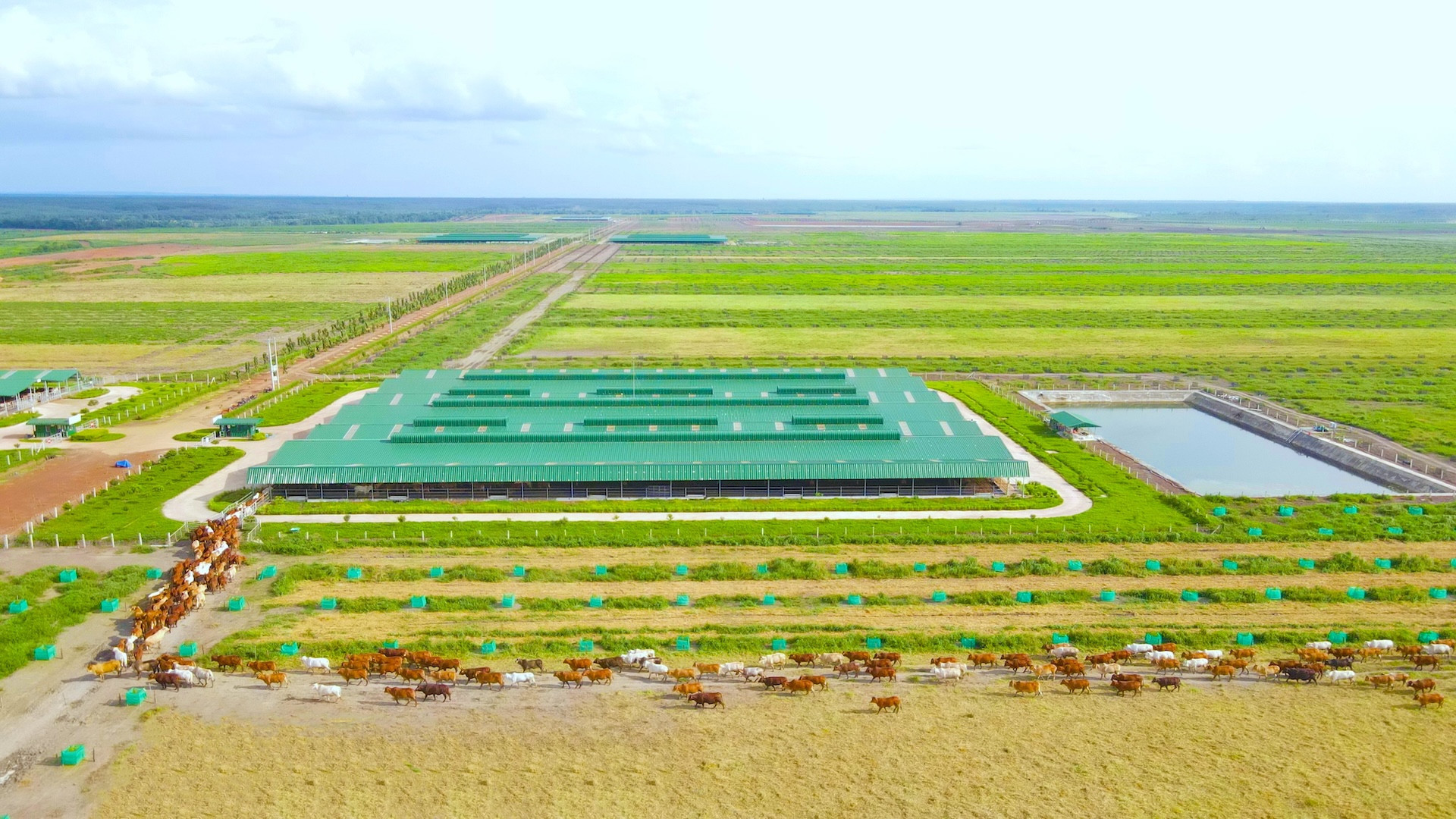
Beyond water canals, bananas, and cattle, this project has created a new life for nearly 20,000 Cambodian workers, those whose fates are tied to the fields.
Krai Tha and his wife were seen planting decorative grass. He told VietNamNet that his entire extended family, including his sons and daughters-in-law, are working for the farm. "We live very well because we do not have to spend money on food. I save my entire salary to buy gold," Krai Tha said with a smile.
Adjacent to the farms are well planned collective housing areas. Single workers stay in rooms for 4–6 people, while working couples are provided with private rooms. Three meals a day are served at collective kitchens, with costs of about VND2.1 million per person per month supported by the company in addition to their salaries.
After one month of training, 100 percent of workers who meet requirements are signed on as official employees. Unskilled workers earn between VND6–9 million per month. Skilled workers receive VND10–13 million. Salaries are reviewed and adjusted periodically.
Household electricity, purified drinking water, internet, health insurance, accident insurance, pension insurance, regular health checkups, and skills training all are designed as integral parts of the project’s structure, not “extra support.”
Along the housing areas are convenience stores, medical rooms, primary schools for workers’ children, and weekend cultural and sports spaces. A labor community is gradually taking shape on the red soil, where workers do not just come to work and leave, but can plan to stay long term.
“If workers do not have a stable life,” Tran Bao Son said, “then no agricultural project can operate sustainably.”
In Cambodia, where agriculture still largely relies on seasonal labor and small-scale production, a large agricultural project that creates tens of thousands of stable jobs with insurance, training, and community life goes beyond the scope of a purely economic project.
It becomes a development project, where production, social welfare, and people are placed together in a single comprehensive equation.
Billionaire’s long-term vision
For Tran Ba Duong, although he entered agriculture later than other sectors, “this game” has to be long term. His model must be a structure capable of long-term survival, resilient to market fluctuations, and most importantly, able to operate on its own without depending on seasonal luck.
“Because I grow bananas, I have to raise cattle. Because I raise cattle, I have to grow other crops,” he said. “Everything has to be connected into a closed, circular ecosystem.”
“We approach it from stable quality and output,” Duong said. “Bringing industrial production philosophy into agriculture means zero tolerance for errors. If you make one million products and only one is defective, that is considered a failure.”
Instead of starting with plant varieties or market outlets, THACO first invests in things few people see: land preparation, irrigation, electricity, water, people, and management organization. Mechanization and automation are applied not only in the fields, but also in operations, control, and decision-making.
In 2026, THACO AGRI expects banana output of about 512,000 tons, equivalent to 26,000 containers. Of this, Fresh Del Monte will purchase about 15 percent, equivalent to 71,500 tons; the remainder will be sold to other partners.
Once production stabilizes, THACO plans to expand banana cultivation area to about 20,000 hectares, a small share on the global map, but enough for Vietnam and Cambodia to emerge as a systematically organized growing region.
But THACO’s agriculture is not just bananas. Pineapple cultivation is being expanded cautiously, expected to reach about 2,000 hectares in the coming years. Cattle raising and other cropping activities continue under an integrated, circular model on the same production space, targeting about 600,000 head of cattle and 400 farms by 2027.
Notably, even at this early stage, agriculture already contributes about 30 percent of revenue to the THACO ecosystem, not because of short-term profits, but because the foundation has begun to prove effective.
THACO AGRI is implementing an integrated-circular, organic agricultural model on an industrial and digital platform, with a total scale of over 85,000 hectares across three countries: Vietnam, Laos, and Cambodia. Cambodia alone accounts for over 44,000 hectares in Kratie and Ratanakiri; Vietnam over 10,000 hectares; and Laos over 31,000 hectares in Attapeu and Sekong.
For Son, the goal ahead is clear: to make THACO AGRI a leading ASEAN agricultural group by 2027.
Tu Giang
.svg)
