 Vietnamnet.vn

 Podcast



The highest inflation rate in Asia acted as a blowtorch as Vietnam suffered very hostile macroeconomic conditions in 2011.

Inflation pressures are slightly reducing, reflected in the country’s
month-on-month consumer price index (CPI) staying below 1 per cent during the
past five months. When can the currently tight monetary policy be
loosened?
I think moving from stabilisation to stimulating
growth is really a balancing act. It’s very good that Vietnam’s inflation is
beginning to come down. But, the year-on-year inflation for 2011 is up to more
than 18 per cent. My sense is that growth has been squeezed a bit, but not by
that much.
Growth is not as high as it was three years ago, but 5 plus or
almost 6 per cent is decent growth.
I do take the point that enterprises
complain about access to credit and liquidity.
But there’s, I think, an
issue of allocating efficiency - how you get the liquidity and the resources to
the enterprises that really generate jobs. That’s really a challenge that the
system has. So try to make sure the financial intermediary system works well to
allocate capital and credit.
I think when inflation goes down to levels
that are almost close to single-digits, then you can look at what’s happening on
the growth side. My sense is that the focus still needs to be on stabilisation.
It’s hard to tell the precise time to ease the monetary policy. Vietnam needs to
continue to monitor the inflation trends.
Some analysts now
forecast Vietnam’s macroeconomic conditions will continue to be very hostile at
least until the end of the second half of 2012. Do you agree?
I
don’t see any reason why the inflation situation shouldn’t get better in 2012.
If the government stays on track continuing to address the inflation challenge
and really works on economic restructuring to address some of the efficiency
issues in the economy, I think the country will have pretty good results. The
World Bank predicted Vietnam’s inflation would be about 10.3 per cent in
2012.
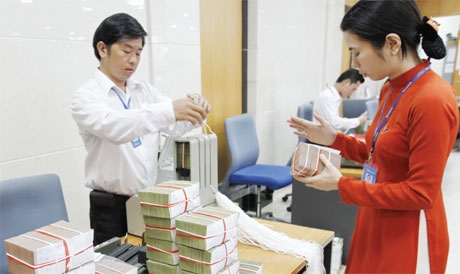
Policy-makers must continue to look over their shoulders
this year to counter inflation threats
Is the ugly macroeconomic picture, particularly the highest inflation
level in Asia, undermining Vietnam’s internationally-recognised achievements in
poverty reduction as the poor are said to be the ones who suffer the most in
such situations?
It’s generally accepted that Vietnam has done
very well both on the economic and social fronts. The current economic situation
is a challenge. But growth of 5 per cent plus is still quite high and overall we
haven’t seen numbers to suggest that poverty reduction gains have diminished.
But it’s still the case that people’s welfare levels are being adversely
affected.
How should Vietnam handle social equality and
protecting the poor in the context of very high inflation and a lack of
confidence in the local currency?
Vietnam has done very well in
getting the majority of Vietnamese people to benefit from growth.
I think
part of the response has to be really strengthening the social protection system
for the most vulnerable, the poorest of the society and people who are
vulnerable to fall back into poverty.
Vietnam has a lot of programmes
that try to help poor people, but they are very fragmented. Many of such
programmes cross several ministries and local level procedures are very
complicated. Thus, at minimum there has to be some consolidation of the current
system and programmes and then an effort to provide instruments that allow the
government to very quickly respond to help the poor when a crisis
happens.
For example, when electricity tariffs were increased, the
government stepped in, giving some financial help to poor households. Clearly
that’s not adequate, but may be that’s all the government could do because it
doesn’t have a framework and a system of social protection and instruments it
can quickly bring to the table.
Restructuring state-owned
enterprises (SOEs) is one of the three mandates that the government has taken on
board as recently instructed by the Party. The other two are restructuring
public investment and restructuring the financial and banking sector. But, the
government embarked on reforming SOEs two decades ago. What should it do to
reinvigorate the SOE restructuring process?
My understanding is
various plans are being prepared to really concretise the action the government
will take, so we wait to see those plans. We’re ready to support the government
financially as well as in terms of policy advice and analytical work to
implement the restructuring plans.
This is very important time to move
forward with some actions when the new administration is in the place, when you
have a new 10-year socio-economic strategy and a five-year socio-economic
plan.
You’re right, a lot was said about SOEs reform and investment
issues, but concrete actions are needed to really move forward. There have been
many equitisations, but only for small enterprises. The big enterprises didn’t
get touched and they got even bigger with the creation of economic
groups.
But it’s not just equitisation, it’s really about corporate
governance, transparency, accountability, giving SOEs clear targets and
performance monitoring.
On the public investment side, the
decentralisation of investment decisions at provincial level has led to a
situation where there is overinvesting in certain areas. Take industrial parks,
for example. There’s an oversupply of industrial parks. Too many have been built
and several of them are empty or not full.
Decisions about investment
made on the basis of sound economic and financial merits should be a big part of
public investment restructuring, because capital would then be allocated more
efficiently than it is now.
In the financial sector in particular,
Vietnam must try to address the issues of capital adequacy, non-performing loans
and regulatory oversight, and the issue of supporting the banks to be able to
adequately assess risk and manage risk.
My sense is the government knows
the solutions and this is a responsible government that wants to do the right
things and continue to move Vietnam forward. I think bringing this determination
into concrete action is what is needed to go forward.
VIR
.svg)
