 Vietnamnet.vn

 Podcast



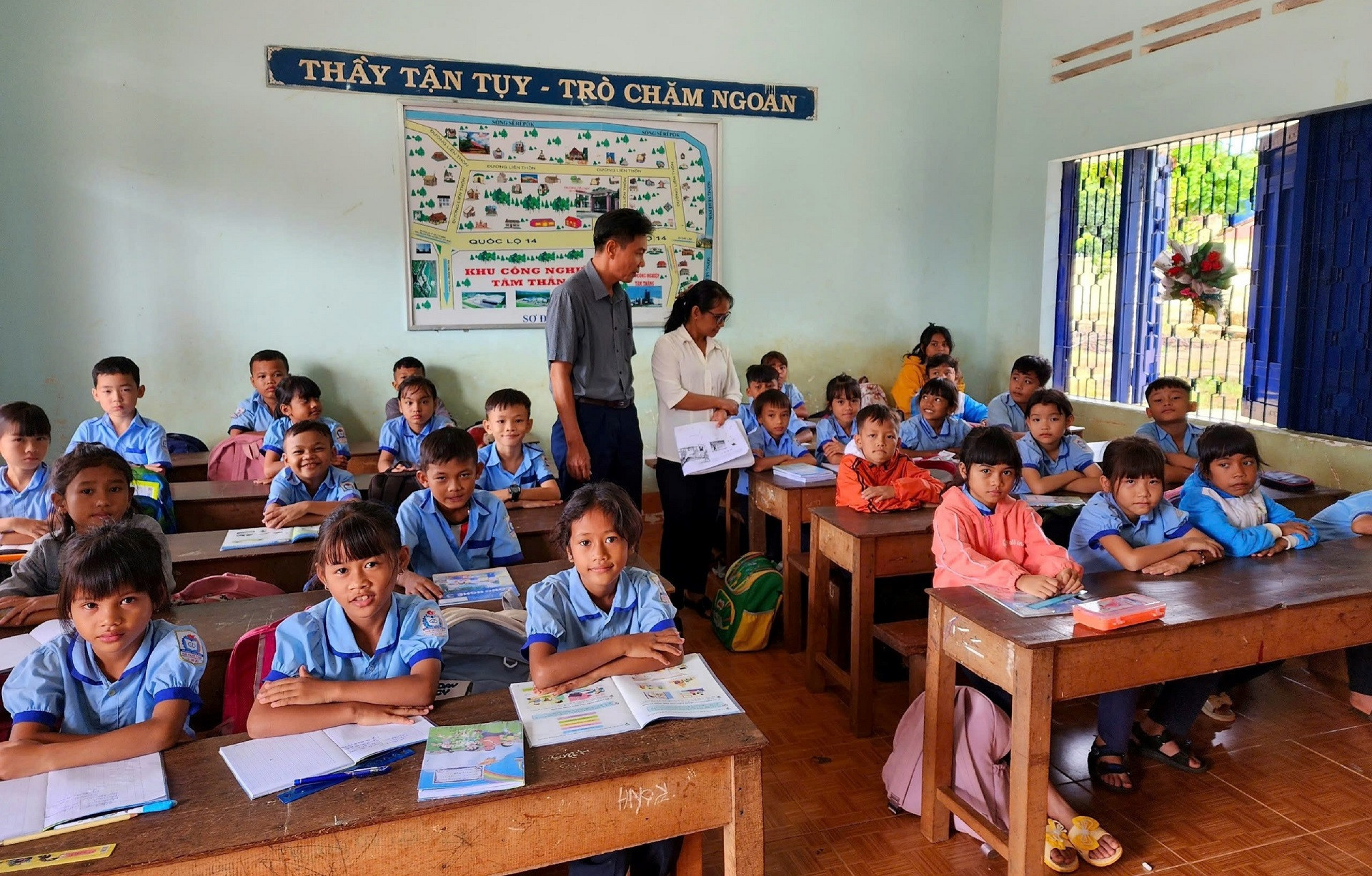
At Y Jut Primary School in Cu Jut Commune, E De language classes have become a familiar activity, creating excitement for students. Thanks to this subject, students absorb general knowledge more quickly while gaining a deeper understanding of their ethnic customs and identity. This is also why teachers here have maintained E De language instruction persistently for many years, despite numerous difficulties.
With over 30 years of teaching, H’Dok Lup clearly understands the hardships of "sowing literacy" in ethnic minority areas, where students often confuse their mother tongue with the national language and pronounce Vietnamese with incorrect tones. Strengthening E De language teaching for primary students will help them absorb general knowledge better.
“In their villages, children can speak E De but cannot read or write it. If we do not teach it now, the E De script will gradually be forgotten. After many years devoted to teaching E De language, I see this not just as a subject but as an effort to preserve the soul of my people’s language and writing.”
Although teaching E De in schools faces many difficulties due to the lack of dedicated textbooks, teachers have had to borrow materials from Dak Lak and adapt them for local students. However, through persistence, they have helped generations of students recognize letters, read fluently, and write confidently in E De.
In the 2025–2026 school year, Y Jut Primary School has 220 students, 100 percent of whom are E De. Introducing E De as an elective subject for students from grades 1 to 3 has made them more confident in communication and less overwhelmed when entering a new learning environment. Given that all students are E De, the subject serves as a “linguistic stepping stone,” boosting confidence and strongly supporting the acquisition of Vietnamese and other subjects.
Not only Y Jut Primary School, but Ha Huy Tap Primary School in Cu Jut Commune has also persistently taught E De for over 15 years. Every year, Ha Huy Tap Primary School has about 95 percent E De students. Since E De students make up the majority, the school has proactively sought materials, photocopied books, and utilized experienced local teachers to lead the classes.
To increase visual appeal, teachers also collect illustrative photos and make learning tools to make the lessons more vivid.
The teaching content is rich, ranging from phonetics, practicing words and sentences, and spelling to essay writing. As a result, students not only learn the script but are also inspired with love and pride for their ethnic language. The rate of good and excellent students in this subject is increasing, and they are also more confident and articulate, actively communicating in both languages.
Although maintaining E De teaching faces many obstacles that teachers face daily, such as a lack of specific textbooks, teaching tools, and supporting equipment, with responsibility and love for the profession, the teachers here have flexibly found solutions to ensure that teaching activities are not interrupted. It is this dedication that has kindled hope for preserving the E De language right within the school environment.
Cao Xuan Hoang, the Principal of Ha Huy Tap Primary School, emphasized that at home, children mainly use their mother tongue to communicate with relatives. If they do not learn E De and Vietnamese in parallel, it is very difficult for them to access the general curriculum.
Thanks to maintaining E De teaching, tens of thousands of students have learned Vietnamese better while forming the habit of preserving their ethnic cultural identity. Teaching E De is not just about keeping a subject, but about protecting a part of the soul of E De culture, helping the younger generation integrate into society without losing their roots.
The silent but persistent efforts of the teaching staff at Y Jut Primary School and Ha Huy Tap Primary School are evidence of the strong vitality of the E De language in village life. And from those simple classrooms, ethnic pride is being passed down, nurtured, and spread, so that the E De language continues to resonate and extend the cultural flow through every generation.
Le Huong
.svg)
