 Vietnamnet.vn

 Podcast



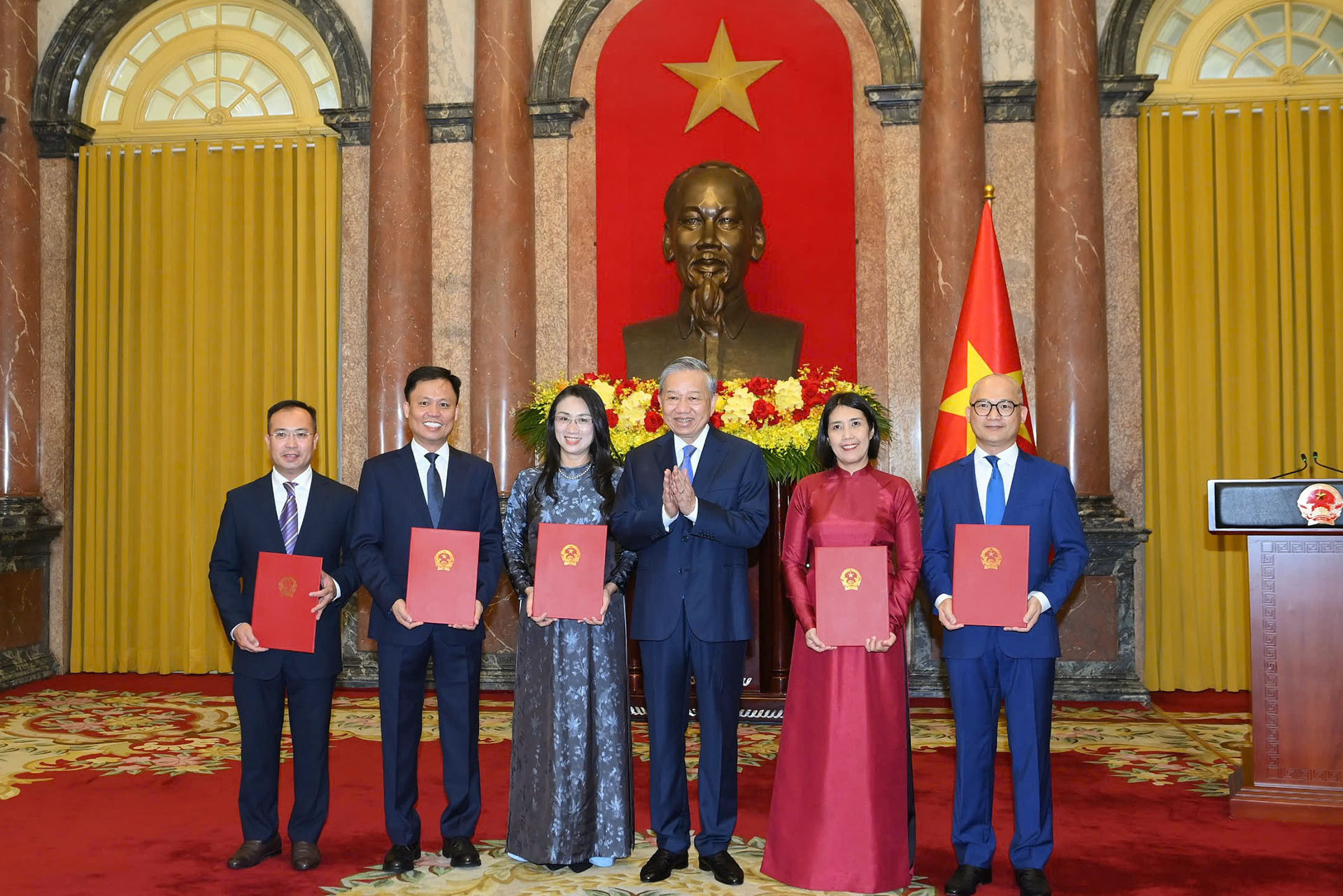
General Secretary and President To Lam hands over appointment decisions to five ambassadors.
Under decisions issued by the President, Trinh Minh Manh, Head of Undergraduate and Postgraduate Training at the Diplomatic Academy of Vietnam under the Ministry of Foreign Affairs, has been appointed Ambassador to India, concurrently accredited to Nepal and Bhutan.
Nguyen Huong Tra, Acting Director of the Institute for Strategic Studies at the Diplomatic Academy of Vietnam, has been appointed Ambassador to Belgium, concurrently accredited to Luxembourg and serving as Vietnam’s Permanent Representative to the European Union.
Doan Khanh Tam, Deputy Director of the Information and Documentation Center at the Diplomatic Academy, has been appointed Ambassador to North Korea.
Chau Mai Anh, Deputy Director General of the State Protocol and Interpretation Department under the Ministry of Foreign Affairs, has been appointed Ambassador to Switzerland, concurrently accredited to Liechtenstein.
Nguyen Thanh Le, Deputy Director of the East Sea Institute at the Diplomatic Academy, has been appointed Ambassador to Kazakhstan, concurrently accredited to Kyrgyzstan, Tajikistan and Georgia.
At the ceremony, President To Lam emphasized that the newly appointed ambassadors would be serving in locations of significant political, economic, security and diplomatic importance. He urged them to fully recognize their responsibilities, demonstrate strong political resolve, intellectual capacity and a high sense of duty, contributing to the development of Vietnam’s relations with partner countries in a deeper, more substantive, stable and effective manner.
In a world marked by complexity and unpredictability, the President stressed that diplomacy must be closely aligned with development. External relations should pave the way for growth, help address challenges, mobilize external resources, enhance the country’s standing and contribute to safeguarding the nation from an early stage, in close coordination with defense and security efforts.
He called on the ambassadors to strengthen their capacity for research, forecasting and strategic advisory, while maintaining and deepening Vietnam’s independent, self-reliant, diversified and multilateral foreign policy, positioning the country as a trusted partner in the international community.
The ambassadors were also tasked with promoting deeper relations with partner countries, especially neighbors, major powers, strategic partners and traditional friends, while persistently building trust, maintaining dialogue, advancing cooperation and handling differences with flexibility, all while firmly safeguarding Vietnam’s legitimate interests.
Diplomacy, he noted, plays a role in protecting the country before risks emerge, helping create the most favorable environment for development.
President To Lam further stressed the need to place economic diplomacy, science and technology, and development-oriented services at the center of foreign affairs. He also highlighted the importance of training human resources to support technological advancement and market expansion.
Vietnam’s overseas representative missions, he said, must act as “radar stations” to identify opportunities, serve as bridges connecting Vietnam with global economic, financial and technological centers, and provide support to businesses, localities and overseas Vietnamese communities.
Ambassadors were urged to quickly develop concrete action plans tailored to their respective postings, clearly identifying strengths, needs, opportunities, resources and measurable outcomes - shifting from “activities to results” and from “relationship-building to value creation”.
The President also emphasized the importance of promoting soft power to enhance Vietnam’s image as a peaceful, stable, reform-oriented and responsible nation.
Ambassadors, he said, must be compelling storytellers of Vietnam - a nation that values peace yet remains resilient, a country undergoing strong transformation while preserving its cultural identity, and one that is ready to contribute to regional and global issues. Work related to overseas Vietnamese communities and citizen protection must also be strengthened.
Quoting President Ho Chi Minh’s teaching that “success depends on unity”, he stressed the need to build representative missions that are cohesive, professional, disciplined and incorruptible.
Ambassadors were called upon to foster unity, discipline, dedication, a strong sense of public service and the ability to coordinate effectively within their missions, maximizing collective strength and avoiding overlap, with all activities serving the common interests of the nation.
Tran Thuong
.svg)
