 Vietnamnet.vn

 Podcast



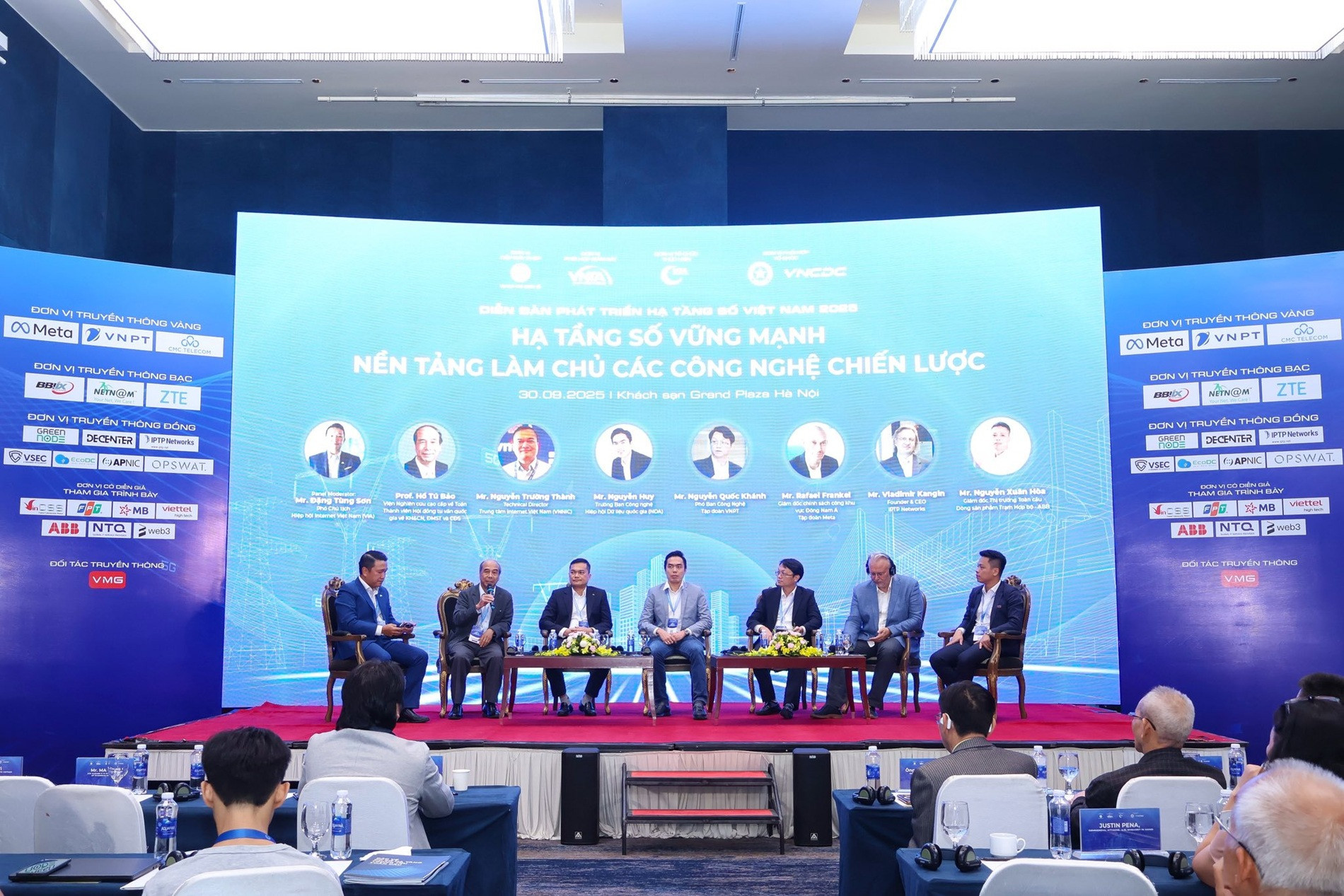
At the seminar “Robust digital infrastructure - the foundation for mastering strategic technologies” held on September 30, experts discussed the components of digital infrastructure and emphasized the indispensable role of data.
Professor Ho Tu Bao from the Institute for Advanced Study in Mathematics, and member of the National Advisory Council on Science, Technology, Innovation and Digital Transformation, explained that digital infrastructure refers to technical infrastructure (hardware, networks), data infrastructure, and application infrastructure. Among these, data infrastructure is the core.
Bao highlighted the Government’s slogan on data: “accurate, sufficient, clean, live, unified, and shared.” He explained that when data meets these criteria, it can solve the critical issue of building digital trust for citizens and businesses.
Sharing the same view, Nguyen Huy, Head of Technology, National Data Association (NDA), warned: “We are entering a phase where failure to clean data could create more problems. For instance, recent online scams and fraud have severely undermined trust in digital transformation.”
He said the issue of digital trust must be resolved to enable citizens to use technology confidently. Huy likened it to having high-performance computing and network infrastructure without data as “raw material,” akin to owning a “top-notch Ferrari” that cannot fully function.
To address this, Huy emphasized the need for three elements: mastering technology (such as blockchain and AI), establishing a “common standard” for system interoperability, and refining policies to mandate data authentication.
Models of success
“We consider Project 06 and VNeID a very successful case study,” Hue said. The project had effectively solved the digital trust issue for citizens, created new economic opportunities, and brought convenience to daily life.
The success clearly demonstrates that when data is standardized, verified, and centrally managed by the government, it can become a strong foundation for building a digital society.
However, quality data infrastructure is just one piece of the puzzle of a resilient digital infrastructure. Experts at the seminar agreed that a strong digital infrastructure must consist of four key components:
For technical infrastructure, there must be high-performance computing, widespread network coverage, fast speeds, and especially stable international connections with backups to mitigate risks.
For data infrastructure, data must be interconnected and interoperable, avoiding “fragmentation and isolation” across ministries and sectors.
For application infrastructure, Professor Bao stressed the need to develop in-depth applications that leverage large national data sources to tackle significant challenges, rather than focusing solely on small-scale issues.
Finally, cybersecurity is mandatory, as no service can scale or develop without it.
Nguyen Quoc Khanh, Deputy Head of Technology at the VNPT Group, compared cybersecurity to a lock on a door or brakes on a car. “We may have powerful engines, but without brakes, we cannot accelerate,” he said.
Overall, building digital trust is a long journey requiring synchronized investment in all three infrastructure layers. The lesson from Project 06 shows that when data is central and there is decisive leadership from the Government, Vietnam can absolutely build a robust digital infrastructure, laying the foundation for mastering strategic technologies and promoting sustainable digital economic growth.
In the global AI race, computing infrastructure is seen as the decisive “foundation.”
Le Hong Viet, CEO of FPT Smart Cloud, pointed out that Vietnam’s data center market remains small, unable to compare with regional peers.
Beyond the investment gap, Vietnam faces challenges such as a shortage of high-quality talent, inadequate R&D spending, and an AI legal framework still under development.
However, Vietnam also has notable bright spots. For instance, Viettel currently operates 15 data centers, and has invested in top-tier GPU systems like Nvidia DGX SuperPOD while building a “Make in Vietnam” product ecosystem serving tens of millions of users.
Vietnamese businesses are also adopting AI Agents to transform operations. According to FPT Smart Cloud’s leadership, over 1,500 AI Agents have automated 46 percent of customer service workloads, boosted telesales revenue by 20 percent, and processed over 400 million documents annually.
Vietnam needs a strategy to “build sovereign AI” to not only catch up but also lead in ASEAN, experts said. The proposed 2025-2030 roadmap includes three phases: preparing the foundation, expanding deployment, and aiming for regional leadership, focusing on four key pillars: people, digital infrastructure, products, and ecosystem.
Du Lam
.svg)
