 Vietnamnet.vn

 Podcast



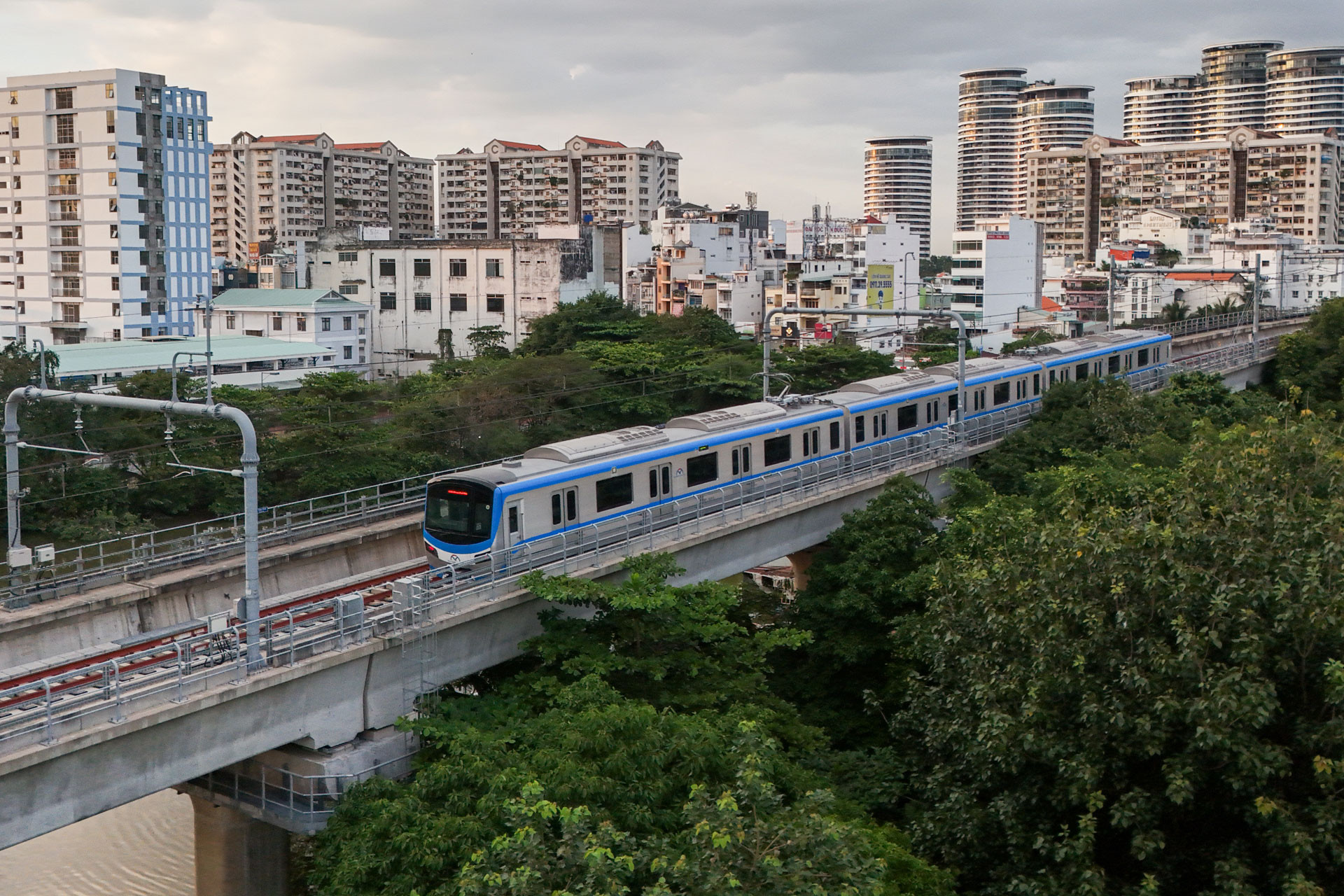
For enterprises, each metro line is not just a transportation project, but a series of orders that could span many decades.
While the majority of metro lines are still on the drawing board, corporate giants like THACO, Hoa Phat, and others have begun preparing manufacturing capacities for a significantly larger railway market.
This metro line, spanning over 6 kilometers, will run entirely underground, crossing the Saigon River and traversing areas with some of the city's most complex geological conditions. For the first time in Vietnam, slurry shield tunneling will be applied to construct the river-crossing segment.
Metro lines are only the tip of a much larger investment iceberg.
Preparation
THACO has invested in a 320-hectare railway and multi-purpose mechanical industrial complex, aiming to manufacture locomotives, railcars, metro construction equipment, Tunnel Boring Machines (TBM), tunnel segments, sleepers, viaduct girders, and numerous components for urban railways.
This investor is also collaborating with Hyundai Rotem to receive technology transfers for locomotive and railcar manufacturing in Vietnam. In a contract to supply 162 railcars for HCMC metro projects, Hyundai Rotem will only complete six cars in South Korea, while production of the remaining units will be transferred to Vietnam.
Today, Hyundai Rotem is one of the world's largest rolling-stock manufacturers. However, the company itself grew through technology-transfer programs and domestic railway orders.
While THACO has chosen to invest in trains and railway equipment, Hoa Phat is approaching the sector with steel rails.
In late 2025, Hoa Phat broke ground on a more than VND10 trillion rail and specialty steel plant in Dung Quat. The facility is designed to produce 700,000 tons annually, including high-speed rail tracks, metro rails, and other specialty steel products.
The first rails are expected to roll off the production line in 2027. If successful, Hoa Phat would become the first company in Southeast Asia capable of manufacturing high-speed railway rails.
One company is investing in rolling stock and railway equipment. Another is investing in rails and foundational materials. Both are positioning themselves for the same trend: the largest railway investment wave in Vietnam's modern history.
The $130 billion market
The large market scale explains why businesses are willing to commit resources long before most projects begin construction.
Hanoi aims to complete 100km of metro lines by 2030. The city has already planned 15 urban railway routes totaling more than 600km and is studying a broader 1,200km railway network.
HCMC aims to complete around 200km of metro lines by 2030, about 462km by 2035, and roughly 700km by 2045.
At the national level, the 1,541km North-South High-Speed Railway, a project estimated to cost around $67 billion is about to start.
At Thu Thiem, the future central station is planned as the intersection for the HCMC metro, the North-South High-Speed Railway, and the rail line connecting to Long Thanh International Airport. Projects once viewed as isolated works are gradually being stitched together into a national-scale railway network.
Combined, the metro programs of Hanoi and HCMC, alongside the North-South High-Speed Railway, have created an investment scale exceeding $130 billion. The next two decades may witness the largest phase of railway development in Vietnam's modern history.
For industry players, metro development is not merely about transportation - it represents an entirely new manufacturing market.
Toward a strategic industrial sector
A modern metro system requires far more than rails and trains. It also needs structural steel, precision engineering, power cables, electrical equipment, signaling systems, automation technology, operational software, telecommunications infrastructure, maintenance services, and thousands of other components.
However, a large market does not guarantee that Vietnamese companies will capture the highest-value segments.
Vietnam has previously seen industries grow rapidly while much of the value added remained in the hands of foreign suppliers.
The railway sector could follow a similar path if domestic companies remain confined to construction and basic material supply.
The difference today is that, for the first time, market demand, corporate readiness, and government policy are emerging simultaneously.
The draft Key Industries Law is being developed to strengthen foundational industries, promote supporting industries, and enhance national technological capabilities. And Decree 319 on special mechanisms for major railway projects has already been issued.
The success of the metro and high-speed rail programs will not be measured solely by kilometers of track laid or passenger numbers transported each day.
A more meaningful benchmark will be how many Vietnamese companies become capable of producing steel rails, railcars, signaling systems, control software, and other core railway technologies.
Tu Giang
.svg)
