 Vietnamnet.vn

 Podcast



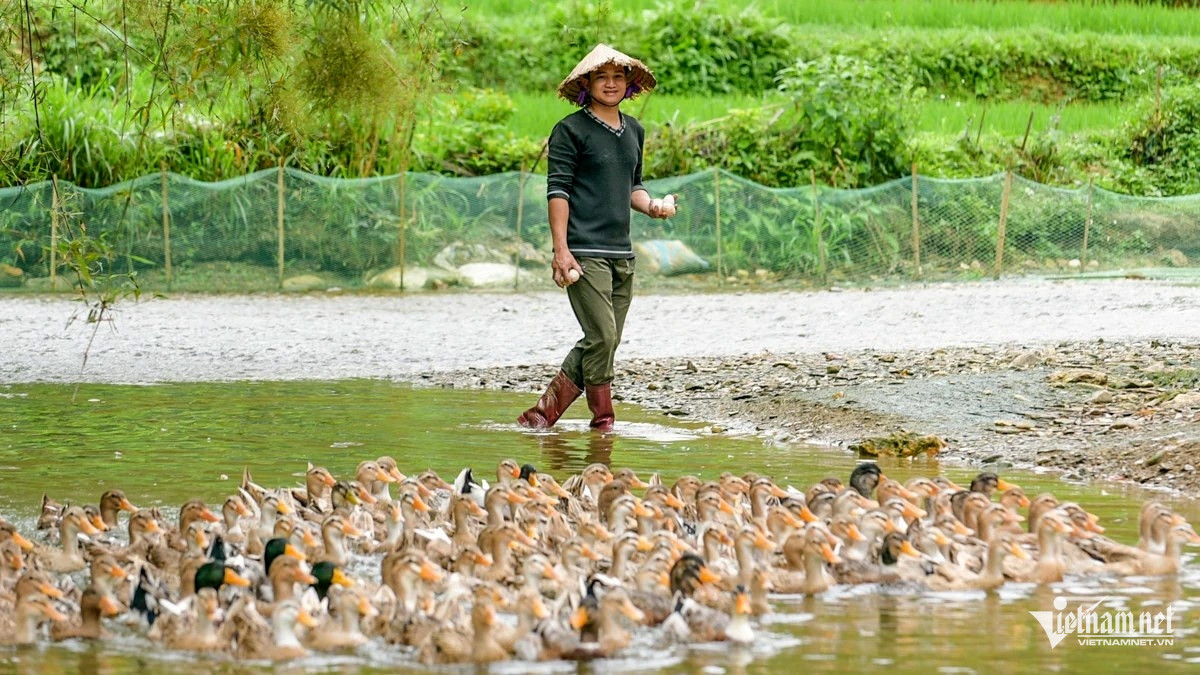
Born and raised in the mountainous region of Thanh Hoa, Nam, 40, of the Thai ethnic group in Khuynh village, Co Lung commune has been attached to streams and upland fields since childhood. After graduating university in agriculture and forestry, instead of choosing a city job or pursuing common livestock models, he decided to return to his hometown to start his business journey with the indigenous duck breed, the Co Lung duck.
For Nam, the ducks are not just a livelihood but also a "spiritual child" nurtured for over 10 years. Every day, he wades through the streams to check the ducks, monitoring every small sign to adjust the care. The work seems simple but requires meticulousness, perseverance, and a deep understanding of the animals' habits.
"Previously, Co Lung ducks were only raised on a small scale by households, mainly serving self-sufficient needs. Realizing that this duck breed has delicious, firm meat and adapts well to natural conditions, I came up with the idea of developing it as a commercial commodity," Nam explained.
In 2014, he began his journey to search for and restore the breed. Undeterred by difficulties, he traveled throughout the highland villages to buy purebred ducks. From a few dozen original birds, the group gradually multiplied through a careful selection process, ensuring the precious characteristics of the breed were preserved.
According to Nam, the most important factor for sustainable development is the farming environment. Instead of confinement, the ducks are released naturally in local streams. Thanks to regular exercise and a rich natural food source, the ducks are less prone to diseases, and the meat quality is superior.
"Stream-raised ducks have firm, fragrant, and low-fat meat, so they are favored by the market. This is a major competitive advantage compared to industrial farming models," Nam said.
Currently, he maintains a team of about 1,000 ducks, including 200 breeding parents, 300 meat ducks, and about 600 ducklings. Each day, he sells 20–30 commercial ducks to local restaurants and tourist areas.
Conserving indigenous duck genetic resources
Nam also provides breeding stock to other local households. As a result, the Co Lung duck farming model is gradually expanding, creating livelihoods for local people.
"Initially, many were hesitant, but when they saw clear results, they started to follow. I am willing to share experience and technical support to develop together," he said.
It is estimated that the model brings his family about VND300 million per year. However, Nam admitted that this is not a path to quick wealth.
"Duck farming depends heavily on the market and input costs. Without proactivity in output or good quality control, it is very easy to face risks," he said.
To maintain efficiency, he always focuses on building links with restaurants and tourist areas while maintaining product quality. Ensuring purebred sources and natural farming processes is also considered the core factor in building market reputation.
Beyond providing income for the family, Nam’s stream-raised duck model is significant in conserving the precious indigenous duck breed of the highlands. In a context where many traditional livestock breeds are gradually fading away, maintaining and developing the Co Lung duck is seen as a sustainable direction.
Nam plans to expand the duck group and link with local households to form a production chain and expand to a larger market.
"I hope to build a local specialty brand, helping increase product value and people's lives," he shared.
Truong Van Hoan, head of the Economic Office of Co Lung Commune, said the duck farming model developed by Nam’s family not only opens a way out of poverty for the locality but also contributes to the conservation of indigenous duck breeds, becoming an example in economic development for ethnic people.
"Co Lung duck is a rare breed that needs to be conserved. Many households in the commune have raised and expanded the scale of Co Lung duck farming, bringing in a stable source of income," Hoan said.
Ha Nguyen
.svg)
