 Vietnamnet.vn

 Podcast


Gia Lai Province, home to diverse ethnic minority communities in Vietnam's Central Highlands, is renowned for its rich cultural heritage and distinctive traditions.
As the province pursues economic and social development, it is also working to safeguard the languages, writing systems, festivals, traditional costumes, crafts and customs of its ethnic communities.
These efforts accompany national target programs for new-style rural development, sustainable poverty reduction and socioeconomic development in ethnic minority and mountainous areas during the 2026-2030 period.
Among Gia Lai's cultural treasures, the Kơ Đơ gong set of the Jrai people stands out as a rare historical artifact embodying generations of artistic craftsmanship, spiritual beliefs and communal memories.
A unique ancient gong set of the Jrai people
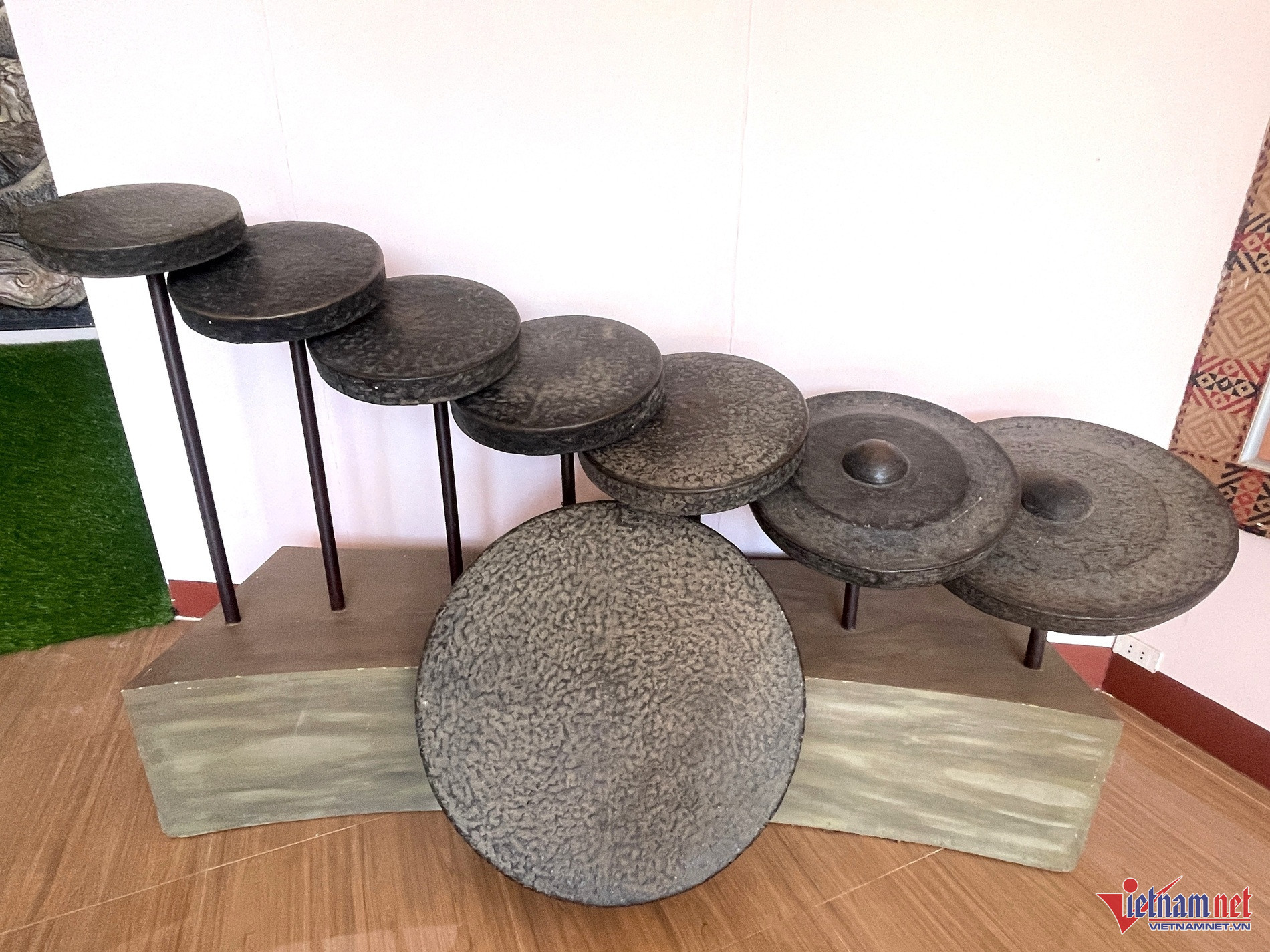
For centuries, gongs have been an indispensable part of life in Vietnam's Central Highlands.
Their resonant sounds are considered sacred, closely associated with the spiritual practices, religious beliefs and cultural identities of local ethnic communities.
Among the Jrai people of the Cheo Reo region, Kơ Đơ, also known as K'Dơ, refers to a traditional gong ensemble characterized by its deep, warm and resonant tones.
The instruments are commonly played in family settings and during joyful ceremonies and celebrations.
Depending on the locality, the ensemble is also known as Tnah, To Nah, Sar, Nam or M'Nam gongs.
According to Le Thanh Tuan, Director of the Pleiku Museum, the Kơ Đơ ensemble dates back to approximately the late 19th or early 20th century.
It was historically associated with the families of Jrai community leaders and was preserved by the family of Nay Nui and Rcom H'Blion.
In 1997, the family of Siu Banh and Rcom H'Blon handed the ensemble over to the Gia Lai Provincial Museum, now the Pleiku Museum.
The collection consists of eight instruments: one large Sar gong, two bossed gongs and five flat gongs.
Each was handcrafted from a copper-based alloy containing silver, tin and lead, giving the instruments a dark brown appearance with golden-bronze highlights.
Their surfaces feature distinctive decorative patterns resembling snake scales and toad skin, contributing to their ancient appearance and unique acoustic qualities.
One of the ensemble's most remarkable characteristics is that every gong was individually crafted and tuned by hand.
Each produces a distinct tone that cannot be replicated or replaced by another instrument.
If even one gong were missing, the ensemble's complete harmonic structure would be lost.
The collection is an original, one-of-a-kind set with no replicas, making it particularly valuable from both historical and artistic perspectives.
Sacred sounds in Jrai spiritual and cultural life
Beyond its craftsmanship, the Kơ Đơ ensemble holds profound cultural and spiritual significance for the Jrai community.
Traditionally, it is performed during ceremonies associated with happiness and positive occasions, including health blessing rituals, ear-blowing ceremonies for infants, weddings and housewarming celebrations.
It is not used during mourning rituals, such as funerals or grave-abandonment ceremonies.
In Jrai beliefs, gongs are sacred objects, with each instrument thought to be inhabited by a spirit.
The older the gong, the greater the spiritual power believed to reside within it.
For this reason, the Kơ Đơ ensemble is regarded not merely as a collection of musical instruments but as a treasured possession closely connected to family traditions and the spiritual life of the wider community.
During performances, each musician plays one gong while seated on the floor or on a traditional Kpan bench.
By striking the instruments and alternately covering and uncovering their surfaces or rims with their hands, performers create a variety of sounds, ranging from long, sustained notes to short, rhythmic tones.
The interaction of all eight instruments produces a warm, resonant harmony that reflects the distinctive musical identity of the Jrai people.
National Treasure preserves generations of cultural memory
Speaking at the Gia Lai Gong Festival 2026, Pham Anh Tuan, Chairman of the Gia Lai Provincial People's Committee, emphasized that gong culture represents far more than musical performance.
"Gongs are not merely music. They are the voice of the soul, the memory of a community, and the bond connecting people with nature, their ancestors and one another," he said.
Tuan also highlighted the recognition of the Kơ Đơ gong ensemble as a National Treasure by the Prime Minister.
He stressed that the significance of the collection extends beyond the physical instruments themselves.
"A gong set is honored as a National Treasure not only for the value of the artifacts, but also for the layers of cultural heritage, traditional knowledge and collective memories embodied within them," he said.
The recognition underscores the importance of preserving both the ancient instruments and the cultural practices associated with their use.
For the Jrai community, the Kơ Đơ gong set remains a powerful symbol of ancestral knowledge, artistic achievement and spiritual identity, carrying the sounds and memories of generations into the present.
Tran Hoan

