 Vietnamnet.vn

 Podcast



The heavy rains on September 29–30 left Hanoi almost unable to cope. Daily life and activities were disrupted, and traffic came to a standstill amid flooded streets across many wards and communes, from inner-city districts to Thang Long Boulevard, Ring Road 2 and Ring Road 3. In late August, due to Typhoon Kajiki, Hanoi streets were also submerged in floodwaters.
Recalling the 2008 flood, architect Pham Thanh Tung, independent critic, assessed this flood occurred when urbanization level was far different, exposing Hanoi’s weaknesses more clearly.
“In 2008, the 4 inner Hanoi districts had urbanized about 250 square kilometers, now it has reached over 900 square kilometers, nearly 4 times more. Agricultural land, lakes, and ponds, the areas capable of absorbing rainwater have decreased and been replaced by concrete, which has greatly reduced natural drainage capacity,” Tung said.
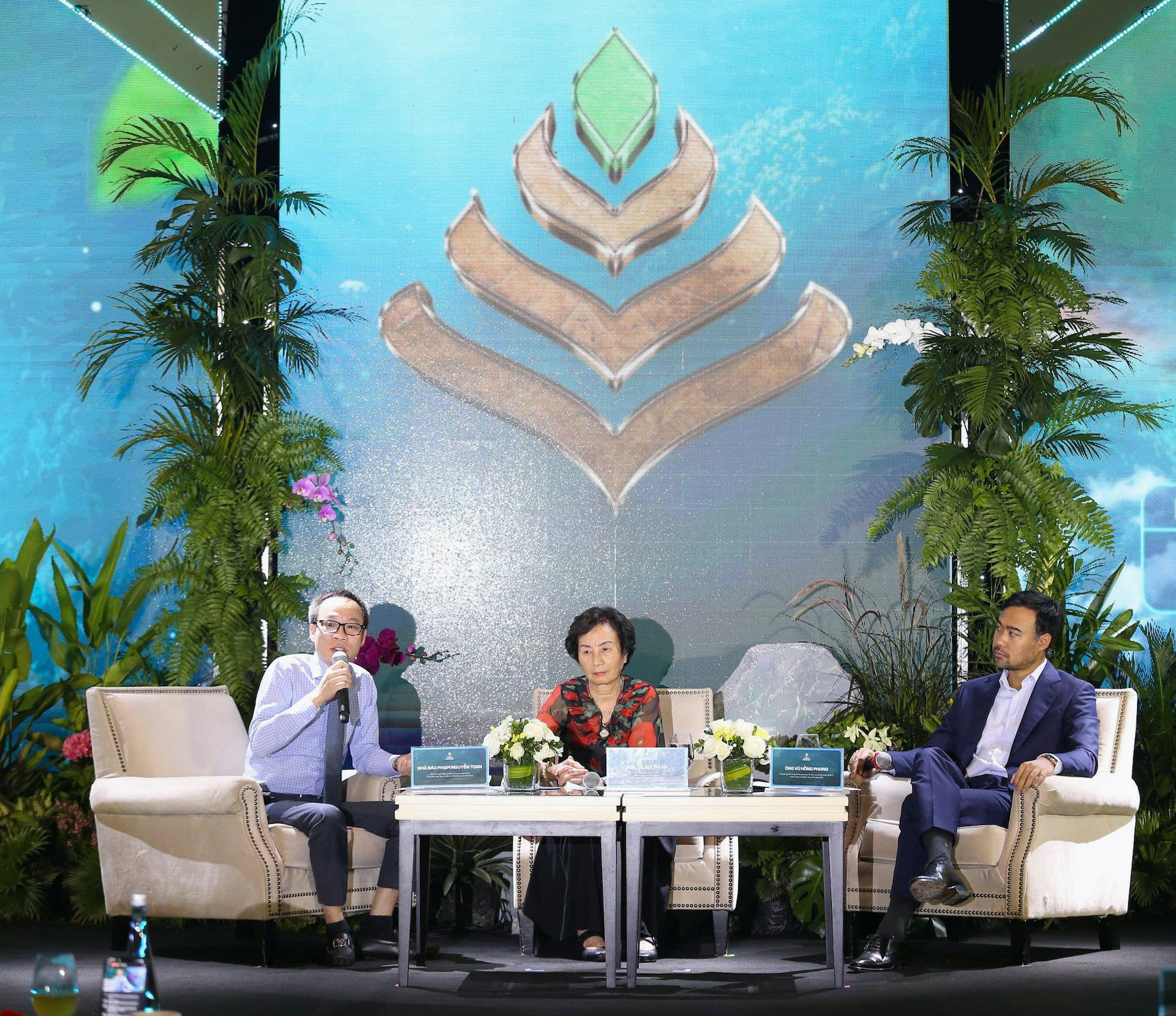
Speaking at the seminar “ESG - Passport for future cities” on October 18, An, a National Assembly Delegate and Director of the Institute of Resources, Environment, and Community Development, noted that in recent years, natural disasters, floods and landslides had left many families isolated and even caused them to lose homes and loved ones. This is the clearest consequence of climate change.
Air and water pollution are also common in Vietnam, especially in large cities. Thus, the question arises: how can development be more sustainable?
The expert said that she recently attended the Hanoi Party Congress, where a new criterion was discussed: “happy residents.” According to An, when applying the ESG principle to projects, developers need to aim at realizing residents’ aspirations.
“The current global trend is green development, including green economy, green society, green technology, and green governance. ESG is a set of criteria very suitable for Vietnam’s development direction, especially urban projects. If we follow this path, we can reduce emissions, save energy, improve residents’ quality of life, and make them safer and more peaceful,” An said.
Vu Hong Phong, a green building expert from the International Finance Corporation (IFC), a member of the World Bank, said that ESG is a set of standards measuring sustainable development. Developers choose criteria to apply to projects, which are then certified and recognized by independent units.
Phon said the value of ESG is visible in daily urban life. “In reality, we face urban compression, traffic jams, and flooding. If the ESG criteria are applied seriously, these issues can be fully controlled or significantly mitigated.”
“Look at current life: are we stuck in traffic or flooded, and how do those factors affect each person’s assets and life? If cities are well-planned and sustainably developed, residents will no longer worry about those things and can focus on improving quality of life, work, and family,” Phong said.
Incentives and support policies
Bui Van Doanh, director of the Vietnam Real Estate Research Institute, emphasized that ESG is not a luxury but the only viable path for sustainable urban development.
“If we don’t act now, we will pay the price through degraded living environments and the declining health of future generations,” said Doanh.
According to research by the institute, projects that integrate ESG factors, such as transparent governance, nature-close design, and human-centered planning—tend to see 20-30 percent higher sustainable value growth in the medium to long term compared to other projects.
Despite its clear benefits, ESG implementation in Vietnam still faces many challenges.
Phong noted that by Q3 2024, Vietnam had fewer than 700 certified green buildings, with a total floor area of around 17 million sqm, equivalent to just 40,000 green apartments. This is a modest number given the scale of real estate development each year.
The key question is how to increase this figure to 2,000 buildings in the next 2–3 years, as targeted.
Meanwhile, An proposed that the government should introduce specific incentives for green credit, land use and more, to support pioneering enterprises applying ESG standards in construction.
“Future happiness means living in a clean, healthy, and safe environment. Developers should research and apply modern technologies to manage and operate their projects sustainably over the long term. If they succeed, cities will truly become livable places,” An said.
Tam An
.svg)
