 Vietnamnet.vn

 Podcast



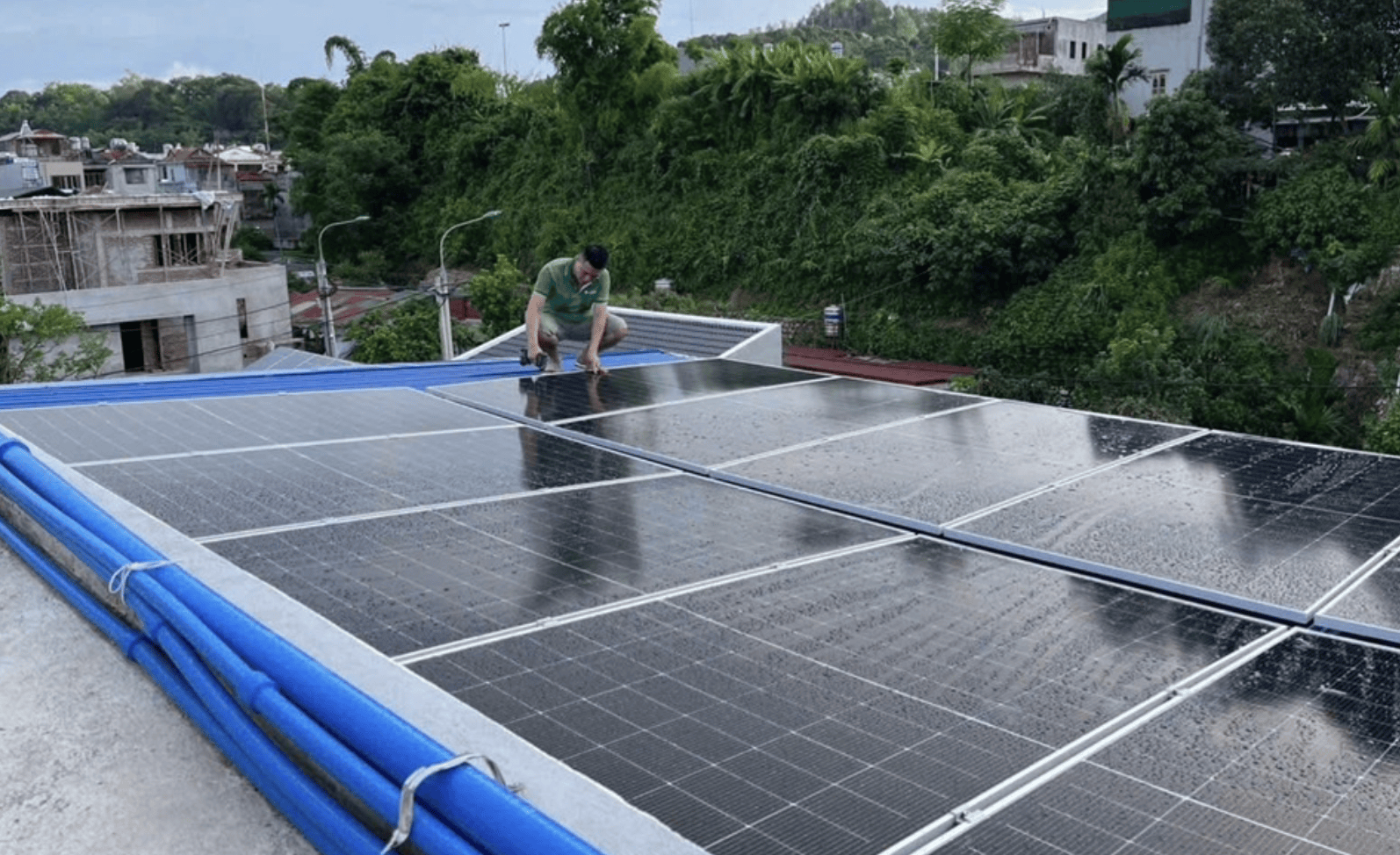
2026 is the 12th consecutive year of record-breaking heat waves, which are increasing and lasting longer under the impact of climate change. As the demand for residential electricity rises, electricity bills for households are expected to skyrocket during peak months.
However, the monthly electricity bill of Dam Thi Lien's family in Chieng Le Ward (Son La) has decreased sharply, despite the sudden surge in electricity demand during the summer.
She said that previously, her family used about 600 kWh/month. After installing the rooftop solar system, electricity costs decreased by an average of 30-40 percent.
Dinh Thi Lieu, owner of Hoang Phuc ice production facility in Chieng Sinh Ward (Son La), runs a 54 kWp rooftop solar system.
Her business’s electricity cost dropped significantly from VND40 million to VND20 million per month.
In addition to cutting costs, rooftop solar allows the facility to be more proactive with its power supply during peak hours, eliminating concerns about outages, she said.
In Hanoi, Nguyen Thi Hai Yen’s family installed a rooftop solar system with a capacity of 8.61 kWp (14 panels).
Since August 2025, the household’s electricity consumption from the grid has decreased from 812 kWh to 444 kWh per month, equivalent to a 45 percent reduction. As a result, the family expects to save around VND18–20 million per year.
During autumn and winter, electricity bills sometimes drop to just a few thousand VND. In contrast, during hot seasons, solar output peaks and offsets most electricity usage.
Notably, the solar panels also act as a heat-insulating layer on the roof, reducing solar radiation and lowering indoor temperatures by 3–5 degrees Celsius during hot summer days, Yen added.
Nguyen Thuong Quan, CEO of Sao Nam Integrated Technology JSC, said rooftop solar combined with storage is an “ideal solution” for households.
For households with monthly electricity bills ranging from VND2.4 million to VND4 million, a hybrid rooftop solar system (grid-connected with storage) is a suitable option. The investment cost ranges from VND50 million to VND100 million, while electricity bills can be reduced by 50 percent to nearly 100 percent. The payback period is under 3.5 years.
Designing a rooftop solar system requires determining a household's load to calculate an appropriate investment cost.
According to Quan, families often use a lot of electricity in the evening, especially for air conditioning needs, so the time frame from 17:00 to 23:00 consumes a great deal of power. Quan suggests installing a Battery Energy Storage System (BESS) to store electricity for evening and nighttime use.
Quan cited an example: a household using electricity with a bill of VND2.4 million/month (based on a 6-tier cumulative residential electricity tariff) has a total consumption of about 720 kWh. If a rooftop solar system with a capacity of 6 kWp and a 16 kWh BESS is installed, the cost is approximately VND100 million.
This system will generate 720 kWh/month in the Central and Southern regions, while efficiency in the North will be lower. Thus, the monthly electricity bill to be paid to EVN would be VND0.
At a recent seminar on electricity saving and solar power, Trinh Quoc Vu, deputy director of the Electricity Regulatory Authority (Ministry of Industry and Trade), said that Vietnam's total solar capacity, including rooftop and utility-scale solar, has reached more than 19,000 MW.
With this scale, Vietnam has become one of the leading countries in Southeast Asia in solar power development.
According to the Adjusted Power Development Plan VIII, out of a total capacity of about 46,000 MW of solar power, the goal is to develop about 26,000 MW of rooftop solar.
To achieve that goal, the Government has assigned the Ministry of Industry and Trade to submit to the Prime Minister a decision on a mechanism to promote the development of rooftop solar in households.
“We expect that once support mechanisms for rooftop solar are approved by the Prime Minister, they will serve as a key driver to boost momentum, remove bottlenecks, and strongly promote this model in the coming period,” Vu said.
Tuan Nguyen
.svg)
