 Vietnamnet.vn

 Podcast


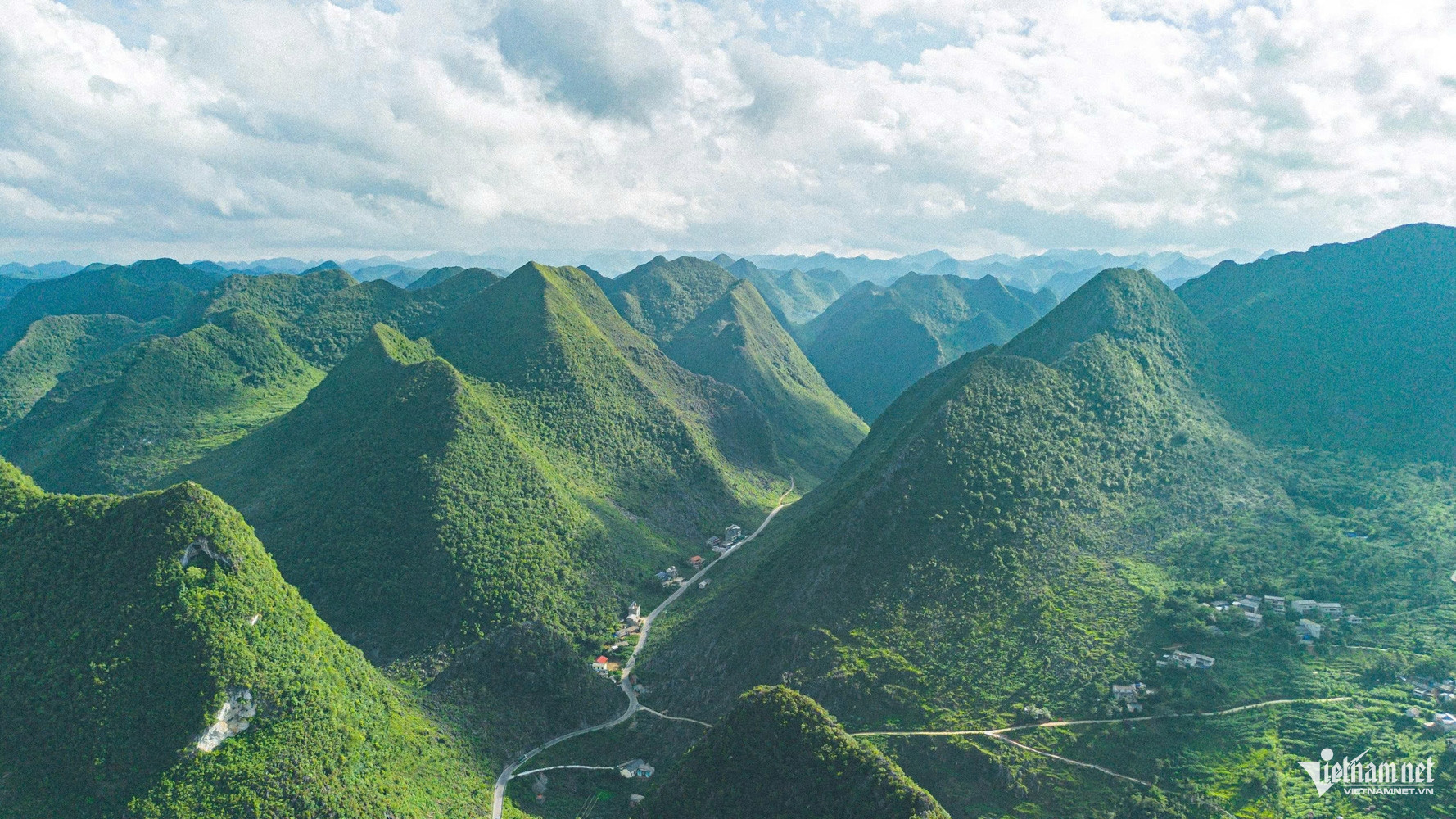
The Dong Van Karst Plateau lies in the northern part of Tuyen Quang Province, covering more than 2,300 square kilometers and home to more than 250,000 people. In a place where ‘summer heat cracks tree branches and winter cold makes even rocks seem to shrink’, the landscape is dominated by endless stretches of towering, barren gray rock.
Nong Van Ngay, Vice Chair of the Khau Vai Commune People's Committee, described the daily struggle to find water. “This land hangs precariously on slopes of hollow rock. When it rains, the water immediately drains into crevices without leaving a trace. In the past, people had to rely on rainwater collected in rock cavities all year round.”
Today, for many families living amid the rocks, such as Vang No Sinh's family in Lung Pu Village, Khau Vai Commune, storing every can of water remains a daily routine.
Rainwater is collected from corrugated-metal and thatched roofs and saved for the dry season. When household supplies run out, residents have to carry 10-20-liter jerry cans from the Nho Que River, climbing back up rocky mountain paths at elevations of 500-700 meters to bring the water home. Even water for cooking has to be purchased, at VND5,000 per 5-liter can.
In Ha Lia Village, Thang Mo Commune, Sinh Mi Cha said water is measured by the container and bucket. Rainy days provide some relief, as residents rush to fill storage tanks, jars and water containers, then use the water sparingly until the rains return.
Small pools of water among the rocks are particularly precious to local residents. As water levels fall, even puddles left in rock cavities are put to use. In some places, people have to wait for water to seep slowly from rock crevices before they can fill a single container.
The difficulty lies not only in having to travel long distances to fetch water, but also in not knowing how long their limited supply will last.
Persistent efforts amid ongoing shortages
Highland communes such as Dong Van, Meo Vac, Sa Phin and Pho Bang regularly face water shortages, affecting the daily lives of around 80,000 people.
Between 2021 and 2025, the province provided decentralized domestic water supplies to 36,978 households and invested in 61 centralized water supply projects. However, a review found that 13,059 households in 16 communes still face difficulties accessing domestic water.
Building water infrastructure does not necessarily mean supplies are secured year-round. During a drought reported in June 2023, four highland districts of Ha Giang Province before the administrative merger had 57 of 121 suspended reservoirs that had completely run dry; 36 had water levels below 30cm, while 28 had water levels above 30cm.
Nguyen Van Dung, Director of the Tuyen Quang Department of Ethnic Affairs and Religion, said the area's rocky terrain, the dispersed settlement of ethnic minority communities and unstable water sources in many locations mean that further investment must be based on the actual conditions and needs of each area.
In Dong Van Commune, Le Trung Quyet, Vice Chair of the commune People's Committee, said the locality currently has 37 water supply facilities, including 12 reservoirs. However, demand for water is increasing. The commune has proposed studying additional reservoirs in villages to serve domestic and production needs as well as support tourism development.
In Meo Vac, Vice Chair of the commune People's Committee Thao Minh Son said the locality has more than 21,000 residents, including around 1,000 households in highland rocky villages that still lack stable access to domestic water.
To address the problem, the locality has proposed building additional suspended reservoirs with capacities of 2,000-3,000 cubic meters, combined with rainwater collection systems to increase storage capacity for the dry season.
Following their review, localities across the Dong Van Karst Plateau have proposed investing in 102 centralized domestic water supply projects, including 52 suspended reservoirs, 21 water tanks with capacities of 5,000 cubic meters and 31 water pipeline projects involving construction, upgrading, repairs and maintenance. The total estimated cost is more than VND812 billion.
According to Le Anh Dung from Tuyen Quang Department of Agriculture and Environment, the province has recently implemented plans to ensure water security, with the goal of securing domestic water supplies for residents under all circumstances, proactively storing and regulating water resources, and adapting to climate change.
Vu Mung

