 Vietnamnet.vn

 Podcast



Traffic accidents a focus for Tet holiday

Police stop a motorbike driver near Hoàn Kiếm Lake in the capital city.
As the Tết (Vietnamese Lunar New Year) holiday approaches, Deputy Prime Minister Trương Hoà Bình has urged the National Traffic Safety Committee along with the ministries of transport and public security to exert all efforts to reduce traffic accidents during the festive period.
The deputy prime minister spoke at a conference on Thursday to discuss traffic safety solutions, following a number of recent collisions.
Khuất Việt Hùng, the committee’s deputy head, mentioned fatal accidents involving trucks and coaches in the first half of January.
“Besides poor driving, transport enterprises are also to blame for these incidents,” he said.
According to Hùng, many transport enterprises put huge pressure on drivers – forcing them to work long hours without being monitored and or conducting periodic checks on vehicles.
The punishments for those companies are not strict enough to stop them committing violations.
A drug and alcohol testing campaign in some localities and accident black spots was suggested by Transport Minister Nguyễn Văn Thể, aiming to reduce traffic accidents, especially those involving large vehicles.
Last week, HCM City Traffic Police started to conduct drug tests on truck and coach drivers.
On the first two days of the campaign, January 12 and 13, five of 44 drivers tested positive for narcotics.
The Deputy PM instructed that the drivers have their licences revoked.
At the same time, investigations will be conducted into a number of transport companies and driving schools.
The Deputy PM also asked for management on the issuance of driving licences to be tightened and harsh punishments imposed on any schools which violate regulations.
Responding to the 24 fatal traffic accidents in late December, 2018 and the first half of January, 2019, Nguyễn Văn Huyện, head of the Directorate for Roads of Việt Nam, said that poor driving was partly to blame.
“Some experienced drivers cause accidents by overestimating their ability or driving dangerously,” he said.
On Thursday, a driving school in the Central Highlands province of Đắk Lắk was reported for deceiving trainees.
According to initial findings, staff said that the school was part of the MoT and promised to help all trainees pass their driving tests by paying between VNĐ6 and 10 million (US$260 to 430).
Up to 400 people had enrolled in the school by the beginning of 2019.
During Tết last year, from February 14 to 20, 2018, 168 people died in traffic accidents while another 37,200 were injured. The number rose sharply on the third and fourth days of the New Year.
Alcohol is the leading cause of traffic accidents during Tết. Besides traffic accidents, 810 people were hospitalised due to alcohol poisoning.
Music gala to be staged at Nhà Rồng Wharf

Meritorious Artist Thanh Thúy will sing folk songs during the music gala Nhớ Lời Di Chúc Theo Chân Bác Bác (Following in the Footsteps of Uncle Hồ), to honour President Hồ Chí Minh and Vietnamese soldiers. — Photo courtesy of the organiser
The Hồ Chí Minh Communist Youth Union, in co-operation with its partners, will organise a special music and song programme at Nhà Rồng Wharf in HCM City tomorrow.
The 120-minute programme, Nhớ Lời Di Chúc Theo Chân Bác (Following in the Footsteps of Uncle Hồ), will feature dozens of young and veteran singers, dancers and musicians from professional art troupes.
The event launches the union’s national campaign, The Year of Active Youth, which will begin next week.
The artists’ performances will be in praise of the country, its history and traditional culture and lifestyles.
Pop singers Thanh Lam and Hồng Nhung will perform songs about love and soldiers by late composer Thuận Yến.
Tenors Anh Bằng, Đào Mác and Meritorious Artist Tạ Minh Tâm of the HCM City Music Conservatory will sing famous songs highlighting President Hồ Chí Minh and his revolutionary career.
The event’s highlights include folk songs staged by People’s Artist Thu Hiền and Meritorious Artist Thanh Thúy, who each have three decades of experience in traditional music.
The singers will perform with the support of Arabesque, one of the city’s leading dance troupes.
“We will try our best to feature the heroic image of President Hồ Chí Minh and Vietnamese soldiers,” said Cao Trung Hiếu, the event’s art director.
“We decided our gala to be staged at Nhà Rồng Wharf because it was the place where President Hồ Chí Minh embarked in 1991 to seek a path to national salvation.”
More than 5,000 guests are expected to attend the gala.
Nhớ Lời Di Chúc Theo Chân Bác will be staged at 8pm tomorrow at Nhà Rồng Wharf on Tôn Đức Thắng Street in District 1, one of the city’s famous tourist destinations that attracts millions of visitors every year.
Maintaining inclusive growth requires strong commitments: experts
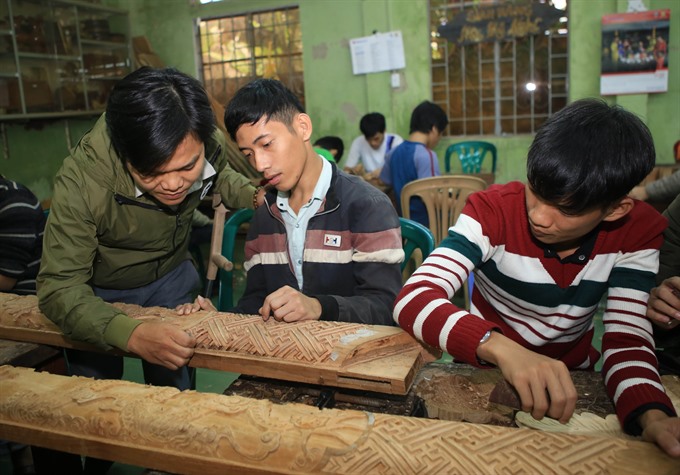
Disabled people learn masonry at a vocational training centre in Huế. Việt Nam has been told to focus on inclusive growth so vulnerable groups are not left behind during the country’s development.
Việt Nam had managed to maintain high economic growth with low inequality in recent decades, but whether the country can continue on this path would depend on how strongly it is committed to green and inclusive growth.
The remark was made by Caitlin Wiesen, United Nations Development Programme (UNDP) Resident Representative, during a leaders & policy session at the Việt Nam Sustainability Forum 2019 held yesterday in Hà Nội.
Citing the GINI index, Palma and quintile ratios – three common measurements used to show how unevenly or evenly the wealth is distributed, the UNDP official hailed Việt Nam’s progress in inclusivity, exemplified by its success in poverty alleviation which earns international recognition.
However, she warned the country would need serious thought about how to deal with the middle income trap, urging it to shift from early stage of a “factor-driven economy” to an “efficiency driven growth stage” by “transforming economic growth from exploiting natural resources and cheap, low-skilled labour to new pathway with enhanced productivity, value addition, competitiveness and environmental sustainability as new key drivers of growth.”
Quoting an International Labour Organisation 2016 report, “The future of jobs at risks of automation”, Caitlin said at least 70 per cent of jobs in the country were at risk of automation, with sectors like agriculture and manufacturing hit the hardest, adding that Vietnamese enterprises – 95 per cent of which were SMEs – needed to grow in size, and transition to formal sectors and green technologies and innovation needed to be promoted, or Việt Nam risked lagging behind.
She said the Vietnamese Government should create inclusive platforms that engender innovations and incentives experimentation of Vietnamese firms with “frontier technologies” to restore the natural environment or promote circular economy and the use of green energy, pay attention to building IT infrastructure and e-Government to “better utilise domestic data resource for growth,” and “catalyse a culture of anticipatory governance, regulations and services” in the age Industry 4.0 to facilitate the growth of ‘sunrise industry’ companies, referring to newly emerging industries like electronics or telecoms.
Skill development system and social protection system would also need to be revised to make sure no one is left behind, she added.
Deputy Minister of Planning and Investment Lê Quang Mạnh agreed that the country would need to craft more effective solutions to address sustainable issues in the fields of human resources, climate change adaptation, smart agriculture, environment and the Fourth Industrial Revolution.
“Promoting sustainable development is not only about economic development, but also the settlement of social issues and environmental protection,” he said.
In 2018, Việt Nam recorded the region’s highest GDP growth at 7.08 per cent as well as a trade surplus of US$7.21 billion, tripling that of 2017.
The agricultural sector posted the highest growth in the past seven years with export turnover of $40.02 billion. Việt Nam has witnessed its poverty rate declining from over 60 per cent in 1986 to around 7 percent at present.
He said Việt Nam was at a “turning point”, claiming the implementation of the national socio-economic development strategy in 2011-20 would bring enormous benefits to the country’s sustainable development, including the improvement of biodiversity, the reduction of environmental pollution, and a more responsible use of natural resources.
Nguyễn Đức Khương, chairman of the Association of Vietnamese Scientists and Experts (AVSE Global), said rapid and sustainable growth much depended on the quantity and quality of human resources, especially as science-technology and innovation played key roles in creating added value.
He added that human resources were the decisive factor in labour and capital productivity. A strategy focusing on the quality of human resources would help Việt Nam gain access to sustainable development trends and digital transformation, he said.
Proposing solutions to the field of climate change, Assoc. Professor Đào Văn Hùng, director of the Hà Nội-based Academy of Policy and Development, said recommendations to macro-regulation policies by the Government should focus on attempts to reduce human impacts on nature and the environment, allocate financial resources to implement climate change adaptation programmes, as well as connect scientists and officials on a global scale to engage in mitigation efforts.
In addition, media agencies needed to be active in co-ordinating information campaigns to raise awareness among communities and the whole society on climate change and environmental protection.
To realise Việt Nam’s vision of becoming a modern nation in the next 20 years, the World Bank and the Ministry of Planning and Investment presented a range of recommendations in their joint Việt Nam 2035 report, including enabling economic modernisation, improving the country’s technological and innovative capacity, reshaping urban policies and investments, and charting an environmentally sustainable development path.
Việt Nam was, however, one of the top five countries in the world most vulnerable to climate change, with intensity and frequency of extreme weather events and natural disasters threatening to undermine its development.
The Việt Nam Sustainability Forum, running its second edition this year, aims at providing a platform for global leaders and stakeholders (policymakers, academics, businesses, entrepreneurs, and NGOs) to present and discuss worldwide initiatives, practices and visionary trends on sustainability.
The ultimate goal is to achieve the long-lasting development of an inclusive and equitable society whereby prosperous growth goes together with a sustainable environment.
Agriucultural sector seeks ways to improve productivity, quality

Clean vegetables in a greenhouse in the northern province of Vĩnh Phúc. Agricultural products have contributed significantly to the country’s exports in the last few years.
To achieve sustainable development, Việt Nam’s agriculture sector must improve productivity and quality, and identify markets for its products, experts said at a conference held in HCM City on Friday.
Highly skilled labour, small-scale production, and increased use of technology are also all needed, they said.
Efficient restructuring of the agricultural sector has brought good results in the last few years, with agricultural products contributing significantly to total exports, but the sector is facing challenges, Nguyễn Trung Kiên, an expert in the field, said.
Kimura Yoshihisa, a consultant in agriculture at JICA, said that Japan used large fields and co-operatives to achieve sustainable agriculture.
Japanese farmers whose fields are located near each other grow crops with the same seed variety and on the same schedule.
They also use advanced farming techniques. If farmers’ fields in some areas are not located near each other, authorities should create favourable conditions for them to swap land, according to the Japanese expert.
For farmers whose land is unproductive or who had no one to farm the land, authorities will help the land owner find a farmer to grow crops on their land.
Nguyễn Đỗ Anh Tuấn, director of the Institute of Policy and Strategy for Agriculture and Rural Development (Ipsard) under the Ministry of Agriculture and Rural Development (MARD), said that Việt Nam’s abundant agricultural supply could meet changing demand of local and global markets.
The sector aims for annual growth of a minimum 3 per cent, with labour productivity improving by 3.5 per cent a year by 2020, according to the agriculture ministry.
The ministry has also set a goal of having 15,000 agriculture co-operatives, increasing income of rural residents by 1.8 times compared to 2015.
To achieve these results, the sector would need to develop a national key product group, a provincial key product group, and a "one commune, one product” group, a MARD representative said.
A systematic approach to training its growing workforce would also fully reap the benefits of free trade, experts said.
Authorities in the Mekong Delta city of Cần Thơ plan to provide training in agriculture for at least 1,400 people in rural areas this year, focusing mostly on crop cultivation and animal husbandry.
The Japan International Cooperation Agency (JICA), Ministry of Agriculture and Rural Development and Việt Nam Farmers’ Union co-organised the conference
An Giang targets organic agriculture development

Speakers at the first Mekong Delta Forum on Developing Partnerships Between Australia and Việt Nam for an Organic Agriculture Movement, held yesterday in An Giang Province.
The Mekong Delta province of An Giang has targeted shifting from traditional agricultural production, which is heavily dependent on fertilisers and chemicals, to more sustainable production and organic standards, said a provincial official.
Nguyễn Sĩ Lâm, director of the Department of Agriculture and Rural Development, said the province was focusing on environmental protection, emission reductions and climate change adaptation, and calling for more local and foreign investment in green agricultural production.
The province since 2013 has had a Jasmine rice production area under GlobalGAP standards in Châu Phú District and a bio-safe rice production area in An Phú District on 400-600 ha per year, with profits increasing for farmers, he said.
In addition, it has piloted an organic rice-shrimp model on 1ha in An Phú District, and has grown high-quality organic rice in Tân Châu Town, Lâm added.
All of these results have created an important foundation for the area to gradually shift from traditional production to safer and organic standards.
Challenges
Despite this progress, the director of An Giang Department of Agriculture and Rural Development said the agricultural sector faced a number of challenges.
The rice yield is very high, but farmers’ incomes are still modest, and investment in agricultural production has not been effective, with excessive use of fertilisers and chemicals.
In addition, the quality of agricultural products has not met the expectations of consumers, who increasingly demand food safety and clean agricultural products. Imported agricultural products are also putting pressure on local products.
The province wants, from now to 2025, to develop its strongest products, including 300ha of rice; mangoes with VietGap standards covering 500ha, of which 100ha of mango is expected to be organic; and VietGap-certified vegetables on 6,000ha, of which 1,000ha will receive organic certification.
According to Alan Broughton, vice president of the Australian Organic Agriculture Association, Australian agriculture has much to share with An Giang province through research and training to ensure safety and efficiency in the supply chain.
The core of organic agriculture is to improve the health of farmers and consumers of agricultural products, restore organic soil, and reduce production costs.
The most important step is to change farming practices through practical experiences and short-term training courses with “hands-on experience” for farmers. This will help farmers see the benefits of organic agriculture.
The Australian Association will continue to support An Giang Province to develop organic agriculture through technology transfer to bring practical benefits to farmers, especially for ethnic women and families.
Trần Anh Thư, vice chairman of An Giang People’s Committee, said he hoped that Australia would continue to support the province in organic agriculture development, through short-term training courses for agriculture officials, scientists and farmers.
Organic agriculture partnership
The first Mekong Delta Forum on Developing Partnerships Between Australia and Việt Nam for Organic Agriculture Movement is one of four components of a project to promote partnership between Australia and Việt Nam.
The project has four work packages.
The first package is to build capacity for three Australian Awards Scholarship (AAS) Alumni from An Giang University (AGU) in agriculture development in Australia, provided by Organic Agriculture Association (OAA), National Association of Sustainable Agriculture Australia (NASAA), Canberra Organic Grower Society (COGS), Fenner School of Environment & Society, and the Australian National University.
In the second package, the AAS alumni team from AGU, including Dr Nguyễn Văn Kiên, Nguyễn Văn Thái, and Lê Ngọc Hiệp, will develop an organic agriculture research centre called the “Mekong Organics Hub” to promote linkages between agriculture, nutrition and public health in the Mekong Delta Region.
For the third package, the Hub will partner with the An Giang Department of Agriculture and Rural Development and An Giang Province People’s Committee to organise the first Mekong Delta Forum on Developing Partnerships Between Australia and Việt Nam for an Organic Agriculture Movement.
The forum aims to share the experiences of organic agriculture research and development with organic growers, organic agriculture associations, farm extension staffs, local governments, business sectors, and NGOs. It will also develop a partnership for organic industry development in the two countries.
The fourth package is the piloting of a home-based organic vegetable farm with female Khmer farmers in An Giang province to promote nutrition and population health outcomes for the communities.
The forum in the province was co-funded by Aus4Skills Small Grants for AAV alumni and An Giang People’s Committee’s Department of Agriculture & Rural Development and An Giang University. It aimed to develop partnerships between Australia and Việt Nam for Organic Agriculture Movement.
Nearly 200 delegates, including scientists and organic agricultural experts, participated in the forum organised by An Giang Province’s People’s Committee.
Ao Dai collection of young Tay ethnic designer introduced at brocade festival

A collection of Ao Dai (Vietnamese traditional long dress) by young Tay ethnic fashion designer, Vu Thao Giang, gained great admiration from visitors at the Brocade Culture Festival in Dak Nong province.
Featuring in bright colours, Giang’s Ao Dai designs were inspired from brocade patterns. She also applied modern printing and embroidering techniques on her designed outfits.
Thao Giang has previously won appreciation in the fashion circle for her Ao Dai collection entitled ‘Heavenly Petals’. Through her work, Giang has generated many initiatives on integrating traditional cultural identity in her designs.
The fashion show also saw the participation of many famous fashion designers, including Do Trinh Hoai Nam, Quang Huy, Vu Viet Ha, and Ngoc Han.
The show was among a series of activated being staged under the three-day Brocade Culture Festival, which wrapped up on January 16.
The festival attracted more than 2,000 professional and amateur craftsmen and artists from 22 Vietnamese provinces and cities, as well as foreign delegations from Laos, Cambodia and Indonesia.

Secretary of Hanoi municipal Party Committee, Hoang Trung Hai (seventh from left) presents Tet gifts to local policy beneficiaries in Ba Vi district on January 17.
Politburo member and Secretary of Hanoi municipal Party Committee, Hoang Trung Hai, joined the city’s Red Cross Society on January 17 to present gifts to disadvantaged locals and victims of Agent Orange in Ba Vi district, encouraging them to enjoy a happy upcoming Lunar New Year (Tet) festival.
Conveying his Tet wishes to locals, Hai said caring for the disadvantaged, Agent Orange victims and people in difficult circumstances is a good cultural tradition of Hanoi. Over the past years, the city has focused on implementing solutions for socio-economic development with encouraging results, aimed at raising incomes for its people and promoting poverty alleviation.
He urged the city’s Red Cross to better promote its core role in humanitarian activities, while continuing to mobilise support from relevant sides in caring for vulnerable groups to help them enjoy a warm Tet.
Ba Vi district was also urged to actively organise visits to the local disadvantaged and give them Tet gifts, while effectively implementing social welfare policies and organising Tet welcoming activities in a joyful, safe and economical manner.
* On the same day, Deputy Chairman of the National Assembly (NA), General Do Ba Ty paid a pre-Tet visit to the Military Region 5 Command in Da Nang city.
Speaking at the meeting, General Ty praised the achievements of the Military Region 5 officers and soldiers in the past year. Regarding the plan for 2019, the NA urged the Command of Military Region 5 to continue improving the quality of training for soldiers, while coordinating with the local authorities to carry out national defence task and participate in local socio-economic development campaigns.
On the occasion of the upcoming Tet, he suggested that the units under the Military Region 5 pay attention to the soldiers' lives and coordinate with the concerned localities to visit and present Tet gifts to policy beneficiaries.
* On the same day, General Do Ba Ty paid pre-Tet visits to policy families in Da Nang city.
In Hai Duong province, local authorities have decided to spend VND37.8 billion from the local budget to visit and give gifts to policy families. The province will present 64,000 gifts, worth VND500,000 each, to families of martyrs, war invalids, policy beneficiaries, wounded soldiers and revolutionary activists. It also provides subsidies to 265 communes, wards and towns with 16,000 disadvantaged households, with each support slot worth VND300,000.
On Thursday evening, in Hanoi, the Vietnam Student Support and Development Centre (under the Vietnamese Student Association) held a programme to care for students in difficult circumstances. At the programme, the organisers handed over free bus tickets and Tet gifts to students and officers of the association who are in difficult circumstances.
The programme is part of a series of activities to support 400 students and staff of the Vietnamese Student Association, implemented in Hanoi, Ho Chi Minh City and the provinces of Thai Nguyen and Tay Ninh. The activities take place from January 17 to 23, with a total support value of about VND400 million.
Vietnam’s typical agricultural products honoured
Deputy PM Vuong Dinh Hue awarding the certificates of honour to typical products (Photo: VGP)
The Vietnamese Farmers’ Union (VFU) held a programme on January 17 to honour exemplary agricultural products in 2017 and celebrate the success of the 7th Union Congress.
In his opening remarks, VFU Chairman Thao Xuan Sung highlighted Vietnamese farmers’ efforts to produce high-quality agricultural products to meet market demands and improve their incomes.
In 2017, a central panel picked 153 products belonging to three categories, agricultural produce, processed products and agricultural supplies, to honour at this event.
Among them, 23 enterprises have seen their products honoured for four consecutive years.
At the ceremony, Deputy PM Vuong Dinh Hue, Vietnamese Fatherland Front President Tran Thanh Man and VFU Chairman Thao Xuan Sung handed certificates of honour to 53 enterprises and cooperatives.
The programme to honour typical Vietnamese agricultural products was first held in 2013, aiming to promote high-quality products and bolster the confidence in Vietnamese agricultural products.
Golden Moment contest – hallmark of Vietnam’s current press photography

VNA General Director presents the special prize to photo set "Luc luong gin giu hoa binh Viet Nam xuat quan lam nhiem vu quoc te" taken by Nguyen Tien Thanh
The “Khoang Khac Vang” (Golden Moment) annual press photo contest organised by the Vietnam News Agency (VNA) has affirmed the important position of press photography in press activities in particular and in the social life in general.
The statement was made by VNA Deputy General Director Le Quoc Minh at the awards ceremony of the fifth edition of the contest in Hanoi on January 18.
He added that increases in the number of participating photographers and entries showed the growing attraction of such a prestigious contest for press photography.
According to the organising board, the contest was launched on September 6, 2018. By December 16, it had received 6,428 works of 632 photographers from 63 provinces and cities, with 25 outstanding entries honoured at the awards ceremony.
At the event, member of the Communist Party of Vietnam Central Committee and VNA General Director Nguyen Duc Loi granted the special prize to the photo set “Luc luong gin giu hoa binh Viet Nam xuat quan lam nhiem vu quoc te” (Vietnam’s peacekeeping force leaves for international missions) taken by photographer Nguyen Tien Thanh.
In the single photo category, one first, two second, three third and five consolation prizes were awarded, with “Bay cao trong chien thang” (Fly high in victory) by Tran Thanh Hai earning the highest prize.
The photo collection category also had one first, two second, three third and five consolation prizes, with the first prize going to a collection of photos titled “Ba phut lu du cuon phang ban ngheo” (Three minutes for a fierce flood to sweep away a poor hamlet) by Nong Viet Linh and Tran Van Thuong.
A new feature of this year’s event was a separate competition section for photos shot with mobile phones. The photo “Pho mua dong” (Streets in winter) captured by Nguyen Duc Giang and the set of photos “Dap lua vu chay lon” (Extinguish a big fire) by Le Minh Son won the best prizes.
Book ‘Tourism Stories – The Vietnam Edition’ launched

At the launching ceremony of the "Tourism Stories-Vietnam Edition"
A book themed “Tourism Stories – The Vietnam Edition” was launched on January 18 within the framework of the ASEAN Tourism Forum 2019 taking place in Ha Long city, the northeastern province of Quang Ninh.
Addressing the launch, Deputy Minister of Culture, Sports and Tourism Le Quang Tung stressed the book meets criteria of the United Nations World Tourism Organisation (UNWTO). It consists of 20 stories highlighting efforts to overcome difficulties, as well as creativeness in the way to think about and do tourism of outstanding individuals across Vietnam, he said.
Tung hoped the book with interesting stories on Vietnam would help domestic and foreign readers to have an insight into Vietnam’s tourism.
The launch of the book showed the Vietnamese Government’s commitments toward the development of national cultural identity, socio-economic development, protection and natural resources and environment, and improvement of the community’s life through tourism.
Since 2013, the UNWTO has built copies of the UNWTO tourism book recording stories of those who engage tourism around the world. The book introduced and honoured normal labourers and their contributions to the local community where they are living.
Following the book, the UNWTO has coordinated with several countries to publish copies of the book in China, Thailand and Philippines editions to help readers to understand more about those who work in the tourism sector and their work.
.svg)
