 Vietnamnet.vn

 Podcast



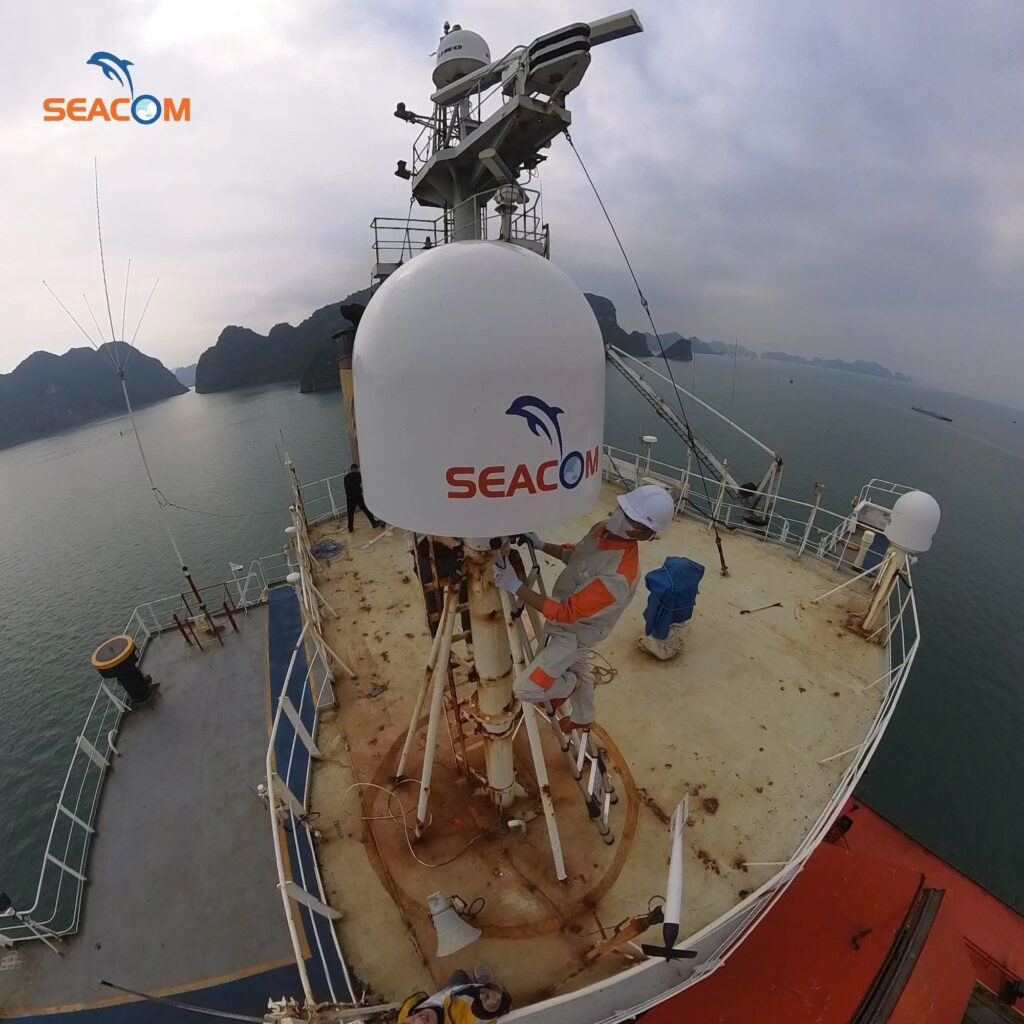
Starlink's official opening of service registrations in Vietnam, with monthly plans starting at just over VND1.1 million ($43), is drawing attention to how its low-Earth orbit satellite network compares with the VSAT services long used by vessels and businesses requiring connectivity beyond terrestrial networks.
Experts say that, based purely on speed and monthly subscription costs, the gap between Starlink and traditional VSAT services such as those offered by VNPT can be substantial.
There is, however, an important distinction. The VND1.13 million ($43) and VND1.71 million ($65) monthly prices currently advertised in Vietnam are for fixed services and should not be interpreted as pricing for Starlink's maritime services.
Even so, the arrival of a low-Earth orbit, or LEO, satellite network could put considerable pressure on the traditional satellite internet model.
Starlink offers dramatically higher speeds at comparable prices
According to information released for Starlink services in Vietnam, a plan offering speeds of around 100 Mbps costs approximately VND1.13 million ($43) per month, while a package with maximum speeds exceeding 400 Mbps costs around VND1.71 million ($65) per month.
That is considerably below the roughly $85 monthly price previously anticipated before the service became officially available in Vietnam.
Traditional VSAT services operate under a very different pricing structure.
According to published VNPT VSAT-IP rates cited in the comparison, some packages cost around VND1.61 million ($61) per month for maximum speeds of 3,072 Kbps, while a package offering up to 4,096 Kbps costs about VND2.1 million ($80) per month.
Other packages range from approximately VND3.67 million to VND5.25 million ($139-$199) per month, despite maximum advertised speeds of only around 3-4 Mbps.
Viewed side by side, the difference appears striking. For around VND1.71 million a month, Starlink can offer speeds exceeding 400 Mbps, while some similarly priced VSAT packages provide only a few Mbps.
But this is not an apples-to-apples comparison.
Traditional VSAT services are often designed for specialized connectivity requirements and may incorporate satellite capacity, VSAT terminals, private networks, technical specifications and operational support.
Starlink, by contrast, is designed as a broadband internet network using thousands of LEO satellites to provide direct internet connectivity to users.
That difference in both technology and business model helps explain how Starlink can deliver broadband speeds of hundreds of Mbps at comparatively low subscription prices.
Gap widens for dedicated VSAT capacity
The price difference can become far greater when businesses require dedicated satellite capacity rather than standard VSAT-IP packages.
According to the published VSAT-IP pricing cited in the comparison, a dedicated two-way 2 Mbps satellite channel can cost more than VND186 million ($7,060) per month, while a 1 Mbps channel can exceed VND93 million ($3,530) per month.
Such figures reflect a fundamentally different model of satellite connectivity, in which customers pay for access to relatively scarce and expensive satellite transmission capacity.
Starlink changes that equation through a constellation of large numbers of satellites orbiting much closer to Earth than conventional geostationary satellites.
From a user's perspective, the most significant shift may therefore be less about headline speeds than the cost per Mbps.
If the cost of connectivity falls sharply enough, satellite internet can evolve from a specialized service used primarily where no alternatives exist into a more widely accessible communications infrastructure.
That possibility makes Starlink's arrival particularly significant for Vietnam's maritime sector.
Vessels could become a key market for Starlink
Fishing boats do not necessarily need 400 Mbps internet. A vessel may simply require enough bandwidth for video calls, messaging, sending images, receiving weather updates, communicating with family members or transmitting operational data ashore.
The difficulty is that offshore vessels cannot access fiber-optic networks and may operate far beyond reliable terrestrial mobile coverage.
In many such cases, satellite connectivity becomes the primary option, making equipment and subscription costs a significant expense for vessel owners.
If Starlink eventually offers maritime services in Vietnam at competitive prices, that equation could change substantially.
Fishing boats, cargo vessels, tourist boats, service vessels and other offshore craft could use satellite broadband not only for basic communications but for a much broader range of digital applications.
Onboard cameras could transmit data ashore. Crew members could make video calls to their families. Vessel owners could monitor operations remotely, while weather, positioning and operational data could be updated more frequently.
Internet access at sea could consequently shift from an expensive communications service to part of a vessel's everyday digital infrastructure.
It is important, however, not to assume that Starlink's VND1.13 million or VND1.71 million monthly fixed-service plans will apply to ships.
Starlink's international offerings for mobility and maritime use have different pricing and hardware requirements depending on data allowances, location and operational needs. Starlink documentation also specifies that in-motion use is available only in approved countries.
The actual impact on Vietnam's maritime connectivity market will therefore depend heavily on the packages and regulatory conditions under which Starlink offers services to vessels.
Starlink could trigger a price shock for internet at sea
The most consequential issue is not whether a fishing boat can make use of 400 Mbps. It is whether Starlink can dramatically lower the cost of each Mbps delivered offshore.
Under the traditional model, even a satellite connection providing only a few Mbps can represent a significant investment. If bandwidth becomes substantially cheaper, applications that were previously uneconomical could suddenly become practical.
Video surveillance, Internet of Things devices, data transmission, positioning, fleet management and online services for crews could all become easier to deploy.
That could put pressure on traditional VSAT providers, particularly among customers who primarily need ordinary internet connectivity but have historically paid high prices because of the technical challenges of connecting vessels at sea.
VSAT, however, is unlikely to disappear.
Traditional satellite services retain advantages for specialized applications, private networks, service-level requirements, integrated maritime systems and customers with particular technical or operational demands.
The emerging competition may therefore be less about Starlink completely replacing VSAT than about Starlink pushing satellite broadband prices toward a new baseline and forcing established providers to adapt.
For Vietnam, that could prove to be one of the most significant consequences of Starlink's entry into the market.
If maritime Starlink services eventually become available for only a few million dong a month, fishing vessels, cargo ships and tourist boats could be among the clearest beneficiaries.
In recent years, some tourist vessels have reportedly installed Starlink equipment without authorization, while some motorists willing to pay for the technology have also used unauthorized Starlink terminals in their vehicles.
Official service availability in Vietnam changes the broader landscape, although users still need to ensure that their particular service plan and type of use - especially mobile or maritime operation - is authorized rather than assuming that approval of fixed Starlink services automatically covers every application.
Ultimately, Starlink's greatest impact may not be its ability to deliver speeds exceeding 400 Mbps. Its more disruptive potential lies in turning satellite bandwidth from an expensive, specialized service into internet infrastructure accessible to a much wider range of users.
Thai Khang
.svg)
