 Vietnamnet.vn

 Podcast



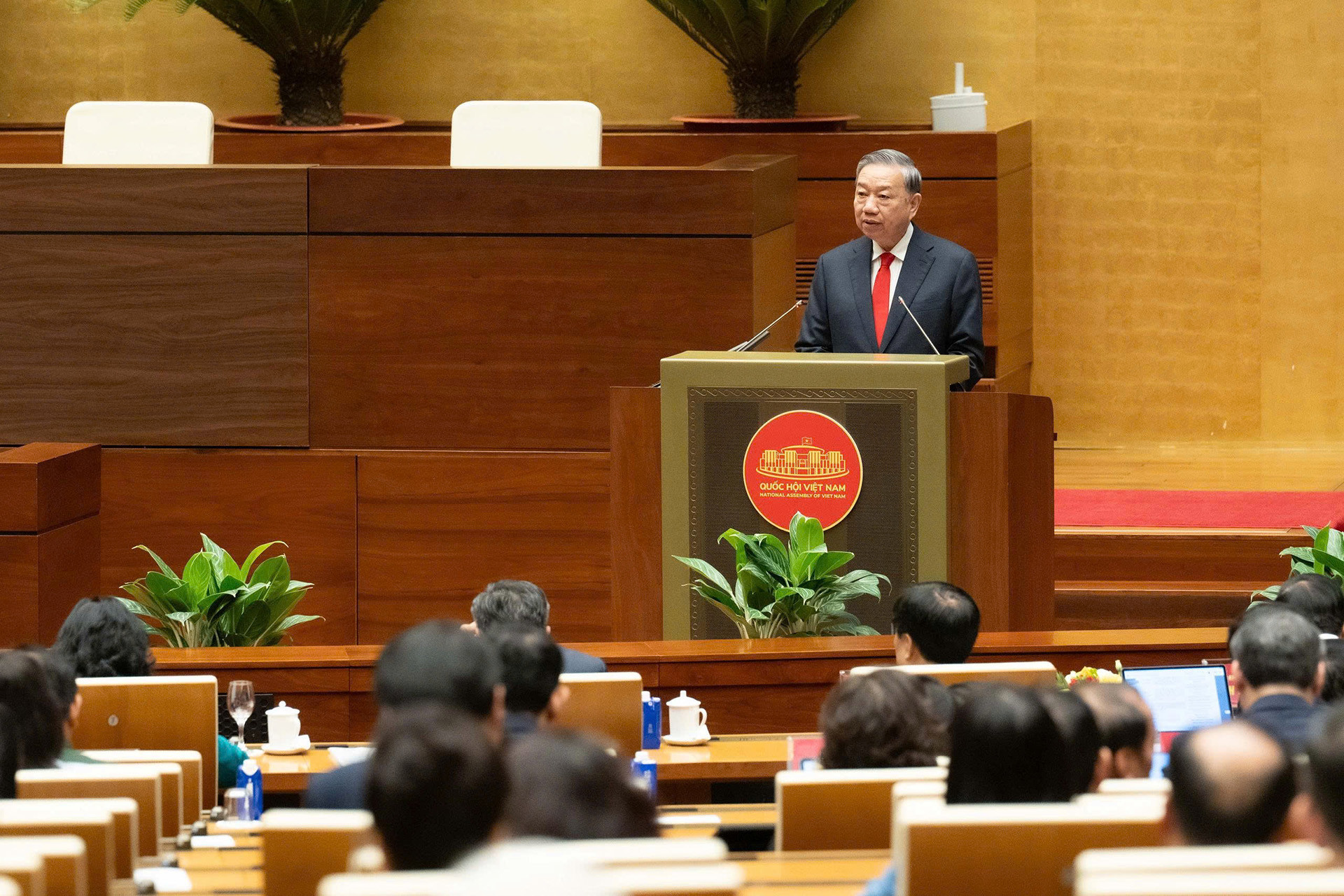
At the national conference to disseminate and implement the Politburo’s Resolutions No 79 and 80, General Secretary To Lam cited an example that gave many pause for thought: three elevated roads in Hanoi all used foreign technology, yet they could not connect with one another.
That story is not just a matter of traffic engineering. It is a warning about the way the State economy operates: without standardized discipline and clear accounting, even a large-scale project using foreign technology has high investment capital, still can be low in efficiency.
When the General Secretary emphasized that the State economy must become a "national foothold," serving as a pillar for macroeconomic stability, this doesn’t mean just expanding in size, but growing stronger in governance quality, leadership capacity, and proven efficiency.
No modern economy exists without state economic sector
Economics does not deny the state’s role. In every country, regardless of its regime, a minimum level of state economic presence is necessary. But mere presence is only a necessary condition; the sufficient condition is that the state must intervene in the right areas, at the right level, and with proper discipline. The issue has never been whether to have a state economy. The issue is what the state does, how much it does, and under what discipline.
Therefore, when issuing Resolution 79, the Politburo not only reaffirmed the leading role of the state economy but also redefined the benchmark: that role is not measured by total capital or the number of projects, but by its ability to guide the market, contribute substantively to major economic balances, macroeconomic stability, economic security, and medium- to long-term growth.
The Resolution calls for strong restructuring, focusing on key sectors and strategic areas, while combating “group interests,” “backyard interests,” manipulation, and policy profiteering, the factors that distort resource allocation and erode public trust.
State economy
From an economic perspective, the state economy is an objective requirement. Public goods, externalities, natural monopolies, and the need to ensure security and sovereignty cannot be entirely left to market self-regulation. The state must participate, and in some fields, must take the leading role.
At the institutional level, however, the scope of expansion or contraction of the state economy depends on each country’s political choices and development philosophy.
Why does efficiency remain low?
The Party General Secretary posed concrete questions: Do multi-billion-dollar projects outperform those of other countries? How long is the payback period? How much do they contribute to growth? If these questions cannot be answered, efficiency cannot be claimed.
In reality, many projects in the state sector remain more focused on disbursement progress than on life-cycle cost–benefit calculations. Disbursement is still an important metric: slow disbursement means delayed construction, delayed infrastructure, delayed opportunities. But disbursement is only a necessary condition. The ultimate goal must be efficiency: what added value does the project create, how much productivity does it increase, is the life-cycle cost optimized, have risks been fully calculated, and how is accountability designed?
When economic accounting does not become a mandatory discipline, investment easily becomes scattered. The deeper root lies in the agency problem: the ultimate owner is the entire people, but the operators are an appointed apparatus. Without transparency and individual responsibility, a state of "everybody's business is nobody's business" emerges.
In that context, wastefulness becomes a terrible disease. Waste is not just money. It is eroded time, missed opportunities, diminished competitiveness, and eroded social trust.
Looking at urban infrastructure projects, the phrase "cost overrun – delayed progress" is no longer unfamiliar. The Cat Linh – Ha Dong urban railway once saw its total investment increase from VND8,700 billion to VND18,000 billion during implementation.
Lessons
The common denominator is not how much the state owns, but how it governs. When the state acts as a strategic investor—calculating long-term efficiency, ensuring transparency, and bearing responsibility - it can become a driving force. When it focuses merely on capital allocation and fulfilling disbursement targets, efficiency declines and waste increases.
The state economy is a requirement of a modern economy. But its effectiveness is not automatic. To become a “national pillar,” the state economy must be restructured to focus on truly strategic and necessary sectors; national standards and regulations must be unified; costs and benefits must be fully and publicly accounted for; and the responsibility of leaders must be tied to final outcomes.
An Hai
.svg)
