 Vietnamnet.vn

 Podcast



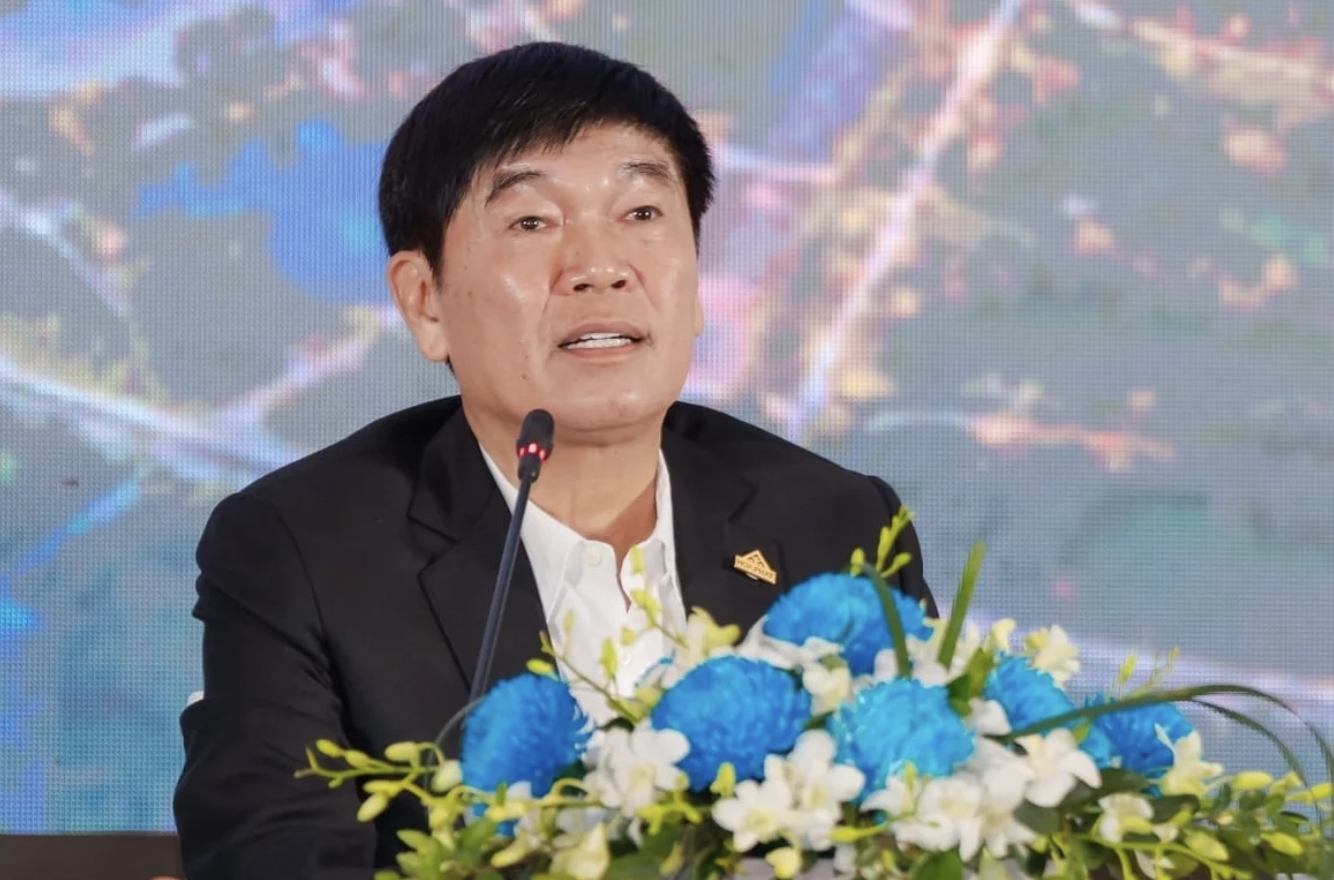
Tran Dinh Long, chairman of Hoa Phat Group, has expressed confidence that the company will produce its first railway steel products by the second quarter of 2027, while also sharing ambitions tied to a major urban development project along Hanoi’s Red River.
Speaking at the company’s annual general meeting on April 21, Long said Hoa Phat is actively participating in supply chains for railway projects, including the recently launched high-speed rail line connecting Hanoi and Quang Ninh.
He revealed that the group’s leadership had recently visited its rail production facility, where teams at the Hoa Phat Dung Quat steel complex and the rail plant are working toward the 2027 milestone.
On raw materials, Long noted that Hoa Phat currently imports more than 90% of its iron ore, with domestic supply accounting for only a small share.
Addressing the entry of other private companies into the steel sector, he said all businesses have the right to participate if they meet regulatory conditions. “Hoa Phat welcomes fair competition, but we are not complacent. We continue to review ourselves, strengthen operations and invest in depth. Competing with Hoa Phat is not easy,” he said.
Beyond steel, the chairman also spoke about the group’s real estate ambitions. Hoa Phat is studying several large-scale projects, including potential involvement in the development of a major corridor along the Red River in Hanoi.
He described the project as a long-term vision that goes beyond economic value, with the potential to reshape the city’s urban landscape. Drawing comparisons with cities such as Paris, Seoul and Shanghai, he noted that riverside areas in those cities were once disorganized but transformed significantly after planning and redevelopment.
“If executed well, the Red River banks could become a beautiful space with a series of thematic parks,” Long said. However, he acknowledged that relocating around 200,000 residents would be one of the most significant challenges. “If it is not done now, it will only become more difficult in the future,” he added.
At the annual general meeting of Hoa Phat Agricultural Development JSC held the same day, CEO Pham Thi Hong Van said that after nearly a decade in agriculture, the company has expanded its scale and strengthened its position in the livestock sector.
In 2025, the company recorded revenue of VND8,326 billion (US$341 million), up 18% year-on-year and exceeding its target. Net profit reached VND1,600 billion (US$66 million), a 55% increase, also surpassing the annual plan. The pig farming segment accounted for 41% of revenue and 67% of net profit.
For 2026, the company has set a more cautious target, projecting revenue of VND7,200 billion (US$295 million) and net profit of VND1,005 billion (US$41 million), representing declines of 11% and 37% respectively compared to 2025.
In the first quarter of 2026, Hoa Phat Agriculture posted revenue of over VND1,813 billion (US$74 million) and net profit of VND345 billion (US$14 million), achieving about 25% of its annual revenue target and more than 34% of its profit goal.
According to company leadership, the conservative outlook reflects risks from disease, geopolitical fluctuations and the cyclical nature of the livestock industry, especially after a strong performance in 2025.
Looking ahead to the 2026–2030 period, the company plans to expand its breeding herd to over 30,000 sows, targeting an annual output of around 900,000 commercial pigs, with investment of about VND1,000 billion (US$41 million). It also aims to build an additional animal feed plant with a capacity of 300,000 tonnes per year by around 2029, raising total capacity to 1 million tonnes annually.
By 2030, Hoa Phat Agriculture targets revenue of more than VND12,000 billion (US$492 million) and net profit of approximately VND1,750 billion (US$72 million).
Tam An
.svg)
