 Vietnamnet.vn

 Podcast



On the morning of January 31, at the Government Headquarters, Prime Minister Pham Minh Chinh chaired the fourth meeting of the National Steering Committee tasked with implementing Resolution 68 on private-sector economic development.
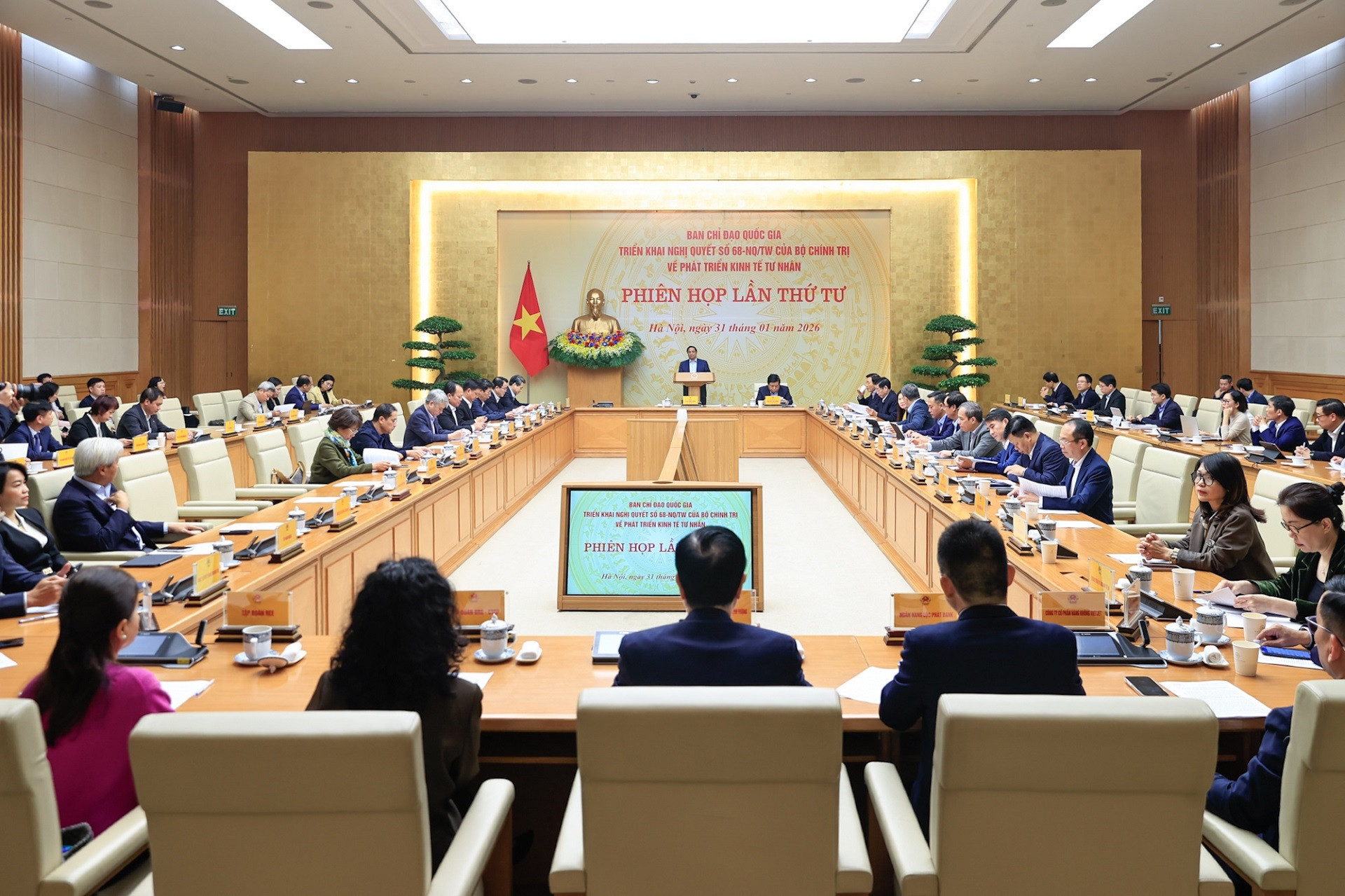
The central agenda of the meeting was to assign specific missions to major enterprises to lead key industries and sectors - creating strategic “locomotives” that help elevate the broader private sector through competition and innovation.
According to the Prime Minister, the core objective is to translate the spirit of the resolution into measurable results. The business environment must become more open and equitable; administrative procedures must be substantively reduced; and support mechanisms must target the right “bottlenecks” to allow enterprises to confidently invest for the long term.
At the meeting, CMC Technology Group was the sole representative from the science & technology and digital technology bloc to deliver a formal policy presentation. Chairman Nguyen Trung Chinh focused on long-standing policy bottlenecks affecting tech enterprises - ranging from data and data centers to building international market access pathways.
Proposing mechanisms for pioneer enterprises and the AI industry
At the outset, Chinh recommended establishing a formal mechanism to select “pioneer enterprises” by field groupings, with a large enough scale to generate spillover effects. He suggested that each grouping could include 10 to 20 leading companies that would receive missions and tailored support mechanisms, allowing them to serve as sectoral locomotives.
In tandem with the national orientation toward promoting a semiconductor ecosystem, Chinh also proposed the early establishment of a Vietnam Artificial Intelligence Association. This entity would help consolidate resources, standardize capabilities, accelerate commercialization, and improve Vietnam’s standing in global AI capability rankings.
On data policy: Vietnam not yet competitive in attracting major capital
A core concern Chinh highlighted was the data policy framework. According to evaluations by international partners, Vietnam’s current data policies remain less competitive compared to countries such as Singapore, Malaysia, and Thailand. As a result, some investment funds and large corporations remain hesitant to enter the market.
Chinh recommended that the Government instruct the Ministry of Public Security, the current data management authority, to review and improve existing policies. He called for an approach that ensures “tight control, but predictability” - balancing national data sovereignty with interoperability needs, aligning with international standards, and establishing a legal foundation capable of attracting major capital flows into Vietnam’s digital sector.

Electricity pricing for data centers: a strategic cost barrier
Regarding digital infrastructure, Chinh cited CMC’s investment plan for building data centers with a total capacity of 120 to 150MW over the next five years. He emphasized that Vietnam’s regional competitiveness in this area would hinge significantly on electricity costs - the largest single cost component in the operation of data centers.
He expressed concern over the potential classification of data centers under commercial electricity pricing, which could dramatically increase operational costs and reduce Vietnam’s attractiveness in securing large global clients from the US, Japan, and South Korea.
In his view, data centers should be recognized as foundational infrastructure of the digital economy. As such, a stable and appropriately tailored electricity pricing mechanism is essential to enable long-term service contracts and investment planning.
Promoting outbound growth through economic and tech diplomacy
Chinh also called for the expansion of economic and science & technology diplomacy, shifting toward a “market-problem driven” approach. He proposed that enterprises be allowed to participate in shaping market-entry strategies tailored to each country and sector.
According to Chinh, Vietnam’s domestic market is not yet broad enough for technology firms to scale up rapidly. To break through, there must be practical mechanisms supporting outbound expansion and the signing of international contracts.
Concluding his remarks, Nguyen Trung Chinh reaffirmed CMC Technology Group’s commitment to sustaining over 20% annual revenue growth and contributing steadily to the national budget. He also proposed working with the Ministry of Science and Technology to review policies related to digital technology, data, and data centers - ensuring outdated or impractical regulations can be promptly amended to reflect real-world needs.
The meeting concluded with a consistent message from the head of Government: assign clear missions to leading enterprises in each sector, and establish strong, fast-moving implementation mechanisms that can transform Resolution 68 into real growth and enhanced national competitiveness.
PV
.svg)
