 Vietnamnet.vn

 Podcast



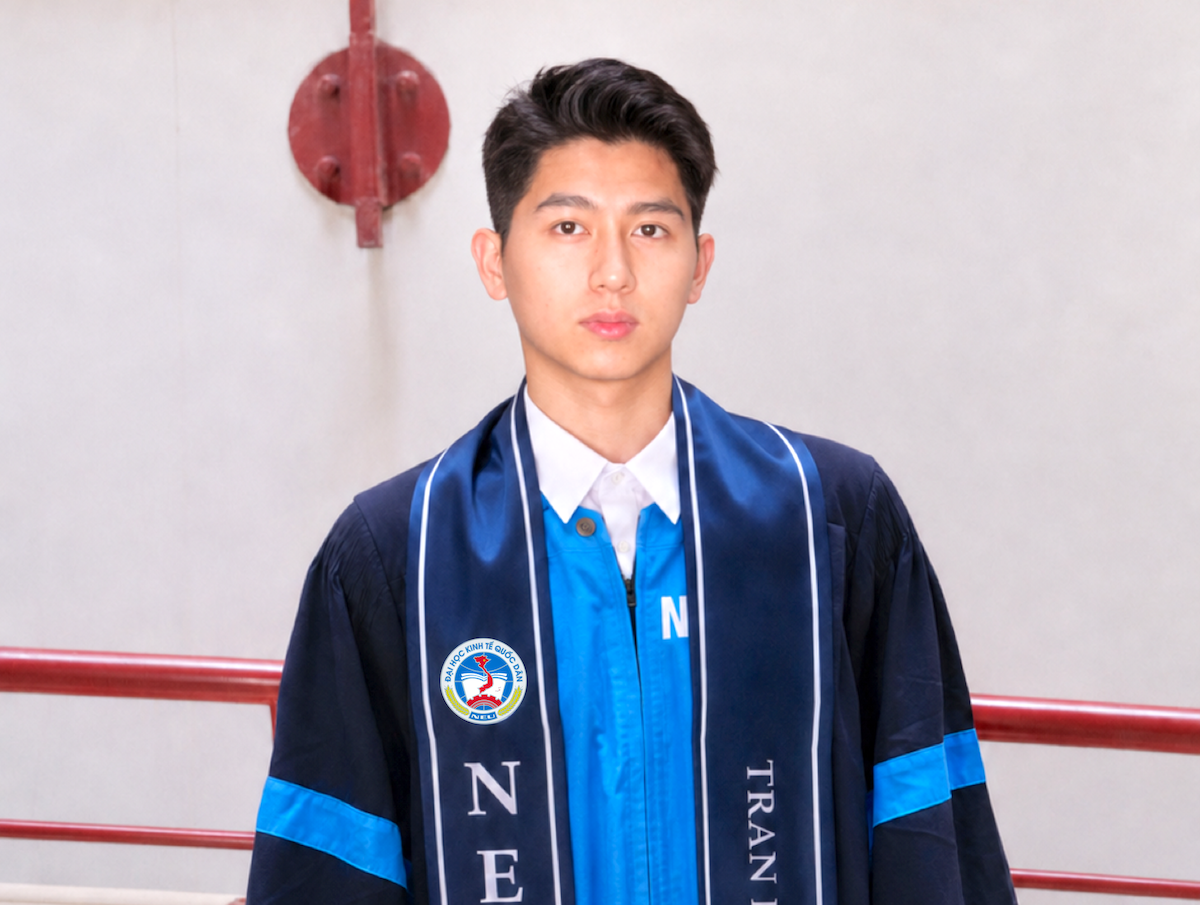
Tran Ky Anh, an alumnus of Viet Duc High School (Hanoi), recently graduated from the National Economics University with a perfect 4.0/4.0 GPA. While becoming the school's valedictorian, Anh considers this merely a milestone rather than the ultimate destination.
Learning beyond the curriculum
Since high school, Anh has taken part in various school activities, from music, acting and volunteer work to hosting events. As an outgoing student who enjoyed trying new things, Anh wanted a university where he could explore different interests. He chose the National Economics University because he felt it was a good fit for him.
Upon admission, Anh did not set out to graduate with a perfect 4.0 GPA. In his first semester, he expected modest grades: a C+ in Management Information Systems, a B in Philosophy, and an A in Microeconomics. Ultimately, he earned A+ grades in all three, far exceeding his expectations. This outcome motivated him to adapt quickly and maintain academic excellence across subsequent semesters.
According to Ky Anh, keeping high grades over four years stemmed not from a high-pressure mindset to achieve a 4.0, but from an unburdened attitude toward scores.
"I still tried my best in every subject without putting unnecessary pressure on myself. That mindset helped me go the distance," he said.
For each subject, he allocated time strategically. Eager and skilled in quantitative subjects, Ky Anh mastered the concepts directly during lectures, requiring minimal revision time later.
Conversely, for subjects requiring rote memorization or political theory, he started revision early, breaking it into multiple review cycles while following lecturers' guidelines and sourcing extra materials from student study groups.
"Effective time allocation means knowing your strengths and weaknesses to invest effort wisely. I also maximized my assessment scores - attending every class and raising my hand to present impactful arguments," Ky Anh said.
Additionally, he leveraged AI tools to generate potential exam questions and scenarios. This strategy helped him verify solid knowledge areas while focusing extra attention on weaker concepts.
Champion in multiple business and startup competitions
Anh co-authored four papers published in international conference proceedings and one paper in a domestic academic journal. His initial research focused on international business, closely aligned with his major, before shifting toward food supply chains as his interest in supply chain logistics grew.
Drawn to data analytics, Ky Anh handled data processing and statistical analysis. He noted that the hardest part of research is not running models or processing data, but translating raw results into meaningful narratives.
"Obtaining statistical figures is one thing, but explaining why those results emerged and what insights can be drawn is an entirely different story," Ky Anh explained.
Whenever research outcomes diverged from initial expectations, he revisited documents and re-evaluated his research questions. This skill later benefited him in solving real-world business cases in competitions.
"Looking at a dataset or a corporate problem, I naturally move beyond 'what are the numbers saying?' to ask 'what action should we take based on this data?'. That is perhaps the greatest value I gained from scientific research," Anh said.
Throughout his four years at university, Ky Anh entered and won top titles in several business and startup competitions. His MC experience also helped him articulate complex issues concisely and persuasively across contest rounds.
Anh emphasized that extracurricular activities never distracted him from his studies; instead, they offered practical perspectives.
"University courses provide the foundation for analytical thinking, while competitions, research, and real-world experiences help students understand when to apply that knowledge and how to adapt it.
Therefore, learning from the outside does not replace classroom learning; it helps us return with a clearer understanding of how to apply knowledge and why we need it. To excel at studying, one shouldn't just study," he shared.
Ky Anh has not set a target for a specific position. He establishes milestones for each phase: when to continue gaining experiences, when to make choices, and when to narrow his focus to build a specialized career path.
"For me, experiencing a lot is so finally know what I am good at and what makes me happy, not to forever stand among many choices," Ky Anh said.
Thuy Nga
.svg)
