 Vietnamnet.vn

 Podcast


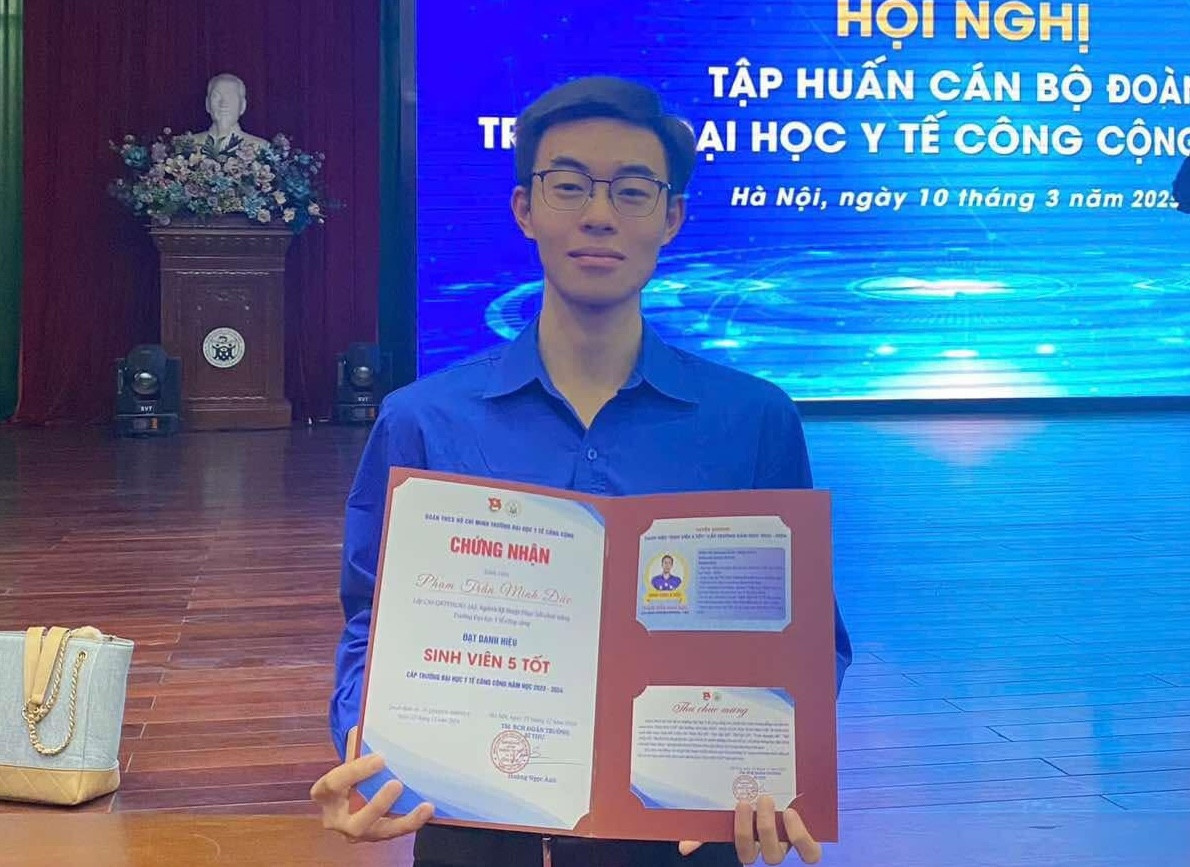
When Duc graduated from Hanoi University of Public Health as the top student of his entire cohort, he waited until his mother finished work before sharing the good news.
Pham Tran Minh Duc, born in 2004, is a former student of Ngoc Hoi High School in Hanoi. His father died of cancer when Duc was young, leaving the family classified as poor. His mother had to take on various jobs to support her son through school.
Born with a congenital deformity in his right foot, Duc underwent plaster casting as a child, while his mother patiently helped him with exercises at home. As he grew older, he gradually noticed that his legs differed in length and that he often experienced pain during high-intensity physical activity. At the time, he simply assumed he was physically weaker than his peers.
After years of grueling physical labor, Duc's mother also frequently suffered from musculoskeletal pain. Watching his mother endure pain while personally facing mobility challenges, Duc resolved to pursue a field of study that would help him understand the body and provide healthcare for them both.
"My wish was very simple: just to find a way to alleviate pain for my mother and myself," Duc shared.
In 2022, Duc gained admission to the Rehabilitation Technology program at the Hanoi University of Public Health.
Knowledge regarding pain and movement allowed Duc to better understand his own physical condition, enabling him to manage his pain effectively.
During his freshman year, Duc dedicated himself to serious study, hoping to win scholarships to ease his mother's financial burden. Rather than rote learning simply to pass examinations, Duc sought to understand core concepts, developing a habit of asking probing questions and approaching problems through evidence-based methods.
Initially, Duc focused primarily on finding ways to relieve pain for himself and his mother. However, the more he studied, the more interested he became in supporting patients to help them overcome everyday physical difficulties.
According to Duc, rehabilitation aims not only at symptom reduction but also at helping patients improve mobility, daily functioning, and independence in life. Alongside professional interventions, patients need information and skills to actively participate in their own care and health management.
"I want to be a companion who helps patients regain confidence, rather than just a technician performing procedures," Duc shared.
During his university years, Duc became interested in issues arising from patients' real-life challenges, such as lower back pain, fear of movement and dietary management after a stroke. He believes that what students learn must be tested and developed through research before it can be applied in practice.
In 2026, Duc proposed a study using the Back-PAQ questionnaire to investigate young people's attitudes and beliefs about managing lower back pain. The proposal won second prize in his university's student scientific research idea competition.
He also contributed to a project to standardize the STarT Back Screening Tool, which is used to screen patients for back pain-related risks. In a study on the dietary intake of stroke patients with swallowing disorders, Duc helped collect clinical data and review the literature. He was also a co-author of a paper published in the Journal of Nutrition and Food in 2025.
Balancing his studies, research and club activities sometimes left Duc exhausted and overwhelmed. Learning about burnout during this period prompted him to reflect on his own pressures and realize that caring for others begins with looking after one's own health.
This experience inspired him to develop a community project supporting the health of students in health-related disciplines through nutrition and rehabilitation. The project attracted more than 150 student participants.
When Duc learned that he had graduated as the top student of his entire cohort, the first person he told was his mother. He waited until she had finished her shift before sharing the joyful news.
“I am happy that I can make my mother proud, but I also understand that the way to repay her sacrifices is to continue living and working responsibly,” Duc said.
Duc is now a practical instructor in rehabilitation at Hanoi University of Public Health. The support he received from his lecturers during university has inspired him to continue teaching, helping students understand concepts, ask questions and apply what they learn in practice.
Thuy Nga

