 Vietnamnet.vn

 Podcast



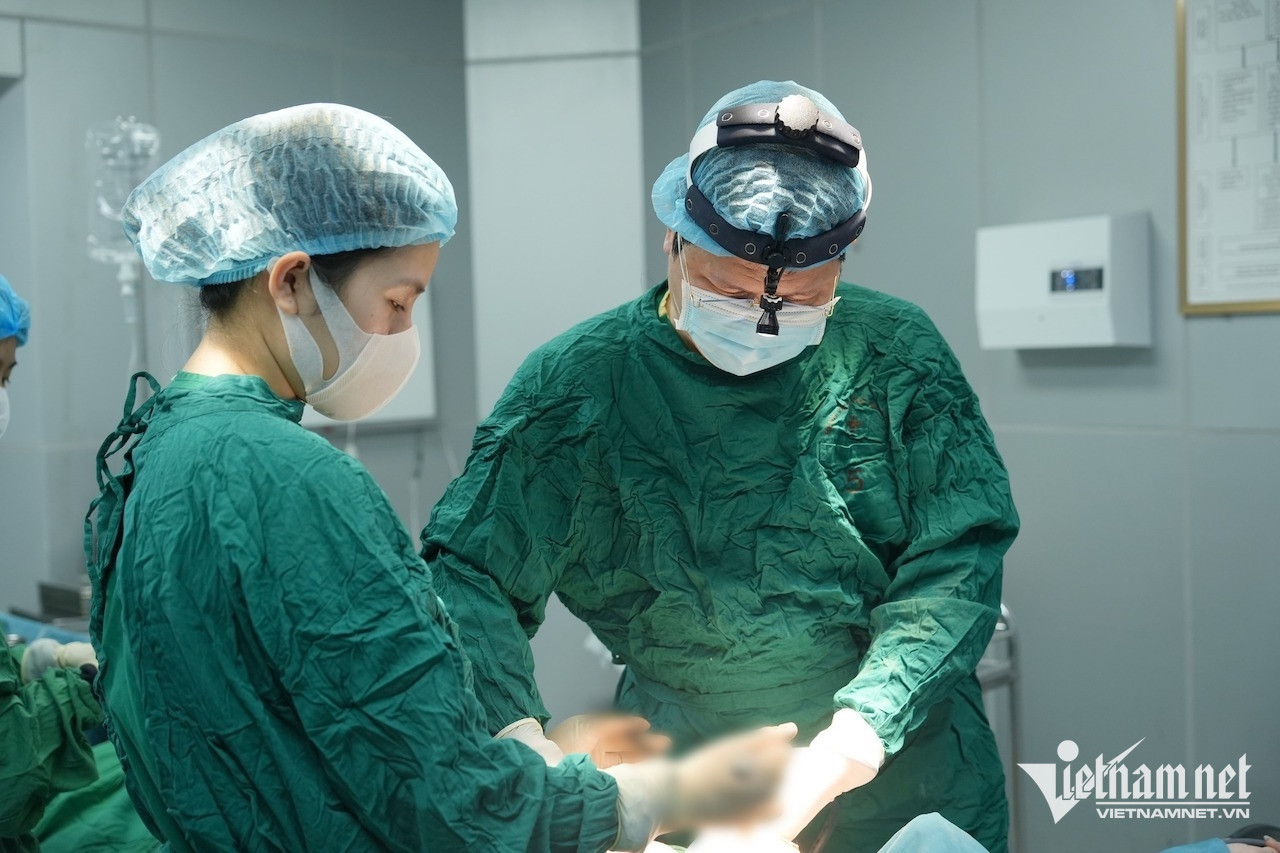
Dr Hai, Phd, deputy director of the Center for Aesthetic Plastic and Reconstructive Surgery at National Burn Hospital, entered the field of microsurgery in his early 30s. But after a three-month trial period, in 2011, he officially joined the Department of Plastic Surgery, National Burn Hospital.
He said severe burn patients often carry heavy sequelae such as contractures of the face, neck, hands, and legs, causing them to lose normal mobility, and even be unable to care for themselves. Many suffer facial deformities, losing the chance to reintegrate into society. For them, reconstructive microsurgery is the only door back to life.
A typical case is Chau A Dung, a young man from Sa Pa (Lao Cai), who had an accident at age 16. Dung suffered acid burns that caused his entire face and neck to shrivel and become deformed. The scars contracted so severely that his neck bent downward, and Dung could barely turn his head or move normally.
To restore the patient’s appearance and motor function, Hai and his team performed two particularly complex major microsurgeries.
In the first stage, he harvested a flap of skin from the back and grafted it onto the neck, helping release the wrinkled, contracted skin so the patient could move again. Then, a huge U-shaped skin flap measuring 29x14cm was taken from the back to reconstruct nearly the entire deformed face.
"The special difficulty of the surgery was the microsurgical technique, a field requiring the highest level of skill in plastic surgery. My team and I had to use a microscope to magnify and connect each tiny blood vessel just a few millimeters wide to keep the grafted skin flap alive for many hours,” he recalled.
“Even a very small error could block the blood vessel, causing the entire grafted skin to necrose and the surgery to fail. Fortunately, after eight hours, the surgery was successful. The patient was later able to open his mouth, and his facial and neck muscles moved flexibly," Hai said.
The major surgery in late 2011 became a special milestone when microsurgical techniques were successfully applied for the first time to reconstruct an entire face. This was also the first case in Vietnam of reconstructing an entire face using a large autologous skin flap performed by Hai.
Few know that behind Hai’s complex microsurgeries are years of quiet practice in the cadaver operating room. In microsurgery, where each tiny blood vessel can decide the success or failure of a surgery, practicing on cadavers plays a key role in improving a surgeon’s skills, confidence, and precision.
For many years, he regularly traveled to HCMC to operate on cadavers 3-4 times each year to hone his expertise.
Operating on cadavers helps doctors access human anatomical structures in the most realistic and detailed way. Each layer of muscle, blood vessel, nerve, or organ position is observed directly, building a solid foundation for microsurgeries that demand absolute precision.
“I came to reconstructive surgery at age 32, much later than many resident doctors. So I had to find ways to compensate by studying and training more to achieve the same sensitivity and skill level, even surpassing them," Hai shared.
To date, after more than 20 years in the profession, Hai has participated in treating thousands of burn patients with complex injuries. But for him, each surgery is still a separate journey, and each vessel connection and skin graft is a time "patching" a part of a patient’s life.
Phuong Thuy
.svg)
