 Vietnamnet.vn

 Podcast


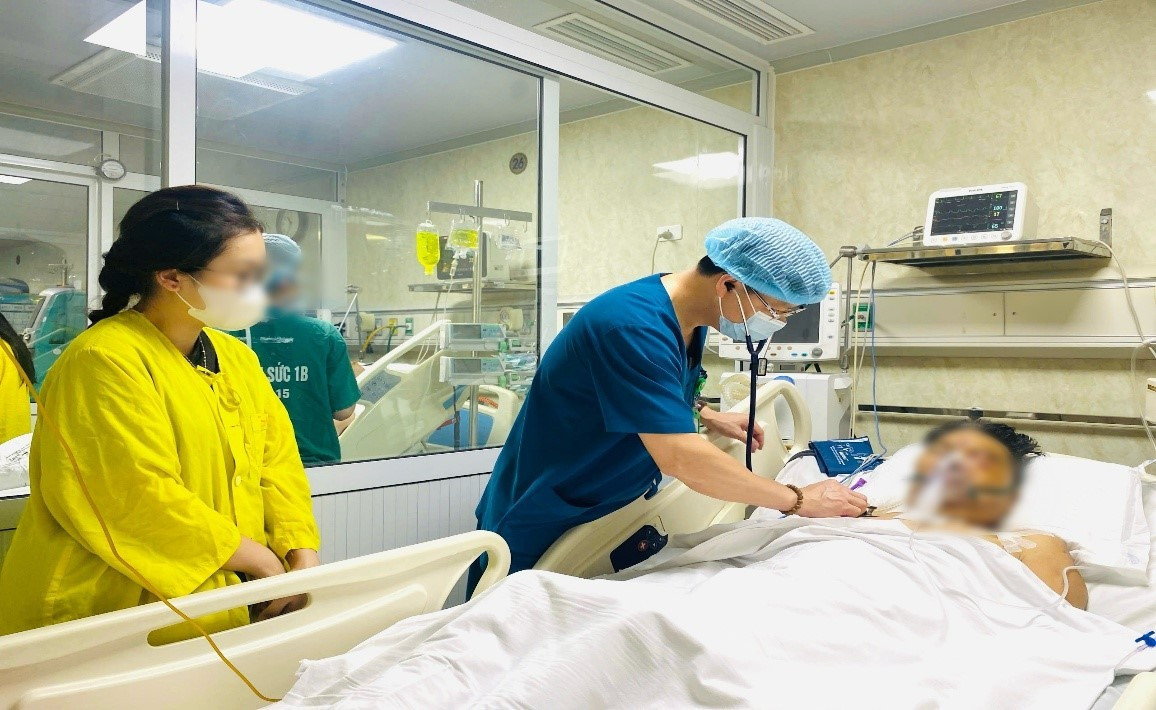
The accident occurred about 100 km from Lao Cai Province's General Hospital No1. Without timely surgery to stop the bleeding, the patient could die from severe blood loss and circulatory failure.
Associate Professor Luu Quang Thuy, director of the Center for Anesthesiology and Surgical Intensive Care at Viet Duc Friendship Hospital, and other specialists concluded that transferring the patient directly to Hanoi would take more than two hours and carry significant risks.
The specialists agreed that emergency surgery should be performed locally. However, the patient had a ruptured iliac artery, and the local hospital lacked surgeons specializing in vascular surgery and the necessary vascular surgical instruments.
Over the phone, Viet Duc Hospital specialists guided the Lao Cai team to perform a laparotomy to locate and temporarily control the bleeding site. During surgery, doctors discovered complex damage to the external iliac artery requiring synthetic graft replacement.
The two hospitals maintained remote consultations via the Telemedicine system. A team of vascular surgeons along with specialized equipment from Hanoi was dispatched to Lao Cai to assist the operation. The surgical team successfully controlled the bleeding and replaced the damaged arterial segment with a synthetic graft. The patient was transferred to Viet Duc Hospital for further care and discharged home in June.
Another case in Lao Cai likewise highlighted the pivotal role of remote professional connectivity in complex clinical scenarios.
Not long ago, Lao Cai Obstetrics and Pediatrics Hospital admitted two young female patients, aged 12 and 14, suffering from congenital anomalies obstructing menstrual outflow, leading to severe pain and blood accumulation.
The hospital conducted remote consultations with Assoc. Prof. Dr. Vu Van Tam, Director of Hai Phong Obstetrics and Gynecology Hospital nearly 500km away, using remote medical systems along with ultrasound and CT scans.
With remote technical guidance, local doctors in Lao Cai performed surgeries on both young patients, spaced four days apart. Post-intervention, both patients achieved stable recovery.
Dr. Hoang Thi Nguyet, then Director of Lao Cai Obstetrics and Pediatrics Hospital, noted that previously, similar complex cases invariably required transfer to tertiary facilities. But now remote consultations enable local physicians to perform operations directly at their hospital, reducing travel and treatment costs for patients' families.
From emergency assistance to long-term professional collaboration
For mountainous and border regions like Lao Cai, where over 60 percent of the population belongs to ethnic minority groups, enhancing local healthcare capacity holds profound significance. Assistance from central-level institutions extends beyond isolated cases, taking shape through field surveys, clinical directive activities, training, and technical transfer.
In recent years, Viet Duc Hospital has collaborated with Lao Cai Provincial General Hospital and Lao Cai Provincial General Hospital No. 1, surveying demands to pinpoint critical support areas including spine surgery, orthopedics, laparoscopic surgery, anesthesia and resuscitation, rehabilitation, infection control, and diagnostic imaging.
Bach Mai Hospital recently signed cooperation agreements with six provinces - Nghe An, Cao Bang, Lang Son, Lao Cai, Quang Ninh, and Thai Nguyen - aiming to develop primary healthcare. Collaborative efforts center on high-quality human resource training, advanced technical transfers, regular case consultations, and updating medical trends, empowering local medical staff to elevate skills and better serve the public.
Telemedicine opens an additional conduit for technical exchange, assisting local doctors in consulting on difficult cases, sharing diagnostic imaging, and deliberating treatment plans with top-tier experts.
At Moc Chau Regional General Hospital (Son La), Dr. Trinh Anh Tuan, Deputy Director of the hospital, shared that online consultations with Hanoi Medical University Hospital are maintained routinely every Thursday. In 2025, the two institutions conducted remote consultations for eight severe cases.
Doan Thi Man, 73, suffered from staghorn calculus coupled with diabetes and hypertension. Through telemedicine consultations, local physicians received expert advice and surgical guidance. The patient was discharged after five days in stable condition without needing a 200km transfer to Hanoi for surgery.
However, online consultations cannot entirely replace direct training and hands-on guidance. To build local capacity, Hanoi Medical University Hospital dispatched 17 delegations of resident doctors and master's candidates - each with 14–16 personnel - to support healthcare facilities in difficult and remote areas across Ha Tinh, Lao Cai, Tuyen Quang, Quang Ninh, and Son La.
Each doctor spends two months working directly at the local level, engaging in clinical consultations, technical transfers, and on-site training. This initiative enhances local professional capabilities while offering a practical clinical environment for young physicians to refine skills and gain experience.
Vo Thu

