 Vietnamnet.vn

 Podcast



The idea of transforming Mars into a habitable world has long symbolized humanity's ambition to conquer space.
Yet turning the cold, barren and nearly lifeless planet into a "second Earth" is not merely a scientific puzzle - it is also an immense challenge involving materials, energy and technology.
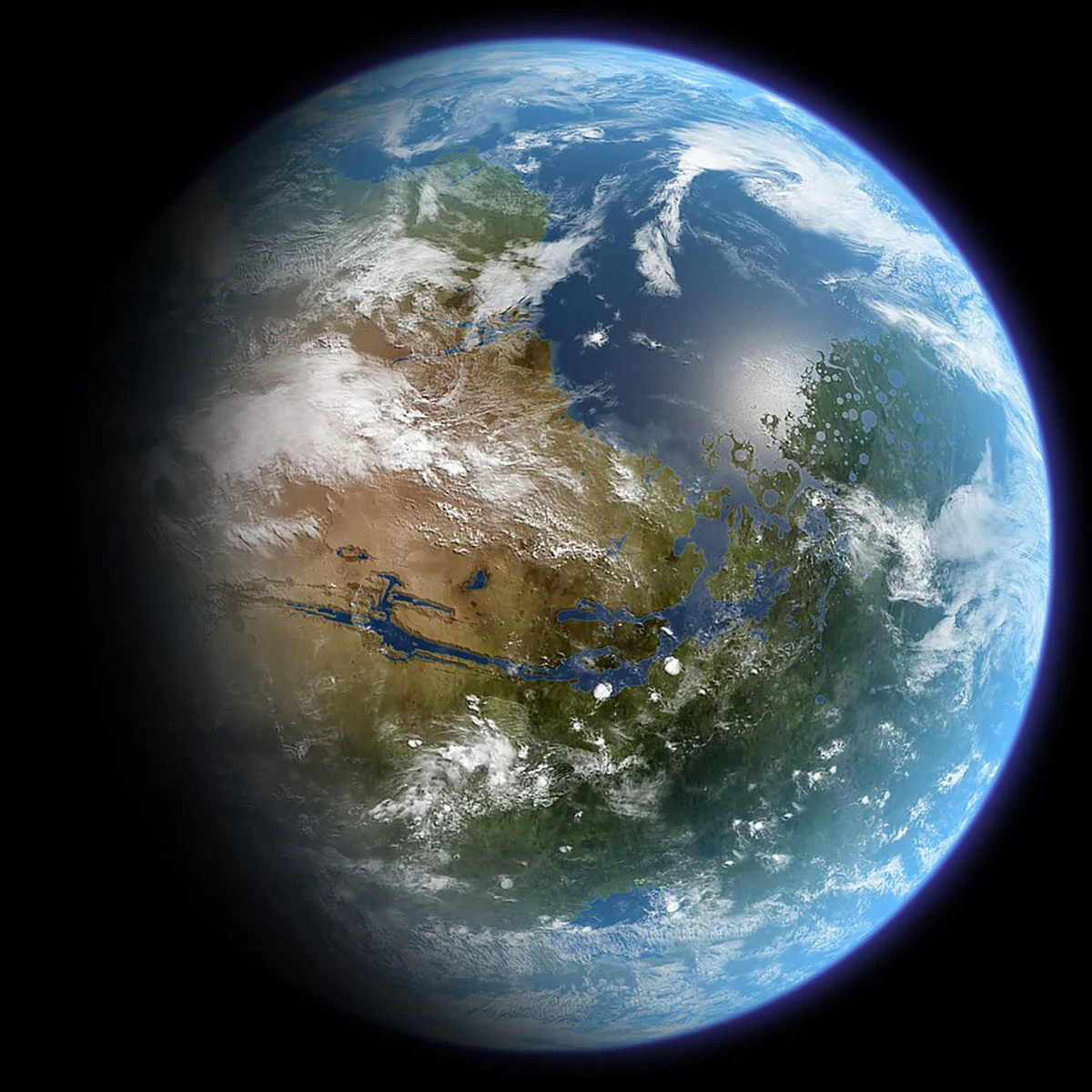
A new study published in APS Open Science by Slava Turyshev, a scientist at NASA's Jet Propulsion Laboratory (JPL), concludes that while terraforming Mars is not theoretically impossible, the scale of the undertaking far exceeds humanity's current technological capabilities.
According to the study, it could take centuries - or even longer - before Mars becomes a world where humans can live under Earth-like conditions.
Five milestones on the road to a habitable Mars
To understand why this goal is so difficult, it is important to first consider the stages Mars would need to pass through.
Today, Mars is an extremely cold world with a very thin atmosphere. Atmospheric pressure is only about 1% of Earth's, making human survival impossible without fully enclosed life-support systems.
The first milestone would be raising atmospheric pressure above the triple point of water - approximately 6.1 millibars at 0°C.
This is the minimum condition under which water can exist simultaneously as a solid, liquid and gas. Reaching this threshold would allow liquid water to exist, at least temporarily under certain conditions.
The next phase would involve constructing massive greenhouse complexes where crops could be grown for agriculture.
This concept, known as paraterraforming, focuses on creating enclosed artificial environments rather than transforming the entire planet from the outset.
If expanded across the planet, these structures could eventually form a giant roof covering much of Mars.
As atmospheric pressure continued to rise to around 62.7 millibars, conditions would become considerably safer. At this level, human blood would no longer boil at normal body temperature while standing on the Martian surface - a minimum requirement for moving closer to genuine habitability.
The final - and by far the most difficult - milestone would be creating a breathable atmosphere containing abundant nitrogen and roughly 210 millibars of oxygen within a total atmospheric pressure of about 500 millibars.
At the same time, the planet's average temperature would also need to rise dramatically above current levels.
The amount of material required is almost beyond imagination
On paper, these objectives may appear achievable over a centuries-long project.
However, when translated into the amount of material that would actually need to be added, the scale becomes astonishing.
Simply increasing atmospheric pressure by one millibar would require approximately 3.89 × 10¹⁵ kilograms of gas.
That is nearly equivalent to the entire mass of Deimos, the smaller of Mars' two natural moons.
Creating a breathable atmosphere would require roughly 10¹⁸ kilograms of gas - comparable to the mass of Janus, an irregular moon orbiting Saturn.
Although hundreds of similarly sized celestial bodies may exist throughout the Solar System, mining, transporting or redirecting one toward Mars remains far beyond today's engineering capabilities.
Warming Mars may be even harder than building its atmosphere
Atmospheric pressure is only half the challenge. Mars would also need to be significantly warmer. According to the study, the planet's average temperature would have to increase by about 60°C for liquid water to remain stable on a global scale.
Scientists have proposed several approaches over the years, including dispersing sunlight-absorbing nanoparticles into the atmosphere, releasing vast quantities of carbon dioxide, or deploying enormous mirrors in space to reflect additional sunlight onto the Martian surface.
Turyshev's calculations, however, indicate that the mirror approach would require a reflective area of approximately 70 million square kilometers - many times larger than Russia and far beyond humanity's industrial manufacturing capacity.
Meanwhile, producing enough oxygen for humans to breathe would require around 8.2 × 10¹⁷ kilograms of oxygen. The most practical method would be extracting oxygen from water through electrolysis.
The encouraging news is that Mars appears to possess enough frozen water. As little as 20% of the confirmed surface ice reserves would be sufficient to generate the required oxygen while still leaving enough water to form future rivers, lakes and perhaps even oceans.
This means extreme proposals, such as directing large numbers of water-rich comets toward Mars, may no longer be necessary, although extracting and processing the planet's own ice would remain an extraordinarily complex undertaking.
Energy remains the greatest obstacle
According to the researchers, the biggest challenge is not materials, but energy.
Producing enough oxygen for a breathable atmosphere would require at least 1.2 × 10²⁵ joules of energy.
Even if this effort were spread evenly across 1,000 years, the system would still need to generate a continuous power output of roughly 380 terawatts.
That is nearly 20 times greater than humanity's current total annual energy consumption.
This represents the single greatest barrier preventing Mars terraforming from moving beyond scientific theory. With today's technology, humanity has no practical way to generate such an enormous amount of energy continuously over many centuries.
Building Martian oases is the more realistic path
Although transforming Mars into a new Earth remains a distant prospect, scientists stress that this does not make current efforts meaningless.
The most realistic objective over the coming decades is to establish self-contained settlements equipped with advanced greenhouses, allowing people to live and produce food inside carefully controlled environments.
The concept closely resembles the vision presented in Kim Stanley Robinson's acclaimed Mars Trilogy science fiction novels.
The author may have underestimated the time and energy such a transformation would require, but the appeal of the Red Planet remains as strong as ever.
With exploration programs being pursued by multiple countries and private companies, Mars is expected to remain one of humanity's most important destinations in the future.
Nevertheless, the new NASA study underscores that turning Mars into an Earth-like world will not be the story of a few decades. Instead, it is likely to become a multi-generational endeavor, achievable only when human civilization develops energy sources and technologies far beyond anything available today.
Photo caption: An artist's illustration showing a fully terraformed Mars. Credit: Daein Ballard/SciTechDaily.
Hai Phong
.svg)
