 Vietnamnet.vn

 Podcast




Legacy systems rarely fail all at once. Their decline is gradual, unfolding until each change feels increasingly risky, every upgrade grows more expensive, and delays become harder to justify. For years, organizations have responded with large, periodic transformation programs - rebuilding or replacing systems every five to ten years, often at considerable cost and disruption.
That model is beginning to shift.
Enterprises are moving toward continuous modernization, upgrading systems incrementally while maintaining ongoing operations. This approach reduces disruption, but it also demands a deeper understanding of how systems behave in real-world conditions.
Artificial intelligence is accelerating this transition. According to Grand View Research, the global AI market is projected to exceed US$1.8 trillion by 2030, while IDC estimates that annual global spending on digital transformation will surpass US$3 trillion in the coming years.
Yet speed does not equate to simplicity.
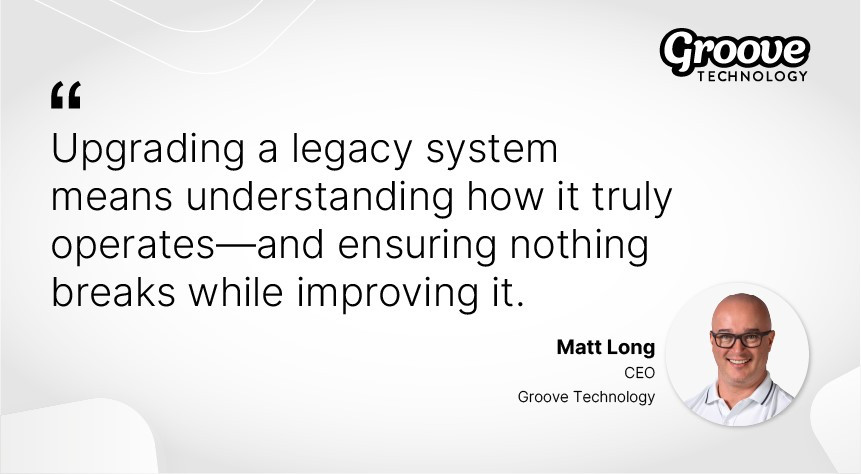
Matt Long, CEO of Groove Technology, points out that successful upgrades begin with a clear understanding of how systems function in practice: “Upgrading a legacy system starts with understanding its real behavior - not just the code, but how it supports daily operations. From there, the focus is ensuring full coverage of existing functions so nothing breaks during the transition. AI helps us speed up analysis and troubleshooting, but responsibility for system stability still rests with experienced engineers.”
The hidden layers inside legacy systems
Legacy systems rarely become problematic simply because they are old. The greater challenge lies in how they evolve over time.
As businesses grow, systems are expanded with new integrations, regulatory updates, and features. Quick fixes are introduced to meet immediate demands, while documentation gradually becomes outdated. As teams change, institutional knowledge fragments.
What begins as a structured platform can evolve into a layered and opaque environment, where dependencies are difficult to trace and risks are not immediately visible.
Modernization efforts tend to expose these hidden layers.
AI is helping engineering teams analyze such systems more effectively. It can scan large codebases, map dependencies, identify outdated frameworks, and highlight areas where upgrades may introduce instability.
However, these technical insights often lead to broader business decisions.
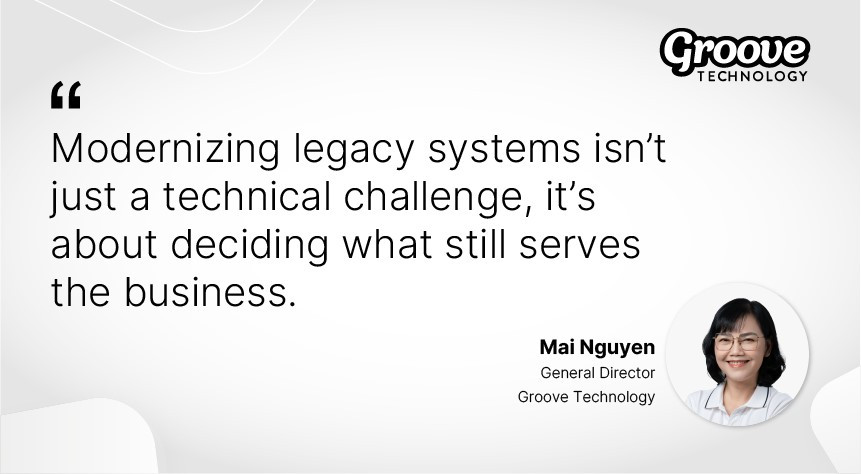
Mai Nguyen, General Director at Groove Technology, notes: “When organizations begin modernizing legacy systems, they often discover that the challenge is not purely technical. Once the system becomes more transparent, teams must decide which behaviors still support the business and which should be redesigned.”
Modernization, in this sense, becomes both a technical exercise and a strategic reassessment.
AI speeds up analysis - not decision making
One of AI’s most immediate contributions to enterprise upgrades is the speed it brings to analysis.
Tasks that once required days - reviewing upgrade documentation, interpreting compatibility notes, identifying breaking changes - can now be completed in minutes. Developers gain faster insight into differences between framework versions and can anticipate potential conflicts earlier in the process.
In a recent legacy upgrade project undertaken by Groove Technology engineers, a front-end framework that had not been updated for seven years presented a significant challenge. The system consisted of approximately 1,500 files, with more than 60 percent requiring modification to support the newer version.
AI assisted in gathering relevant documentation and flagging compatibility risks. However, defining the upgrade path - including how to sequence changes and manage associated risks - remained firmly in human hands.
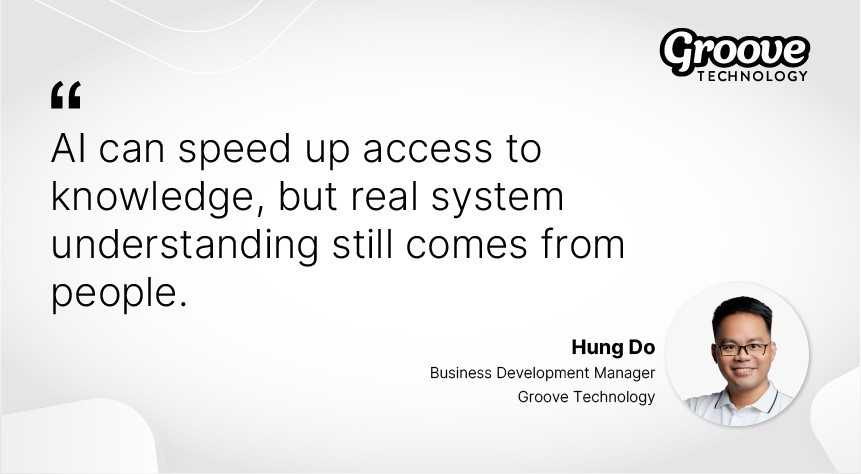
Hung Do, Business Development Manager at Groove Technology, explains: “AI enables faster access to technical knowledge, but it does not understand how systems are used in day-to-day operations. That context comes from engineers, end-users, and stakeholders who work with the platform.”
In practice, AI enhances visibility. Decision-making, however, continues to rely on experience and judgment.
Where AI makes a tangible impact
During the execution phase, AI proves particularly valuable as a troubleshooting tool.
As developers transition between framework versions, they encounter issues ranging from deprecated APIs and syntax changes to build failures and runtime conflicts. Instead of navigating multiple sources of documentation, engineers can use AI to analyze error messages and generate potential solutions in context.
In the project referenced earlier, approximately 70 percent of AI-generated solutions resolved issues immediately, while a further 20 percent required minor adjustments before implementation.
Although not flawless, the efficiency gains were substantial. Automation accelerates progress, but experienced oversight remains essential to ensure accuracy and stability.
Understanding hidden business logic
A critical challenge in upgrading legacy systems lies in uncovering embedded business logic.
Enterprise applications often contain deeply embedded rules - calculations, validations, and workflow exceptions - that are poorly documented or entirely undocumented. Altering or removing these elements without proper understanding can disrupt core operations.
AI has shown considerable value in helping engineers interpret such code.
By analyzing extensive sections of source code, AI tools can summarize logic flows and identify conditions that may represent important business rules. Engineers can then review these insights before making changes.
This capability reduces the likelihood of unintentionally breaking essential functionality during modernization.
Context and documentation remain essential
Despite its analytical strength, AI is highly dependent on context.
In environments where documentation is incomplete or inconsistent, AI-generated outputs become less reliable. The effectiveness of AI in modernization projects is therefore closely tied to the quality of system documentation.
In the upgrade project described, the development team maintained detailed records at every stage - covering version changes, architectural decisions, and technical adjustments.
These records improved collaboration and provided the context needed to use AI tools more effectively. In modern engineering environments, managing system knowledge is becoming as critical as writing code.
Supporting enterprises through AI-assisted modernization
As continuous modernization gains traction, many organizations are turning to experienced development partners to manage complex upgrades with minimal disruption.
Groove Technology, founded by Matt Long, operates engineering teams in Vietnam and supports enterprises across multiple industries. The company focuses on modernizing legacy systems while maintaining operational continuity.
Its services include legacy system assessment and modernization planning, cloud migration and scalable architecture design, secure authentication and compliance integration, AI-assisted code analysis and troubleshooting, and custom enterprise software development.
Rather than positioning AI as a standalone solution, the company integrates it into structured engineering processes designed to reduce risk and support long-term system stability.
A more realistic view of AI in enterprise systems
AI is not simplifying enterprise systems. It is making their complexity visible.
It exposes hidden dependencies, surfaces inconsistencies, and accelerates decisions that organizations have long deferred.
The competitive advantage will not necessarily belong to those who adopt AI most quickly, but to those who understand their systems well enough to apply it effectively.
While AI can accelerate modernization, its success ultimately depends on human expertise.
Visit our website: https://groovetechnology.com/
PV
.svg)
