 Vietnamnet.vn

 Podcast



Vietnam recorded approximately 12,200 new thyroid cancer cases and nearly 750 deaths in 2024, placing the disease among the country's 10 most common cancers. Among women, thyroid cancer ranked second only to breast cancer in new diagnoses, with more than 10,000 cases.
The figures were presented by Dr. Do Duc Linh, Director of the Diagnostic Imaging and Interventional Center at Hanoi General Hospital, during a seminar titled "Proactively Protecting Women's Health - Updates on the Diagnosis and Treatment of Breast and Thyroid Diseases," co-organized by Vietnam Family Magazine on October 16.
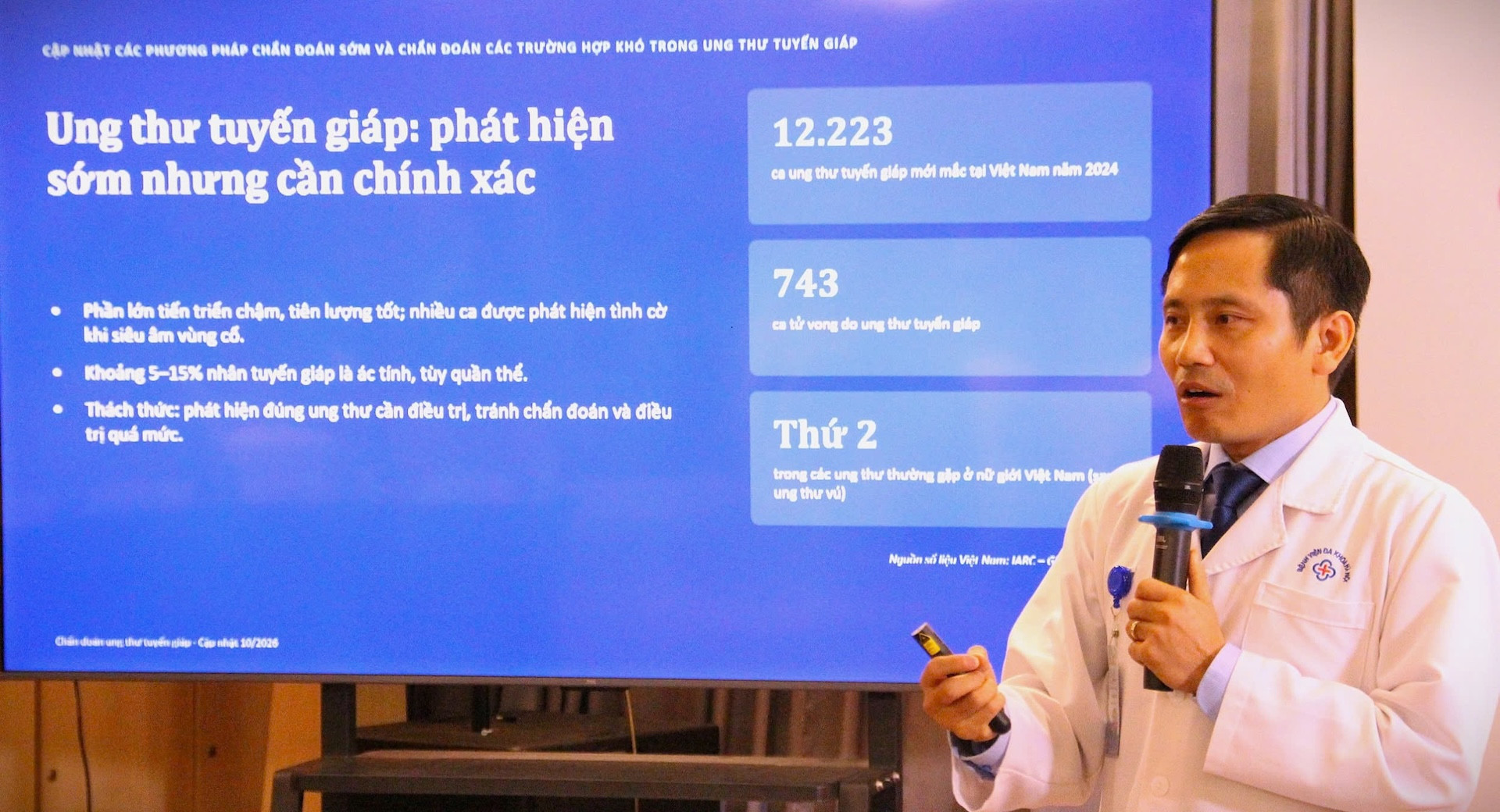
Research data indicate a rapid increase in thyroid cancer diagnoses in Vietnam, with the disease climbing from ninth to sixth place in cancer incidence rankings, making it one of the fastest-rising cancers in the country.
Earlier, GLOBOCAN 2022 estimated approximately 6,100 new thyroid cancer cases and more than 850 deaths in Vietnam.
The gender gap has also widened. While women were previously twice as likely as men to be diagnosed with thyroid cancer, the reported ratio has now risen to three or four women for every man.
Experts believe the increase in reported cases is largely attributable to improved detection rather than a genuine rise in the underlying occurrence of the disease.
Thyroid cancer is most common among people aged 40 to 70, although diagnoses are increasingly being reported in younger age groups.
Unlike liver, lung or stomach cancer, thyroid cancer has several distinctive characteristics. It generally progresses slowly, and despite the sharp increase in diagnoses, mortality remains relatively low.
It also has one of the most favorable prognoses among cancers, with a five-year survival rate exceeding 90% when detected early.
Warning signs that warrant medical attention
Doctors advise people with a history of radiotherapy or radiation exposure involving the head and neck, particularly during childhood, to inform their physicians during medical examinations.
A family history of thyroid cancer or certain associated inherited syndromes is also important information to share with healthcare professionals.
People who have been diagnosed with thyroid nodules should undergo monitoring as recommended by their doctors.
Most thyroid nodules are benign. The presence of a nodule, its size or how long it has existed is not enough to establish a cancer diagnosis. Nor should patients assume that a benign nodule will inevitably become malignant over time.
Warning signs that warrant medical assessment include a new lump or nodule in the neck, palpable swollen lymph nodes, difficulty or discomfort when swallowing, a sensation of pressure in the neck, or persistent unexplained hoarseness.
Doctors note that hoarseness can have many causes. In patients with thyroid conditions, it requires careful evaluation but does not automatically indicate advanced cancer.
As a simple self-observation technique, doctors suggest standing in front of a mirror, tilting the head slightly backward and swallowing a sip of water while watching for any visible lump or asymmetry in the neck.
Sometimes, changes in the neck are first noticed by another person.
However, this visual check can only help identify certain external abnormalities. It cannot determine whether a thyroid lesion is benign or malignant.
Vo Thu
.svg)
