 Vietnamnet.vn

 Podcast



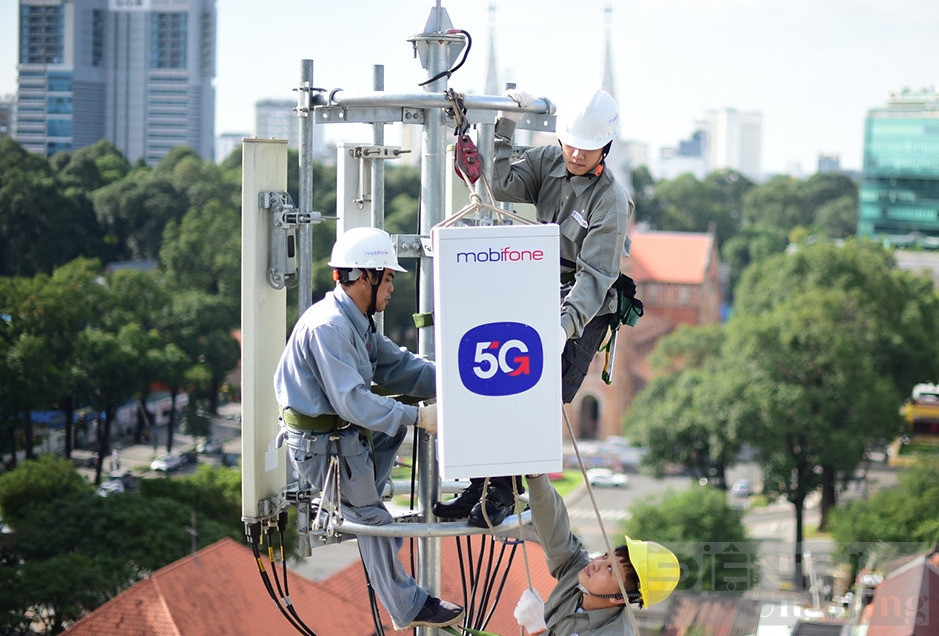
5G networks are seen as a crucial digital foundation for the ongoing fourth industrial revolution worldwide. Recognizing this importance, Vietnam has taken initial steps in commercializing 5G.
In 2024, the Ministry of Information and Communications (now the Ministry of Science and Technology - MST) auctioned and licensed 100MHz of the 2600MHz band to Viettel and two C-band blocks (3700-3800 MHz and 3800-3900 MHz) to major operators VNPT and MobiFone.
These are important steps, laying the initial foundation for widespread 5G deployment.
Just over a year after licensing 5G frequencies to operators, Vietnam's 5G speed and quality have achieved outstanding results, placing it among countries with high download speeds.
The latest Speedtest Intelligence report from Ookla showed that as of August 2025, Vietnam ranked 16th globally in mobile download speeds, averaging 150-200 Mbps.
However, compared to top nations like the United Arab Emirates (UAE), Kuwait, Qatar, and South Korea, where speeds reach 400-600 Mbps, Vietnam still needs further efforts to improve 5G speeds.
Experts say that to achieve 400-600 Mbps 5G speeds like Kuwait, Qatar, and South Korea, part of 180MHz of the remaining national C-band spectrum (3600-3700 MHz and 3900–3980 MHz), a precious resource, needs to be utilized.
Amid booming data demand and global competition in digital transformation, activating this 180MHz is not just a technical issue, but atrace strategic requirement to deploy 5G advanced (featuring ultra-high speed, extremely low latency under 1ms, massive-scale IoT support, and deep AI/ML integration), helping fuel digital economic growth.
Analysts point out that the fundamental difference between countries isn’t the technology, but the bandwidth allocated to carriers. A 100MHz bandwidth is a good starting point, but it's not enough for a breakthrough in speed and capacity, especially when compared to global competitors. To reach the top, expanding bandwidth and deploying 5G advanced is the only path.
How are countries using spectrum for 5G?
The common trait of the nations deploying 5G is that leading operators in 5G quality hold wide spectrum. Top US, Arab, and South Korean operators possess over 200MHz of 5G bandwidth, such as T-Mobile (US) with over 200MHz in mid-band (including C-band), holding outstanding advantages in speed and coverage.
SK Telecom (South Korea), a global 5G pioneer, holds large contiguous bands. European and Middle Eastern operators have at least 100MHz, aiming for 200MHz to ensure competitiveness.
In Vietnam, economic growth is accelerating (7.1 percent in 2024 with a target of double digits in 2025), and the number of people owning 5G phones is growing rapidly. Most young people, students, and early-career professionals already own at least one 5G device.
However, network performance in crowded areas is still underwhelming at events such as those at My Dinh Stadium, Dong Anh Exhibition Center, or Hoan Kiem Lake. Adding another 100MHz of 5G spectrum would be a strategic step which allows carriers to scale total bandwidth up to 200MHz.
This will not only significantly improve speed and capacity for current users but also lay a strong foundation for advanced 5G services, boosting competitiveness and opening up new revenue streams.
Clear benefits
The most immediate benefit is a doubling of download and upload speeds. Theoretically, doubling bandwidth from 100MHz to 200MHz can also double the maximum user speed. This means activities like downloading 4K/8K videos, high-graphics gaming, or high-quality video conferencing will become much faster and smoother.
With 200MHz of total bandwidth, carriers can support far more users in the same area without affecting individual speeds. This is especially critical in high-density locations such as city centers, stadiums, shopping malls, or large-scale events. Additional spectrum will effectively resolve network congestion, ensure stable connectivity, improve service quality, and enhance user experience.
Another key benefit is greater connection stability. Users will experience fewer speed drops, resulting in a seamless and more reliable connection.
Opening doors to new services and driving economic growth
Experts say wider bandwidth is not just for individual users, but also provides a platform for carriers to deploy advanced 5G services for businesses and industries. These include network slicing to flexibly allocate resources for specific services, allowing users to access specialized services with guaranteed quality.
It also enables high-speed broadband access for homes and businesses via 5G FWA (Fixed Wireless Access), especially useful in areas where fiber infrastructure is difficult to deploy.
Thai Khang
.svg)
