 Vietnamnet.vn

 Podcast



As one of Hanoi's main, vital roads, Tran Duy Hung street, 60m wide, with two-way traffic, about 7m wide sidewalks, is quite spacious. It hosts numerous banks, high-end fashion stores, restaurant chains, and office buildings.
This street was once likened to a “guesthouse street” due to the high concentration of lodging facilities in its alleys. This partially helps keep land prices consistently high.
According to the official land price framework, frontage locations on the main street exceed VND100 million per sqm, while alleys 3-5 meters wide are priced around VND72 million per sqm. However, actual transaction prices are often double that due to limited supply and steady demand for properties on main roads, especially as central land becomes increasingly scarce.
Market surveys in the area indicate that properties on Tran Duy Hung street belong to the ultra-luxury segment thanks to their prime business potential, wide sidewalks, and central location. Common prices range from VND350 million to VND750 million per sqm.
For well-located land, or “golden” plots as called by Hanoians, with large areas, wide frontages, or strong potential for office or serviced apartment development, asking prices can hit or exceed VND1 billion per sqm. Typical main street properties, sized 60-100 sqm and built 6-8 stories high, are usually priced from VND30 billion to VND55 billion or more, depending on location and construction quality.
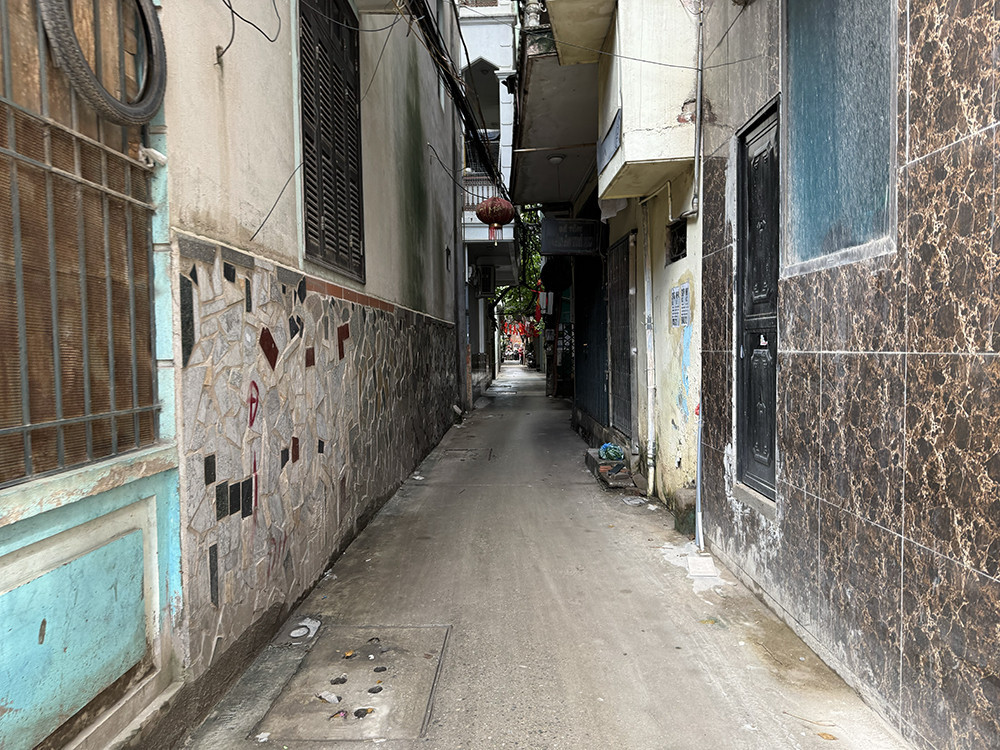
Meanwhile, houses located in alleys are more “affordable” but still expensive compared to surrounding areas. Properties in car-accessible alleys or alleys suitable for business are traded at VND250-450 million per sqm, equivalent to VND16-25 billion for plots of 40-70 sqm.
Properties deeper inside smaller alleys or in motorbike-access alleys are priced lower, from VND200 million to VND350 million per sqm, equivalent to VND8-15 billion for areas of 35-55 sqm.
End of the ‘guesthouse street’ era
Tuan, a long-time real estate broker in the area, said he is currently seeking a buyer for a newly built 5-story building with a red book (land use right certificate) area of 220 sqm, designed to modern office standards. The asking price is VND220 billion, equivalent to around VND1 billion per sqm. According to him, the building can generate rental revenue of VND900 million to over VND1.2 billion per month.
“With high rental yields, many investors are willing to spend big on rare main street properties like this,” Tuan said.
Tuan revealed that he has quite a few alley properties listed. For example, a 35 sqm in floor area, 5-story house, about 40 meters from the main road is being offered at VND9.8 billion, suitable for young families wanting to live near the center. Another property in a car-accessible alley, 48 sqm, 6 stories, with two alley frontages, is listed at VND22.5 billion, equivalent to VND450 million per sqm. A 59 sqm, 6-story property in a wide car alley is being sold for VND23 billion, or VND383 million per sqm.
According to brokers, Tran Duy Hung’s alley properties still hold strong appeal thanks to their “near-street” location, developed infrastructure, high population education levels, and flexible usability - for living, doing business, or renting out. Urban infrastructure development is said to be driving prices up by 10-15 percent annually, especially after the expansions of nearby roads, such as Nguyen Chanh, Trung Kinh, and Pham Hung.
Tuan believes the VND1 billion per sqm price is only seen at extremely prime locations with strong profit potential. Most actual transactions are still in the VND400-700 million per sqm range. Prices over VND1 billion per sqm are largely symbolic, reflecting commercial value rather than residential worth.
One notable change is the gradual disappearance of the “motel street” label that has stuck with Tran Duy Hung for over a decade. Many former mini hotels and motels have been renovated or repurposed into homestays, short-term rental apartments, or small office spaces.
One notable change is the gradual disappearance of the “guesthouse street” label that has stuck with Tran Duy Hung for over a decade. Many former mini hotels and motels have been renovated or repurposed into homestays, short-term rental apartments, or small office spaces.
Le Hong Hanh, the owner of a former guesthouse on the street, said: “Five to seven years ago, there were lots of short-stay guests, but that number has dropped significantly, especially after the COVID-19 pandemic. Instead of short-term rentals, we’ve shifted to the serviced apartment model for more stable income.”
Hong Khanh
.svg)
