 Vietnamnet.vn

 Podcast



After millions of years of geological tectonics, nature has endowed Ninh Binh with a magnificent natural wonder of green mountains and blue water. It is the Trang An Scenic Landscape Complex.
A beautiful landscape
Trang An Scenic Landscape Complex covers an area of 10,000ha in Hoa Lu,
Gia Vien and Nho Quan Districts and Ninh Binh City. It includes the
Trang An Eco-tourist Site, Tam Coc- Bich Dong Landscape and Hoa Lu
Ancient Citadel.
From the Trang An wharf we took a boat ride to visit a complex of 51
grottos which is called a “Ha Long Bay on land”. On both sides of the
river there are mountain ranges. Sometimes drops from a light rain fell
on the clear, blue water, making the scene more beautiful.
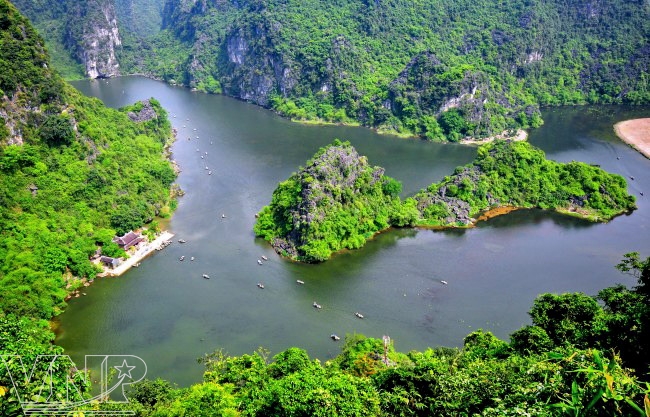 A part of the Trang An Scenic Landscape Complex. Photo: Trang An’s Management Board 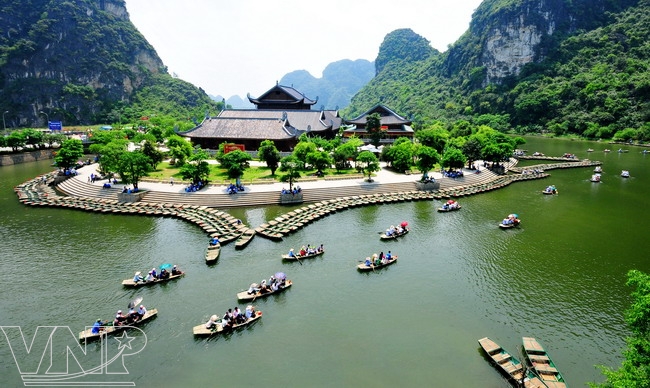 Trang An Ferry Wharf. Photo: Trang An's Management Board 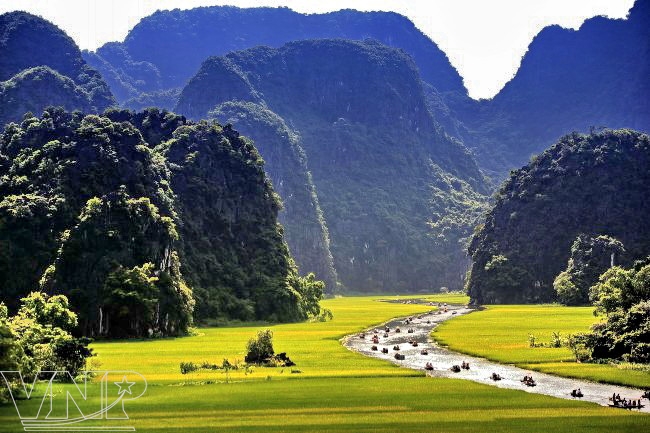 Yellow rice fields on the way to Tam Coc - Bich Dong Landscape. Photo: Dinh Cong Hoan 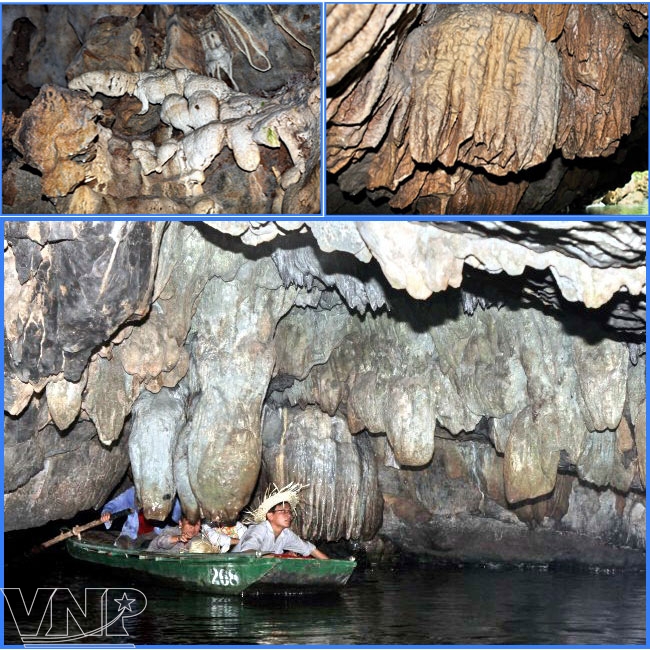 After millions of years of geological tectonics, nature has created primitive caves with wonderful stalactites. Photo: Cong Dat 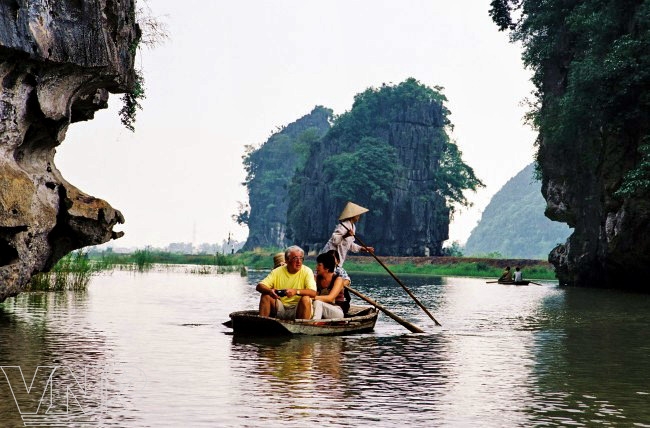 A mountain in the shape of an eagle’s beak on the way to Tam Coc - Bich Dong Landscape. Photo: Trang Linh |
Our boat passed through the Toi (dark), Sang (bright), Seo and Nau Ruou
(wine-making) Grottos to reach Ba Giot (three drops) Grotto. Inside the
caves the stalactites and stalagmites have diverse shapes which
stimulate the imaginations of visitors.
According to researchers, Trang An area was formerly the “Hoa Lu ancient
bay”. After 250 million years, limestone mountains with characteristics
of karst tectonics have been formed here. They are weathered limestone
mountains eroded by water. In addition, the ancient Vietnamese built
dykes to prevent floods and the encroachment of the sea, giving this
area the appearance it has today.
The traces in the “core area” show the researchers’ evaluations are
completely reasonable. Although the sea receded a very long time ago,
there are still sink holes and karst islands with imprints of the sea at
the foot of the limestone mountains. That may be the reason why experts
consider Trang An an “outdoor geological museum”.
During our trip, we were lucky to meet a team of experts from the
Vietnam Institute of Archaeology who were doing scientific research at
Trang An Eco-tourist Site. We followed the experts to visit the Moi and
Sinh Caves and the watery areas of Binh 1, 2 and 3. In these caves,
traces of the sea are clearly seen in the layers of freshwater or sea
mollusk shells. There are also many relics, such as animal remains,
kitchens, tombs, human remains and working tools made of stone, bones
and ceramics. These show that Trang An might have been the home of
Vietnamese people about 10,000-20,000 years ago.
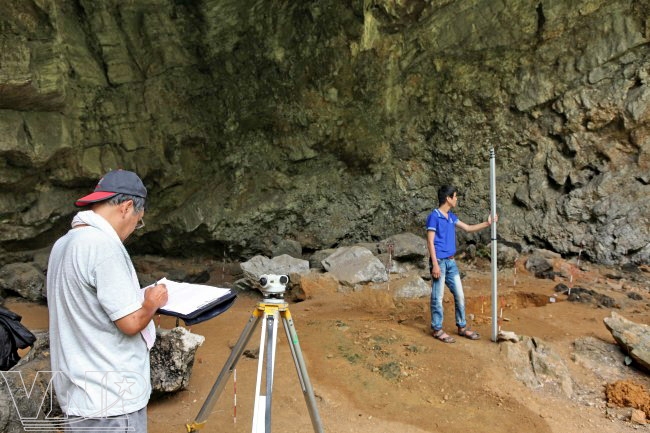 A delegation of researchers conducts a survey in Sinh Cave, one of the new caves in Trang An. Photo: Cong Dat 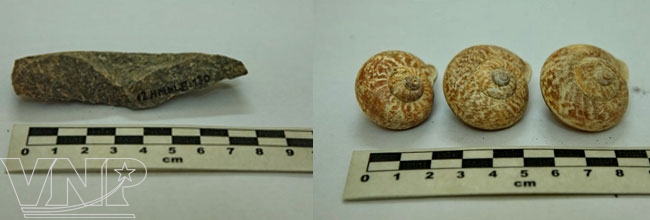 Some of the specimens excavated from new caves in Trang An. Photo: Cong Dat 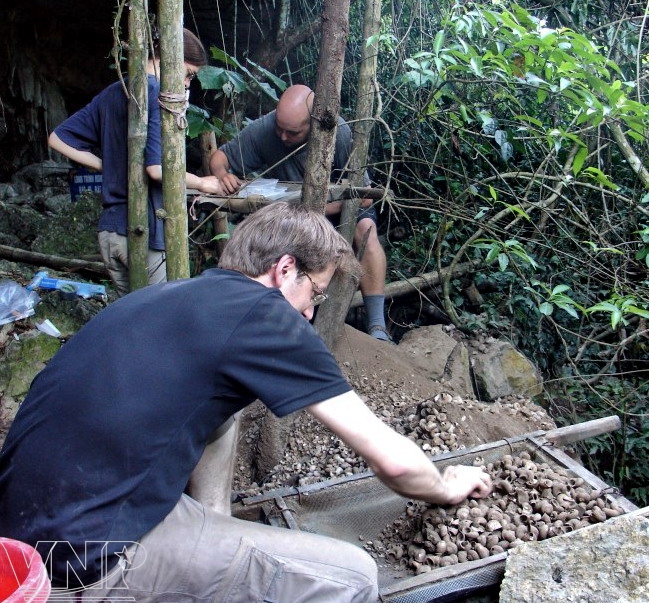 Experts from the University of Cambridge (UK) survey one of the new caves in Trang An. Photo: Trang An's Management Board |
According to Associate Professor, Dr. Nguyen Khac Su at the Vietnam
Institute of Archaeology, the excavated archaeological relics have
created the unique features of the prehistoric caves in Trang An.
Dr. Ryan Rabett from the McDonald Institute for Archaeological Research
of the University of Cambridge (UK) who had similar ideas as Prof. Su,
said: “Trang An is a very unique example of human history, not only for
Vietnam but also for the region. It has a combination of both natural
and cultural values.”
After visiting the caves we continued our journey to Tam Coc-Bich Dong
Landscape which is considered “Vietnam’s second nicest grotto”. During
summer days in June, Tam Coc-Bich Dong area seemed more beautiful with
its yellow rice fields at the foot of the limestone mountains. While
sitting in a boat that ran along the Ngo Dong River we enjoyed the
mountain scenery. Boats loaded with yellow rice ran up and down the
river.
At Tam Coc-Bich Dong area there is Thai Vi Temple which is famous at
home and abroad. The temple has unique architecture with all of its big
and tall columns made of green monolith. In front of the temple there is
a well built with green stone. The old bell in the yard was cast in the
19th Chinh Hoa year (1689). Bich Dong Pagoda on Truong Yen limestone
mountains is an ancient pagoda of oriental style. Looking down from this
pagoda people can see the boundless beauty that nature has bestowed on
the area.
A thousand-year-old ancient capital
To visit the ancient capital of Hoa Lu we returned to Trang An
Eco-tourist Site. Near the wharf of the tourist site there is Trinh
Temple honoring two mandarins who were credited with safeguarding this
area. We also visited Khong Temple which is also called Cay Thi
(persimmon tree) Temple because there are two ancient persimmon trees
with two types of fruit, round and flat. The temple honors seven loyal
mandarins of the court (968-980).
Situated on a high mountain, Tran Temple is known as a very sacred
ancient temple. The way to the temple is long and steep but the more
people go up the more they are interested in the beautiful scenery and
feel comfortable in the fresh and cool air. Legend has it that the
temple was built by King Dinh Tien Hoang during the time the Hung Kings’
Temple was built in Phu Tho. Later, King Tran Thai Tong (1218 –1277)
came to this area to establish Vu Lam royal step-over place and improved
the temple, hence the temple was called Tran Temple. It honors the Quy
Minh Genie who defended the southern gate of Hoa Lu Capital. Every year,
on the 18th of March according to the lunar calendar, many visitors
from all parts of the country come to attend the Tran Temple festival
and visit Trang An area. More than 10 centuries have passed but the
images of dragons, unicorns, tortoises and a phoenix delicately carved
on the stone pillars of the temple are still intact.
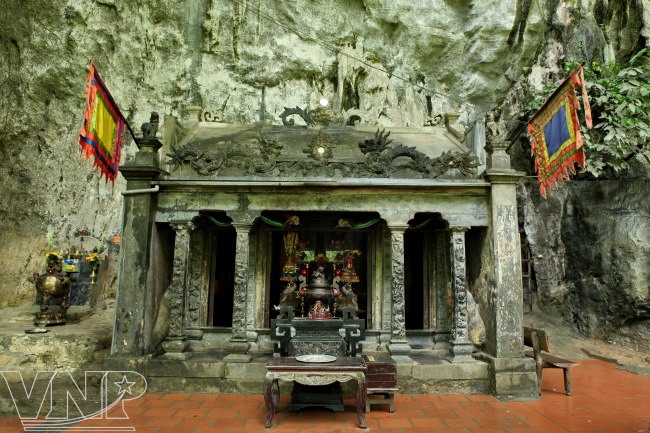 Noi Lam or Tran Temple. Photo: Cong Dat 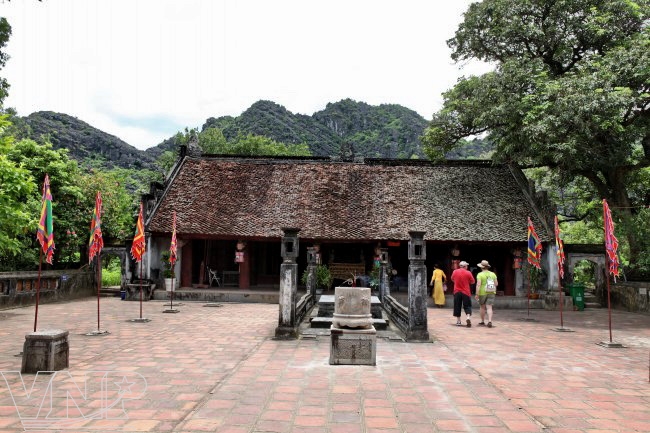 The dragon yard at King Le’s Temple in the relic complex of the ancient capital of Hoa Lu. Photo: Cong Dat 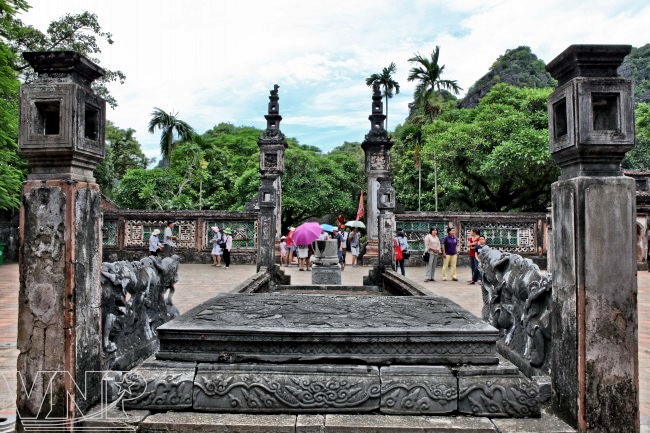 The dragon yard at King Dinh Tien Hoang’s Temple in the relic complex of the Ancient Capital of Hoa Lu. Photo: Cong Dat 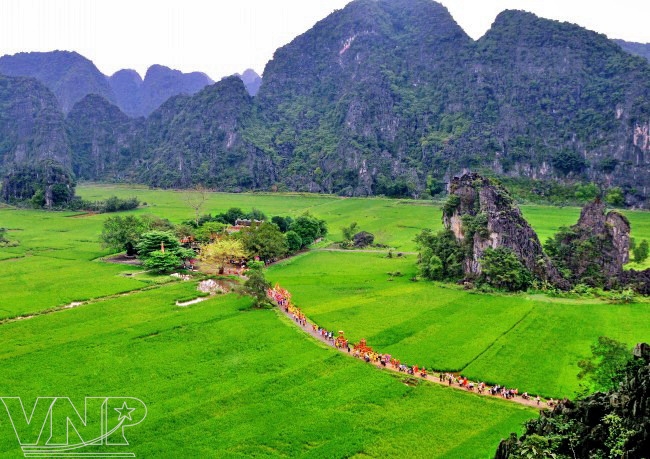 The Thai Vi Temple Festival in the ancient capital of Hoa Lu. Photo: Duong Duy Khang 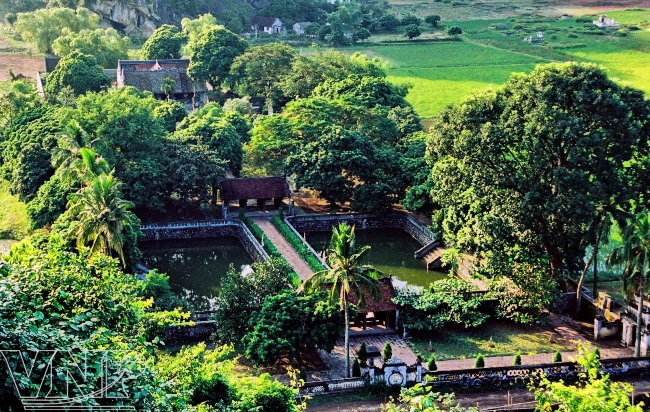 Dinh and Le Kings’ Temple seen from the Truong Yen Mountain. Photo: Trang Linh 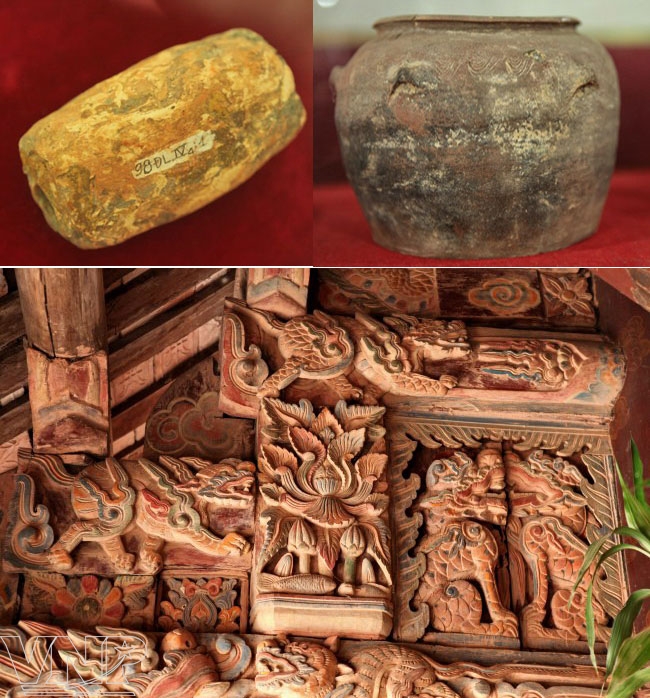 Some of patterns and specimens are found in the relic complex of Hoa Lu. Photo: Cong Dat 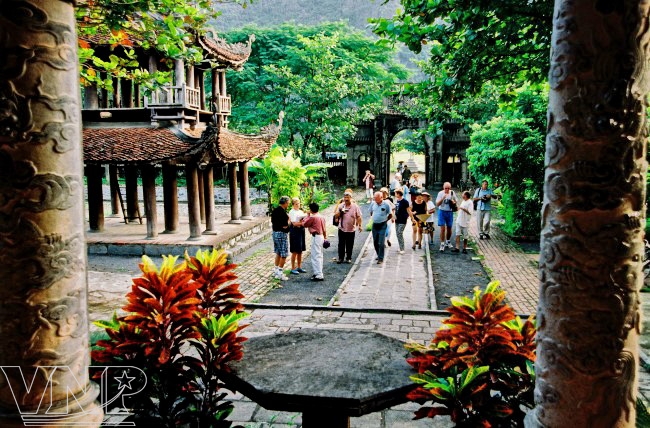 Spanish tourists visit Thai Vi Temple. Photo: Trang Linh 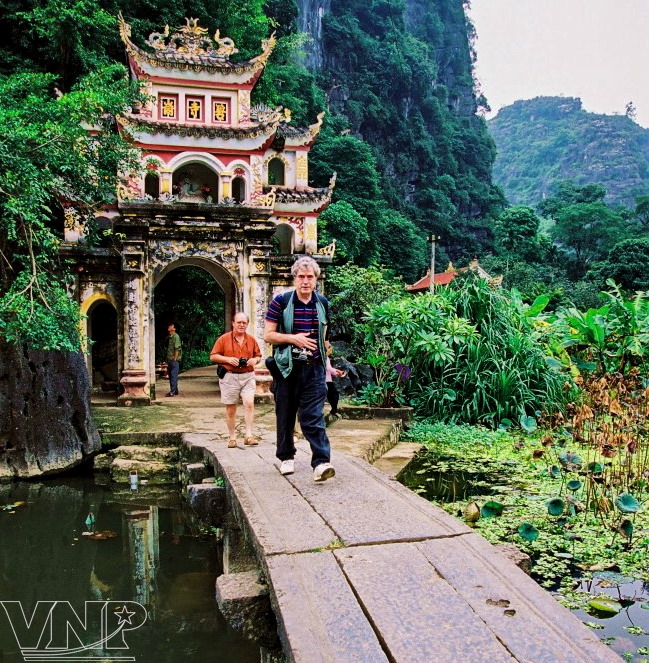 Bich Dong, a beautiful landscape, attracts a large number of tourists. Photo: Trang Linh |
Historians say that Trang An is associated with the historical and
cultural values of the ancient capital of Hoa Lu. According to old
historical books, in 968, after defeating twelve armies of aggressors
and unifying the country, Dinh Tien Hoang became a king. He set up the
capital in Hoa Lu and named the country Dai Co Viet. From 968 to 1009,
six kings of the Dinh, Le and Ly Dynasties set up the capital there. In
1010, King Ly Thai To moved the capital from Hoa Lu (Ninh Binh) to Thang
Long (Hanoi). Since then Hoa Lu has remained the ancient capital.
Dao Thi My Dung, a tourist guide of the ancient capital of Hoa Lu
tourist site led us to visit the architectural structures of the
dynasties of Dinh and Le kings. These places still preserve many
historical imprints showing the golden era of the nation that built the
capital and protected the independence and sovereignty of the nation
over a thousand years ago.
Every year, from the 6th - 8th of March according to the lunar calendar,
the residents in Ninh Binh Province organize the festival of the
ancient capital of Hoa Lu to commemorate Kings Dinh Tien Hoang and Le
Dai Hanh. Recently, Hoa Lu has been recognized as a special national
relic by the Government. With the approval of the Government, Ninh Binh
Province is preparing a file to submit to UNESCO for its recognition of
Trang An as a World Natural Heritage.
Talking with us, Nguyen Cao Tan, Deputy Director of the Management Board
of the Trang An Scenic Landscape Complex said that the data on the
values of the landscape, geology, geomorphology, relics, cultures and
activities of the people which were collected in Trang An from March
2012 to May 2012 has been highly appreciated by New Zealander expert
Paul Dingwall. The management board will continue coordinating with the
Vietnam Institute of Archaeology, the Vietnam Institute of Geosciences
and Mineral Resources and the Tradition and Development Research
Institute to collect more data to send to domestic and foreign experts
for their consultancy. Then they will select the outstanding criteria to
complete the file to submit to UNESCO in September 2012.
They will also promote activities to call on international organizations
and diplomatic missions to support and assist Ninh Binh Province during
UNESCO’s consideration process to recognize Trang An as a world
heritage site.
.svg)
