 Vietnamnet.vn

 Podcast



At FLC Group's extraordinary shareholders' meeting held in Hanoi on May 27, shareholders approved several major resolutions, including the election of a new board and strategic directions for the next phase of development. Notably, Trinh Van Quyet, the founding chairman of FLC Group, was absent from the newly elected Board of Directors.
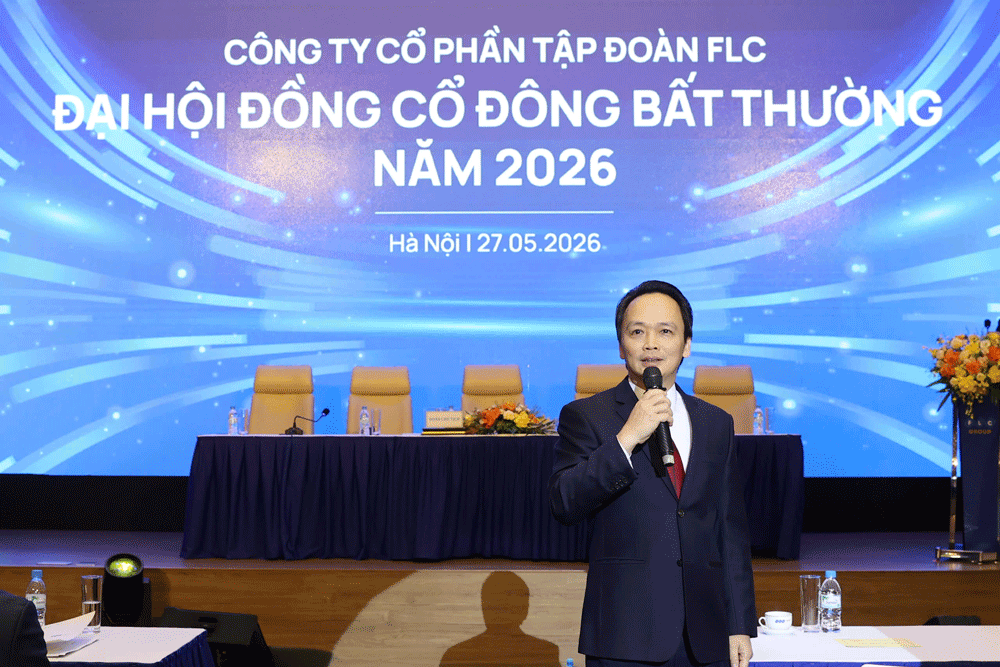
According to company executives, FLC plans to transition to a holding company structure to strengthen capital management and enhance connections among its real estate, hospitality, aviation and service businesses. Under the proposed structure, Trinh Van Quyet is expected to appear at the top of the holding ecosystem, owning FLC and its member companies.
A holding company primarily owns shares and exercises control over other businesses rather than directly engaging in production or commercial activities. This structure allows the parent company to oversee strategy, allocate capital and manage an ecosystem through subsidiaries that operate with a degree of independence.
Following Quyet's re-emergence, the shift toward a holding structure is widely viewed as an effort to rebuild the FLC ecosystem. The model could help the group restructure debt, classify assets more effectively, isolate risks and attract new partners. If one business segment encounters difficulties, other companies within the system would be less exposed to knock-on effects.
FLC is far from the first Vietnamese enterprise to pursue this approach. Over the past decade, many of the country's largest private corporations have adopted holding structures or operated in practice as diversified holding groups.
Major private conglomerates such as Vingroup, Masan, Sovico, T&T and BRG have all developed under holding company frameworks or similar organizational structures.
Vingroup, led by billionaire Pham Nhat Vuong, has built an ecosystem centered on businesses such as VinFast, Vinhomes, Vinpearl, Vinmec and Vinschool. More recently, the group has expanded into new ventures including VinEnergo, VinMetal, VinSpace and VinSpeed.
Masan, associated with billionaire Nguyen Dang Quang, has also grown through a holding structure spanning consumer goods, retail, food and financial services. Sovico Group, linked to Nguyen Thi Phuong Thao, has built an ecosystem around HDBank and Vietjet Air. T&T Group connects businesses including SHB, SHB Finance and a wide range of infrastructure and energy projects.
BRG Group, Geleximco, Sun Group and Thaiholdings have likewise adopted similar structures.
The strengths and weaknesses of the holding model
The greatest attraction of the holding model lies in its ability to manage capital efficiently while separating risks. A parent company can own shares, appoint executives and control strategic direction without directly running every business operation. Separating business segments into independent companies also makes divestments, initial public offerings and fundraising easier.
For Vingroup, the holding structure has enabled rapid expansion into electric vehicles, technology, healthcare, education, energy and infrastructure. Masan has used the model to connect manufacturing with retail operations and build an integrated consumer ecosystem. Sovico Group employs a holding framework to link finance, aviation, real estate and energy businesses, creating synergies across its portfolio.
For FLC, the model could provide a pathway to recovery after a prolonged crisis. Separating real estate, resort and aviation operations into independent legal entities may improve financial oversight and reduce pressure on the broader system. At the same time, Trinh Van Quyet's role is expected to focus more on strategic planning than on direct management as in the past.
Globally, holding companies have flourished for decades in the United States, Japan, South Korea and Europe. Notable examples include Berkshire Hathaway of Warren Buffett, Samsung of South Korea, Japan's SoftBank and India's Tata Group. During periods of industrial expansion, these structures enabled companies to raise substantial capital, diversify operations and build integrated business ecosystems.
However, holding companies also carry risks. In South Korea, chaebols have long faced criticism over complex cross-ownership structures and excessive concentration of family power. Following the 1997 Asian financial crisis, many countries tightened corporate governance requirements and imposed stricter financial transparency standards.
Today, a new trend toward "lean holding companies" is emerging, with greater focus on core businesses rather than expansion across too many sectors. Large groups increasingly prioritize technology, artificial intelligence, data, green energy and digital finance. Many modern holding companies now function more like strategic investment platforms than traditional management organizations.
In Vietnam, the shift toward holding structures is expected to continue as companies seek larger scale, international capital and more professional governance systems. Yet global experience suggests that success depends not merely on establishing a parent company, but on maintaining financial transparency, modern management practices and effective risk control throughout the corporate ecosystem.
Manh Ha
.svg)
