 Vietnamnet.vn

 Podcast



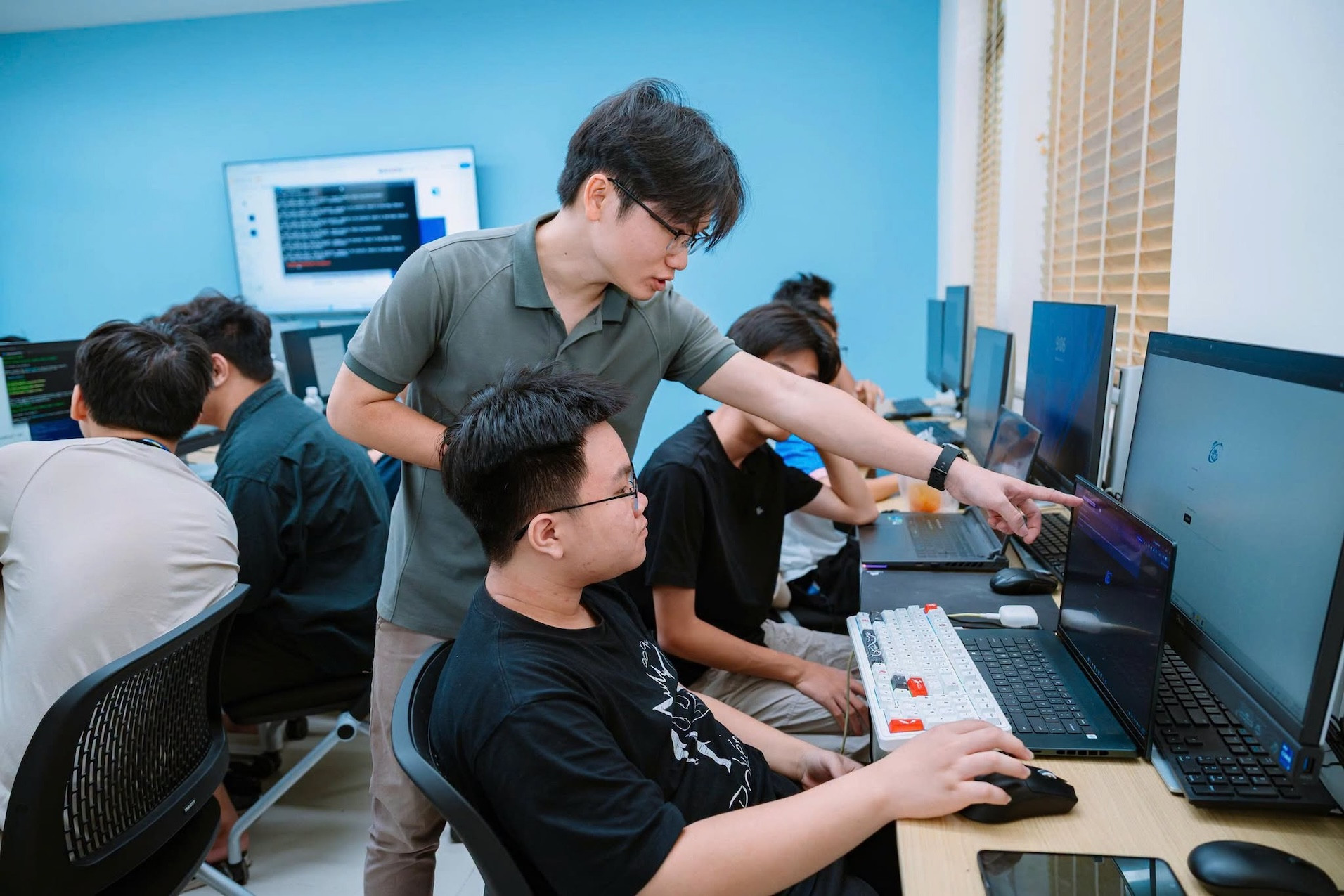
Most universities across the country have announced their 2026 admission benchmarks. In this year's landscape, majors such as Artificial Intelligence, IC Design, Computer Science, and Data Science continue to dominate with soaring scores.
At the University of Information Technology (UIT), AI topped the list with a perfect score of 100/100, equivalent to 30/30 under the national grading scale. It is the first time in the university's history that an academic program has required a perfect admission score. Data Science followed with 91.7 points, Semiconductor Design 90.5, Information Security 88.7 and Computer Science 88.5, equivalent to at least 26.55 points on the 30-point scale.
At Hanoi University of Science and Technology (HUST), several programs also posted admission scores approaching the maximum. The advanced Data Science and AI program led with 29.54 points, while the advanced Computer Science and Cybersecurity programs both exceeded 29 points.
At the University of Technology under Vietnam National University HCMC, most majors saw their admission scores increase by about 0.5 to over 13 points out of 100 compared to last year. Notably, Semiconductor Engineering had a benchmark of 85.8/100 in its very first year of admission. A series of majors with scores of 80 and above include Computer Science, Computer Engineering, the group of Electrical - Electronics - Telecommunications - Automation - IC Design, and Mechanical Engineering.
At the University of Natural Sciences under Vietnam National University HCMC, Computer Science in the advanced program had the highest admission score, reaching 29.32 points. Second was AI at 28.68 points.
Other majors and programs with high scores include IC Design at 27.93 points; Data Science, Statistics at 27.63 points; Data Science - English-enhanced program at 27.48 points; and Semiconductor Technology at 27.34 points. At the University of Economics HCMC, Data Analysis reached 91.50 points and Data Science reached 88.10/100.
Scholarship policy under Decree 179
Tran Dinh Ly, vice rector of the Nong Lam University HCMC, said three main factors explain the sharp rise in admission scores for AI, Semiconductor Design, Computer Science and Data Science.
First, AI and digital transformation are becoming key drivers of growth across most economies. Major policies adopted by Vietnam's Party and State identify science, technology, innovation and digital transformation as the foundation for the country's next stage of development. This has strengthened students' confidence in future career prospects.
Second, the labor market is experiencing strong demand for technology professionals in areas including AI, big data, semiconductors, automation and cybersecurity. Salaries and global career opportunities are also more attractive than in many other fields.
Third, parents and students have changed the way they choose university majors. Rather than focusing solely on personal interests, they increasingly consider long-term adaptability to future labor market trends, making technology-related programs a top choice.
Ly said the soaring admission scores reflect both booming demand for technology talent and the impact of new scholarship incentives.
AI, semiconductor design and several other strategic technology disciplines are now eligible for preferential support. Under Decree 179/2026/ND-CP, students majoring in semiconductor design, basic sciences, key engineering disciplines and strategic technologies are entitled to state-funded scholarships.
According to Bui Hoai Thang, head of the Academic Affairs Office at the HCMC University of Technology, there are two separate reasons behind the growing appeal of AI and semiconductor programs and this year's higher admission scores.
First, interest in AI and semiconductors has been rising steadily in recent years. AI, in particular, has surged in popularity since the emergence of ChatGPT. This year saw an especially sharp increase in applicants interested in AI, driven by the technology's expanding role across all aspects of daily life and growing demand for AI engineers.
The semiconductor trend began about two years ago, fueled by projections that Vietnam will need around 50,000-100,000 semiconductor professionals by 2030.
While HCMC University of Technology first offered Microchip Design within a combined Electrical-Electronics-Automation-Microchip Design group in 2024, launching an independent English-taught program in 2025 provided the momentum for the major to climb to second place in cutoff scores by 2026.
The "crown" went to Semiconductor Engineering, offered for the first time. This represents a clear trend in candidate selection. The powerful boost, or "knockout punch", was Decree 179 on scholarship policies for STEM students. This policy further elevated the appeal of AI, semiconductors, and technology fields.
Second, the number of high-performing applicants registering for these majors increased while admission quotas did not experience sudden surges.
Le Huyen
.svg)
