 Vietnamnet.vn

 Podcast



Admiral Samuel Paparo, Commander of the US Indo-Pacific Command (USINDOPACOM), has praised Vietnam's role in promoting ASEAN unity and supporting a rules-based order in the East Sea, while highlighting expanding defense cooperation between Vietnam and the United States.
His visit coincided with the arrival of the aircraft carrier USS George Washington in Da Nang, an event he said would strengthen military-to-military ties and deepen people-to-people exchanges between the two countries.
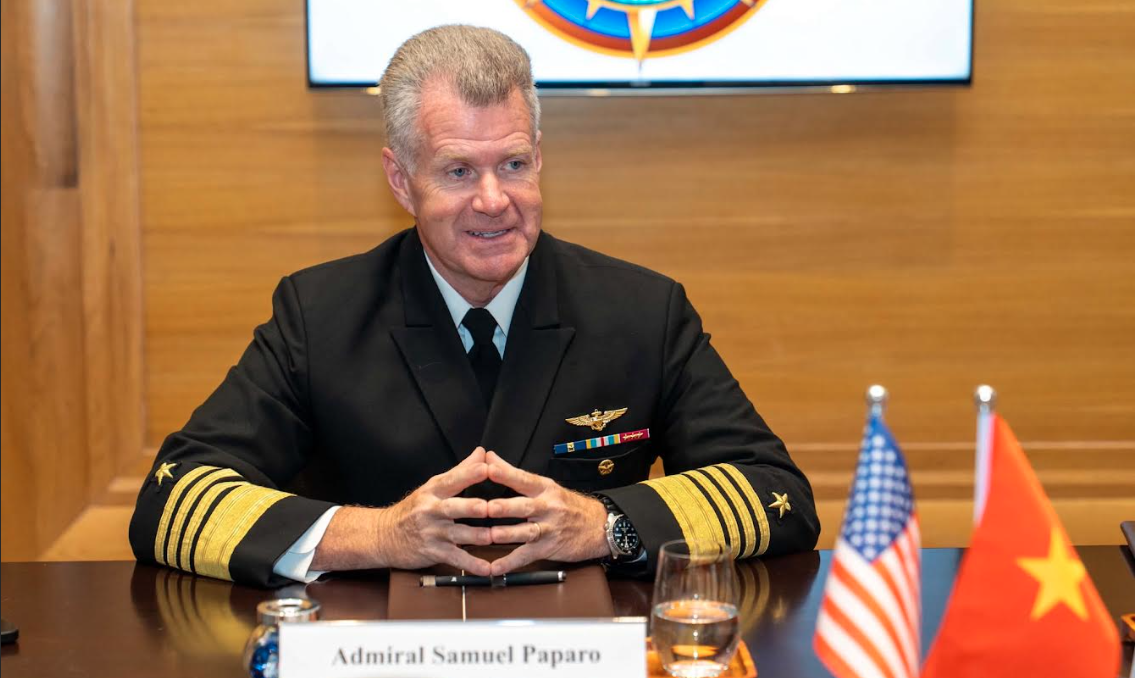
In an interview with Vietnamese journalists during the visit, Admiral Paparo discussed maritime security, bilateral defense cooperation and regional issues.
ASEAN unity is key to maintaining the rule of law
Asked about the most important factors for maintaining the rule of law in the East Sea, Admiral Paparo stressed that maritime domain awareness is essential.
"The first priority is understanding what is happening across the maritime domain and making that information available to the public," he said.
He added that regional countries should remain united in upholding international law, particularly the United Nations Convention on the Law of the Sea (UNCLOS), while identifying actions that violate international norms.
"The greatest source of strength comes from ASEAN centrality. The more united ASEAN members are, the better it is for regional peace and stability," he said. "I regard Vietnam as a positive example in advancing ASEAN centrality."
Expanding Vietnam - US defense cooperation
Admiral Paparo said defense relations between Vietnam and the United States continue to grow in both scope and capability.
One of the foundations of bilateral ties, he noted, remains Vietnam's longstanding cooperation in helping the United States search for military personnel still missing from the Vietnam War. According to the admiral, 1,564 American service members remain unaccounted for.
In return, the United States is supporting Vietnam's 500-Day Campaign to search for, recover and identify the remains of Vietnamese war martyrs by sharing forensic expertise, DNA identification technology and information from former witnesses.
The two countries also continue to cooperate on dioxin remediation at Bien Hoa Air Base, unexploded ordnance clearance and other efforts to address the legacy of war.
Looking ahead, Admiral Paparo said bilateral cooperation could expand further in areas including maritime capacity building, real-time information sharing and military medicine.
US pledges continued support for Vietnam's 500-Day Campaign
Asked about US assistance for Vietnam's nationwide campaign to identify missing war martyrs, Admiral Paparo pointed to the work of the Defense POW/MIA Accounting Agency (DPAA), based in Hawaii.
He said the agency uses advanced DNA technology alongside family reference samples and historical evidence to identify human remains.
A Vietnamese delegation is expected to visit DPAA headquarters in Hawaii early next year to learn more about its technology and procedures.
Beyond scientific methods, the United States is also helping connect Vietnamese authorities with American veterans who served in Vietnam and may possess information about potential burial sites.
"In our view, this work should not stop until everyone who made the ultimate sacrifice has been found and returned to their families," Admiral Paparo said.
He praised Vietnam's commitment to humanitarian cooperation, noting that the country has consistently supported requests related to the search for missing US personnel.
"For our part, we will do everything we can to support Vietnam's 500-Day Campaign," he said.
Vietnam's APEC 2027 role reflects growing international standing
Admiral Paparo also welcomed Vietnam's selection to host APEC 2027, describing it as recognition of the country's growing regional and global leadership.
He said hosting the summit demonstrates not only Vietnam's diplomatic stature but also the capability of its security agencies to ensure the safety of world leaders attending a major international event.
Thai An
.svg)
