 Vietnamnet.vn

 Podcast



Amid ongoing geopolitical tensions worldwide, Deputy Minister of Industry and Trade Nguyen Sinh Nhat Tan has instructed relevant agencies to accelerate the rollout of E10 biofuel, emphasizing that the transition should be implemented “as soon as possible.”
Fuel prices surge while ethanol prices remain stable
Speaking at a conference on implementing the new roadmap for blending biofuels with traditional fuels on March 9, Do Van Tuan, Chairman of the Vietnam Biofuels Association, said Vietnam currently secures only about 68 percent of its gasoline supply domestically.
However, even this level of self-sufficiency depends heavily on crude oil inputs for the country’s two major refineries.

Do Van Tuan said ethanol prices have increased by only about 4 percent while gasoline prices have surged sharply. Photo: CT
The Nghi Son Refinery and Petrochemical Complex relies on about 70-80 percent of its crude oil from Kuwait, and at times has depended almost entirely on imported crude.
Meanwhile, the Dung Quat Refinery sources about 30-35 percent of its crude oil from imports, including supplies from West Africa, the Mediterranean region, the US and parts of the Middle East.
Do Van Tuan said ethanol prices have increased by only about 4 percent while gasoline prices have surged sharply. Photo: CT
As domestic crude oil production declines, reliance on external energy sources is becoming a growing challenge, highlighting the need for greater energy self-sufficiency.
According to Tuan, many countries such as Brazil, India and Thailand have achieved stronger energy independence through the development of biofuels. This approach not only benefits the environment but also reduces reliance on energy supplies from geopolitically unstable regions such as the Middle East, Russia or the US, while creating additional demand for agricultural products.
Vietnam, as an agricultural country, has strong potential to produce corn, cassava and sugarcane - all of which can be used to produce ethanol (E100).
This means that by expanding from E5 gasoline to E10 or even E20, Vietnam could increase its ability to secure a significant portion of domestic fuel supply.
Another advantage lies in ethanol’s price stability compared with fossil fuels.
Tuan noted that about 60 percent of global ethanol supply comes from the US and Brazil, providing logistical advantages for import.
“Ethanol shipments from the US are not affected by shipping disruptions in the Middle East. If procurement plans are prepared early and tenders are arranged in time, the supply can reach Vietnam according to schedule,” he said.
He also emphasized that ethanol prices do not fluctuate in tandem with gasoline prices. While global crude oil and Singapore Platts gasoline prices have surged by more than 50 percent, ethanol prices on the Chicago exchange have risen by only about 4 percent.
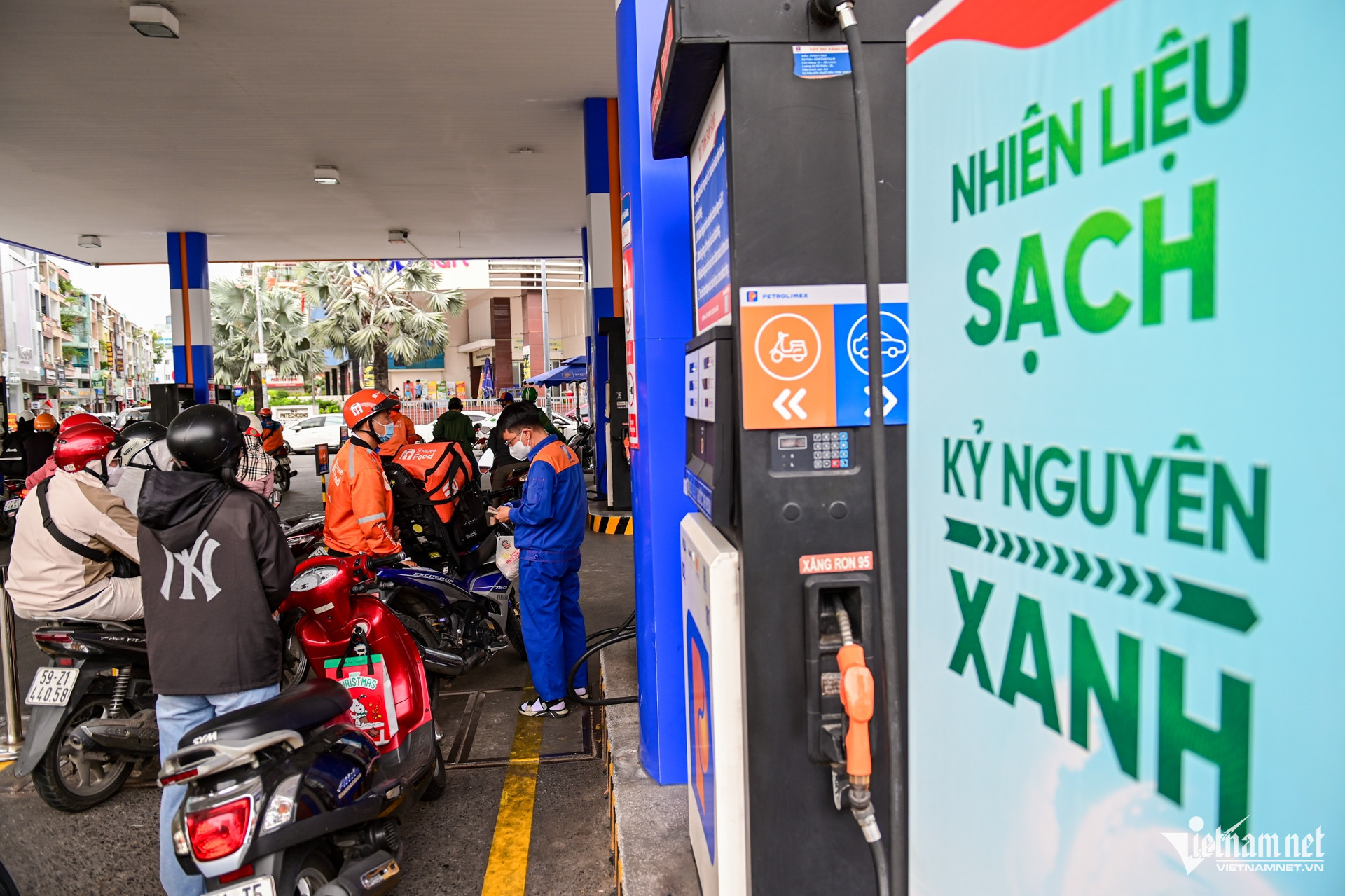
Major petroleum distributors such as Petrolimex and PVOIL have already begun large-scale tenders to purchase ethanol to accelerate blending activities.
These companies aim to begin widespread sales of E10 gasoline from early April instead of waiting until June 1 as originally scheduled.
However, Tuan noted that ethanol imports from the US are mainly accessible to large fuel traders with strong financial capacity - estimated at fewer than 10 major distributors.
Smaller companies may need to source ethanol from regional supply hubs such as Singapore or South Korea.
Early adoption of E10 may ease pressure on conventional gasoline
Vietnam’s gasoline demand currently stands at about 1 million cubic meters per month. To meet blending requirements, the market would need roughly 92,000 to 100,000 cubic meters of ethanol each month, including the current E5 gasoline share of about 15 percent.
Domestic supply remains limited. Five ethanol production plants in Vietnam are currently operating at low capacity, producing a minimum of about 25,000 cubic meters, equivalent to nearly 30 percent of total demand.
Tuan stressed that these facilities will need closer supervision and management in the future, similar to oil refineries, to ensure stable biofuel supply.
From the production side, representatives of Binh Son Refining and Petrochemical Joint Stock Company (BSR), a subsidiary of Petrovietnam, said the Central Biofuel Plant is ready to produce about 60,000 tons of ethanol feedstock for E10 gasoline blending.
By the end of March, the Dung Quat Refinery, operated by BSR, is expected to begin receiving ethanol for blending E10 gasoline. This move could help increase domestic fuel output at a time when import channels are facing disruptions due to military conflicts in the Middle East.
According to Trinh Quang Khanh, Vice Chairman of the Vietnam Petroleum Association, accelerating the adoption of E10 in the current context is a strategic move that could reduce pressure on fossil fuel imports and consumption.
However, he cautioned that E10 should not be expected to significantly lower gasoline prices.
Calls for tax adjustments to support biofuel adoption
Khanh suggested that policymakers should consider reducing certain taxes and fees while recalculating cost components in the fuel pricing structure.
He noted that distributing E10 gasoline requires additional investment in blending infrastructure and equipment. As a result, the standard operating cost allowance for E10 should be around VND200 per liter (approximately US$0.008) higher than that applied to conventional gasoline.
In addition, authorities should review the special consumption tax applied to fossil gasoline used for biofuel blending.
Currently, the special consumption tax on fossil gasoline inputs is 10 percent, while the tax rate for biofuel output is only 7 percent. Adjusting the tax on fossil gasoline used in blending down to 7 percent would help create a more consistent tax structure.
Regarding the environmental protection tax, Khanh recommended applying the same tax rate for both E5 and E10 gasoline.
Currently, the environmental protection tax is VND1,900 per liter (US$0.078) for E5 gasoline and VND1,800 per liter (US$0.074) for E10 gasoline.
Unifying a lower tax rate could simplify calculations and reporting while helping reduce retail prices and make biofuels more attractive to consumers.
Tam An
.svg)
