 Vietnamnet.vn

 Podcast



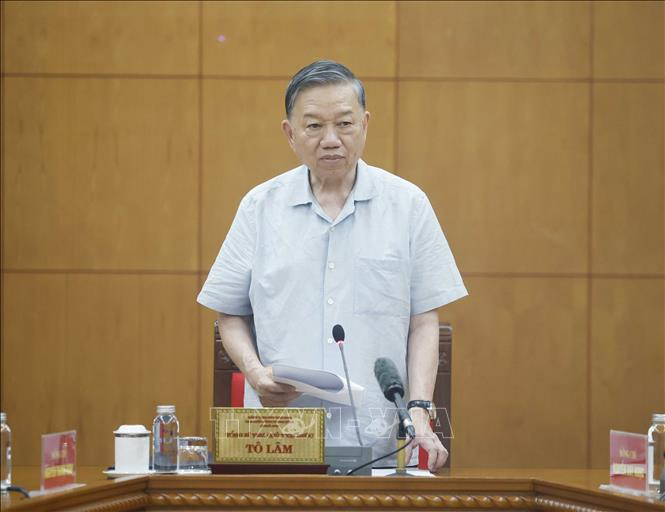
Party General Secretary and President To Lam on May 21 chaired a working session with the Party Central Committee’s Policy and Strategy Commission and representatives from ministries and agencies on the future direction of Vietnam’s materials industry.
Also attending were Politburo members Nguyen Duy Ngoc, Secretary of the Party Central Committee and Head of the Party Central Committee’s Organization Commission; Nguyen Thanh Nghi, Secretary of the Party Central Committee and Head of the Policy and Strategy Commission; Permanent Deputy Prime Minister Pham Gia Tuc; along with Party Central Committee members and leaders of ministries, agencies and related bodies.
In recent years, Vietnam’s materials industry has recorded significant progress.
Sectors including steel, cement, construction materials, basic chemicals, fertilizers, plastics, rubber, textiles, industrial wood products and fibers have expanded rapidly, with many products meeting domestic demand and reaching export markets.
Several enterprises have invested in large-scale industrial complexes.
Vietnam also possesses considerable reserves of rare earths, bauxite, titanium, tungsten, graphite, white sand and limestone.
Emerging sectors such as new materials, green and recycled materials, semiconductors, electronics, batteries, renewable energy, biomedical materials and composites have also begun attracting greater attention.
However, Vietnam’s materials industry still relies more on extensive growth than deep development.
While output has increased, high-quality production remains limited.
The country has abundant natural resources, but deep processing capabilities remain weak.
Several large-scale industries continue to generate high emissions and consume significant amounts of energy and resources.
Although foreign direct investment has increased, linkages with domestic enterprises remain limited, while research commercialization has been slow.
Vietnam still depends heavily on imports for key materials such as semiconductor materials, electronic chemicals, ultra-pure gases, battery materials, specialty alloys, engineering polymers, high-grade steel, testing equipment and deep-processing technologies.
Concluding the meeting, To Lam praised the preparation work carried out by the Policy and Strategy Commission and the contributions from ministries and agencies.
He stressed that Vietnam’s biggest challenge is not a lack of resources or market demand, but the absence of core technologies, deep-processing capacity, leading domestic enterprises, a complete ecosystem for research, testing, certification and commercialization, and a sufficiently integrated national strategy for organizing the materials value chain.
The Party chief outlined five major orientations.
First, the materials industry must be identified as a foundational and strategic sector in Vietnam’s industrialization and modernization process.
Second, development should be selective and focused rather than spread thinly, based on a three-tier approach including foundational materials to be maintained and upgraded, strategic materials requiring breakthroughs, and future materials that need early preparation.
Third, Vietnam must shift decisively from raw resource extraction to deep processing, technological mastery and higher domestic added value.
Fourth, science and technology, standards, high-quality human resources and Vietnamese enterprises must serve as the core pillars of development.
Fifth, the materials industry must advance in a green, sustainable and self-reliant direction with international competitiveness, aligned with global commitments while safeguarding national interests.
To Lam assigned the Government Party Committee to lead the drafting of a national strategy for Vietnam’s materials industry through 2030 with a vision to 2045, calling for the strategy to be completed as soon as possible.
He said the strategy must align closely with major Party orientations on industrialization, modernization, science and technology, innovation, digital transformation, green transition, private-sector development, energy security, national defense, security and international integration.
The strategy, he added, must reflect long-term thinking backed by reliable data, clear objectives, feasible roadmaps and clearly assigned responsibilities.
Rather than serving as a broad compilation, the strategy must answer practical questions, including which material groups Vietnam should develop, why they are selected, the level of technological mastery targeted, which stages of the value chain should be prioritized, which agencies will lead implementation, which enterprises will play central roles, where resources will come from, what policies are needed and how outcomes will be measured.
On that basis, Vietnam should establish a list of strategic national materials, maps of import dependence and domestic industrial capacity, along with key tasks and major projects.
Regarding policy design, To Lam emphasized the need to move away from fragmented support mechanisms toward market creation and product-based procurement policies.
The state should establish a list of strategic national materials and create procurement mechanisms for specific products involving businesses, technical standards, application addresses and commercialization roadmaps.
He also called for controlled pilot mechanisms, intellectual property frameworks and fair benefit-sharing mechanisms between scientists, research institutions and businesses.
Party chief To Lam instructed authorities to focus on identifying priority material groups and avoid spreading resources too thinly.
In the immediate term, Vietnam could prioritize five groups: rare earth materials, semiconductor materials, battery and energy storage materials, new materials and next-generation construction materials.
According to him, these sectors hold foundational importance for industrialization, modernization and economic self-reliance and should therefore be carefully evaluated in the national strategy to ensure the right priorities, timelines and support mechanisms.
Addressing urgent issues in the current construction materials market, To Lam stressed the need for sustainable, self-reliant development with global competitiveness.
He called for greater use of green, clean, energy-efficient and resource-saving materials, along with recycled and alternative materials that help reduce emissions.
Vietnam must also ensure adequate supplies of sand, stone, fill materials, cement and steel for public investment projects, transport infrastructure, urban development, energy projects and housing.
Authorities were instructed to ensure timely and transparent price disclosures, strengthen interregional coordination and promote the use of recycled construction waste and standardized alternative materials.
Party committees and organizations at all levels were tasked with reviewing reserves, mining activities, processing technologies, environmental risks and value-chain potential related to rare earths, bauxite, titanium, tungsten, graphite, white sand, limestone and other important minerals.
The objective, To Lam stressed, is to prevent resource losses, avoid raw exports, reject environmentally destructive exploitation and ensure national resources are not left idle due to policy gaps, technological limitations or weak coordination.
He reiterated the need to persist with the transition from raw extraction to deep processing, technological mastery and higher domestic added value.
Vietnam must modernize traditional materials industries toward greener, cleaner and more technology-intensive production with greater added value, while also creating breakthroughs in science and technology, standards, testing systems and high-quality human resources.
The country should also strengthen Vietnamese enterprises and develop domestic markets for new, green and strategic materials, while improving institutions, enhancing inter-agency coordination, tightening oversight and protecting national interests during international integration.
Party chief To Lam assigned the Policy and Strategy Commission to finalize its report for submission to the Politburo, paving the way for official conclusions guiding the development of Vietnam’s materials industry and forming the basis for the Government Party Committee to draft the national strategy.
TTXVN
.svg)
