 Vietnamnet.vn

 Podcast



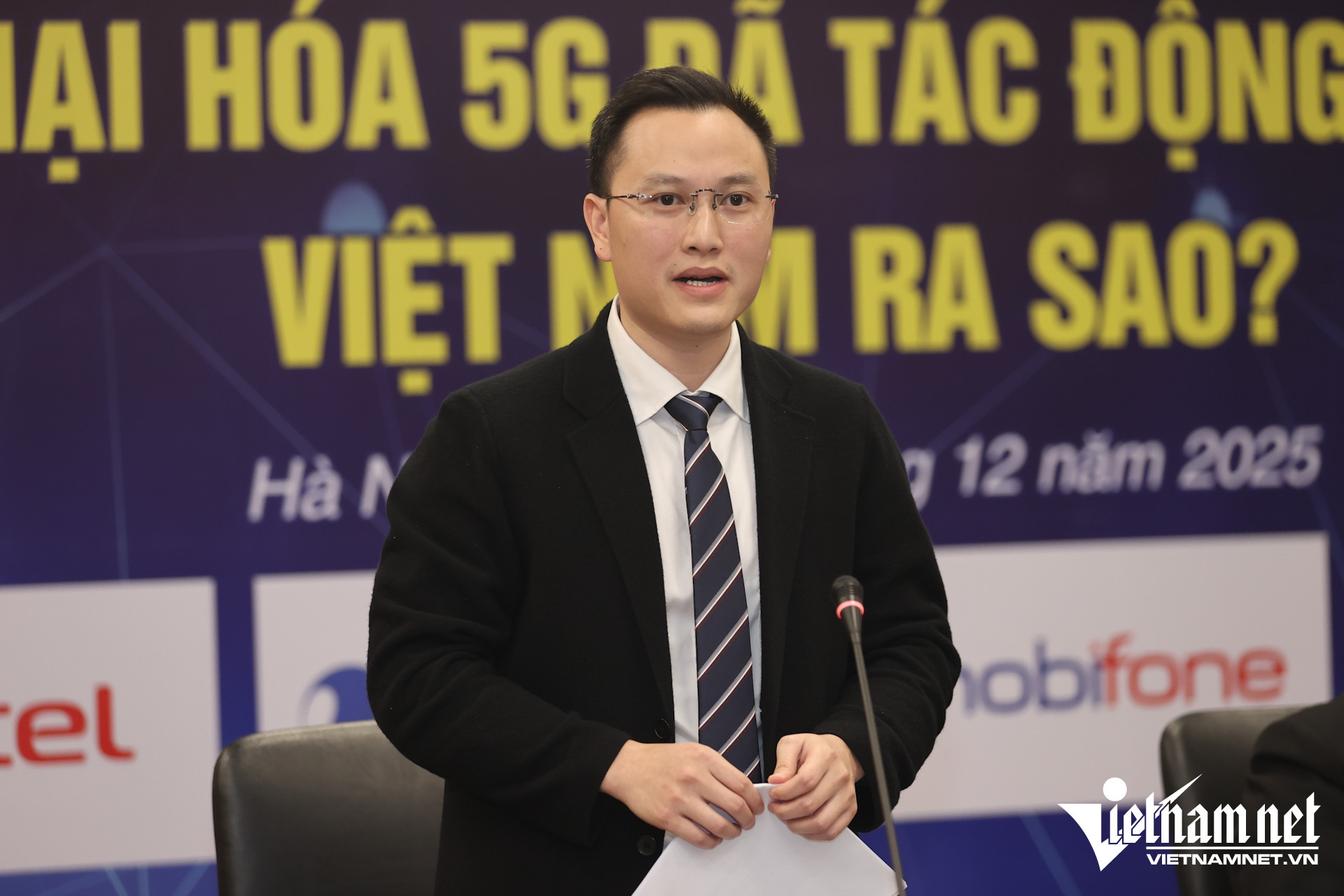
Nguyen Anh Cuong, Deputy Director of the Department of Telecommunications, speaks at the panel discussion on December 29. Photo: Le Anh Dung
This remarkable achievement was highlighted by Nguyen Anh Cuong, Deputy Director General of the Department of Telecommunications under the Ministry of Science and Technology, during the panel discussion "How 5G commercialization is impacting Vietnam’s economy" hosted by the ICT Journalists Club recently.
Nguyen Anh Cuong noted that most countries require an average of three years to reach 90% coverage, with the fastest taking at least two. In contrast, Vietnam managed this feat in just one year.
“This is truly a top-tier global accomplishment in 5G deployment speed,” he said.
A ‘network-first’ strategy
Leading the race is Viettel. According to Nguyen Ha Thanh, Deputy General Director of Viettel Telecom, the company had installed 30,000 5G base stations as of December 2025, including 23,500 deployed in 2025 alone.
Viettel’s outdoor 5G coverage has reached 90%, with indoor coverage at 70% - on par with its first-year 4G rollout.
“We view investment in 5G infrastructure as a strategic move to strengthen the national digital backbone. That’s why we’ve prioritized rapid and widespread deployment,” Thanh explained.
She added that in 2026, Viettel plans to build an additional 15,000 base stations to boost indoor coverage to 85%.
Real-world benefits of this broad deployment are already becoming evident.
At a recent live concert simultaneously hosted in Hanoi and Ho Chi Minh City, 5G’s ultra-low latency allowed audiences to feel like both performers were on the same stage.
From a business standpoint, data usage has increased by 15–20% since the 5G launch, and service satisfaction rates are up 20%.
Sharing more on Vietnam’s infrastructure-first philosophy, Cuong used the analogy of a train: “You need the rails before you can run the train. If you build the train first without the tracks, it goes nowhere. That’s the real waste.”
Targeting key economic zones
Unlike Viettel’s nationwide approach, VNPT and MobiFone have focused their 5G rollouts on strategic hotspots and enterprise customers.
Nguyen Quoc Khanh, Deputy Head of Technology at VNPT Group, shared that their strategy prioritizes coverage in urban areas, industrial parks, seaports, and airports - regions with dense populations and high economic demand.
VNPT aims to cover 55–60% of Vietnam’s population by 2026.
Their focus also includes developing private 5G networks. In 2025, VNPT launched private network trials beyond higher education, exploring use cases in smart manufacturing.
Pilot deployments are already underway in Tay Ninh and Hai Phong, with expansion opportunities being explored at airports and seaports.
Meanwhile, Nguyen Tuan Huy, Head of Technology at MobiFone, emphasized that 5G’s true potential lies in machine-to-machine connections rather than human users.
“Humans don’t really need ultra-low latency,” he said.
5G delivers speeds up to 10 times faster than 4G, with latency as low as 1–30 milliseconds (compared to 30–50 milliseconds on 4G), enabling massive Internet of Things (IoT) connectivity.
MobiFone is currently piloting 5G in selected industrial zones and cities, with a full-scale smart city rollout expected in 2026.
One notable 5G application Huy cited is a hydroinformatics-based flood prevention system in Hanoi.
“To eliminate 108 known flood points, you’d need tens of thousands of sensors. That’s where 5G’s capabilities shine,” he explained.
MobiFone is also developing a drone-based rescue model that can fly to fire sites, identify whether it’s a chemical or traditional blaze, and dispatch AI-directed fire engines accordingly.
State-backed incentives for rapid deployment
Beyond policy guidance and regulatory support, the Vietnamese government is offering direct financial incentives for telecom companies deploying 5G infrastructure quickly.
Under Resolution 193, the government will subsidize up to 15% of 5G equipment costs for operators that build at least 20,000 base stations in 2025.
Nguyen Anh Cuong explained that the subsidy aims to offset accelerated investment expenses such as loan interest and equipment price differences, as hardware prices tend to drop over time.
“If a company can compress a 2–3 year plan into one year, the government will provide financial support to bridge the gap,” Cuong stated.
As of now, Viettel is the only telecom provider registered for the incentive program.
Du Lam
.svg)
