 Vietnamnet.vn

 Podcast



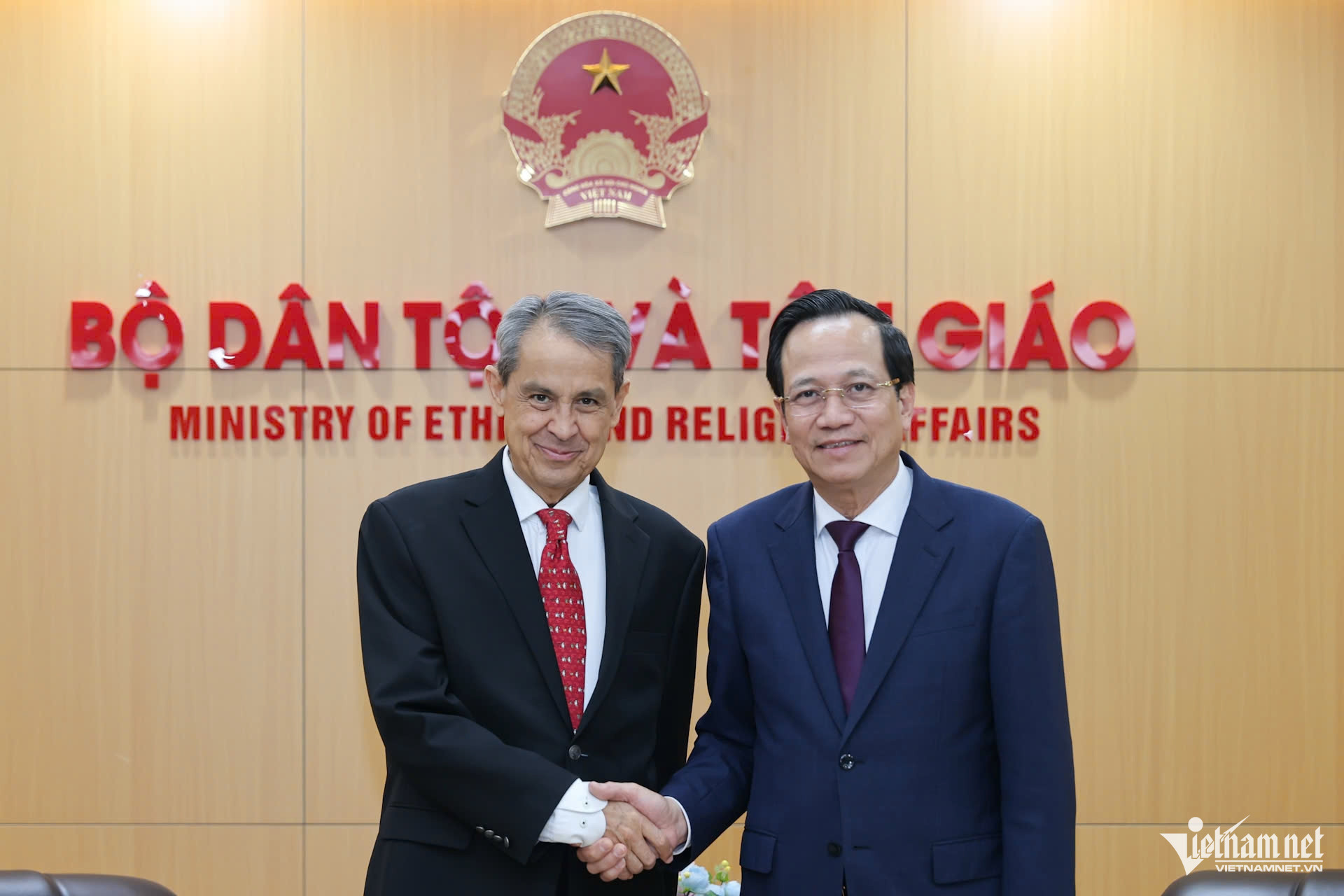
The meeting took place at the headquarters of the Ministry of Ethnic and Religious Affairs in Hanoi, where Minister Dao Ngoc Dung received Alejandro Negrín, Ambassador Extraordinary and Plenipotentiary of Mexico to Vietnam.
During the meeting, Ambassador Alejandro Negrín expressed his honor at meeting the Vietnamese minister and praised Vietnam’s recent achievements in socio-economic development.
Although the two countries are geographically distant, he said, they share many similarities and have maintained a strong relationship built over more than 50 years of cooperation.
“In the context of this visit, we hope to work with Vietnam to further promote bilateral cooperation, particularly in areas such as agricultural development, scientific and technological transformation, handicraft production, traditional medicine, tourism, education and gender equality,” Ambassador Negrín said.
Speaking at the meeting, Minister Dao Ngoc Dung emphasized that Mexico holds a strategic position and is an important potential partner for Vietnam in Latin America.
Relations between the two countries, he said, have continued to develop across various sectors, especially in economics, education and culture.
The minister also highlighted that both Vietnam and Mexico are multi-ethnic, multicultural and multi-religious countries, which creates significant opportunities for cooperation.
“Both countries aim to promote equality, freedom and development for ethnic minorities and indigenous communities, particularly in the fields of economic development, culture, education and healthcare,” he said.
People-centered development
Sharing information about Vietnam’s policies, Minister Dao Ngoc Dung noted that the 14th National Congress of the Communist Party of Vietnam reaffirmed the consistent policy of respecting freedom of belief and religion for all Vietnamese citizens.
Vietnam also ensures that religious organizations can operate within the framework of the law and according to their charters and regulations.
The country’s ultimate goal, he added, is to improve the well-being of all citizens, especially ethnic minorities, ensuring better living conditions both materially and spiritually, including healthcare, education and social security.
Vietnam has implemented a dedicated national target program for ethnic minority communities. Children in Vietnam are provided with free schooling and supported meals at school.
In addition, the government has decided to build integrated schools in border and island communes. Poor and near-poor ethnic minority citizens are also provided with health insurance coverage.
“After many wars to defend our country, Vietnam is among the nations that have endured immense suffering. We understand the value of peace and the responsibility to care for ethnic minorities, the poor and social welfare beneficiaries,” the minister said.
Vietnam’s consistent foreign policy, he added, is to maintain independence and self-reliance while being a friend and partner to all countries, particularly those with strong potential for expanding cooperation such as Mexico.
Minister Dao Ngoc Dung also expressed strong support for the cooperation initiatives proposed by the Mexican side, noting that these are areas Vietnam is keen to develop.
He expressed hope that the two countries will continue working together to develop institutions, mechanisms and policies while consulting with one another on governance in ethnic and religious affairs so that people in both countries can benefit from these efforts.
“Through the ambassador, I hope that more delegations from government agencies responsible for ethnic and religious affairs in both countries will visit and exchange experiences to learn from each other,” the minister said.
Hoang Quy
.svg)
