 Vietnamnet.vn

 Podcast


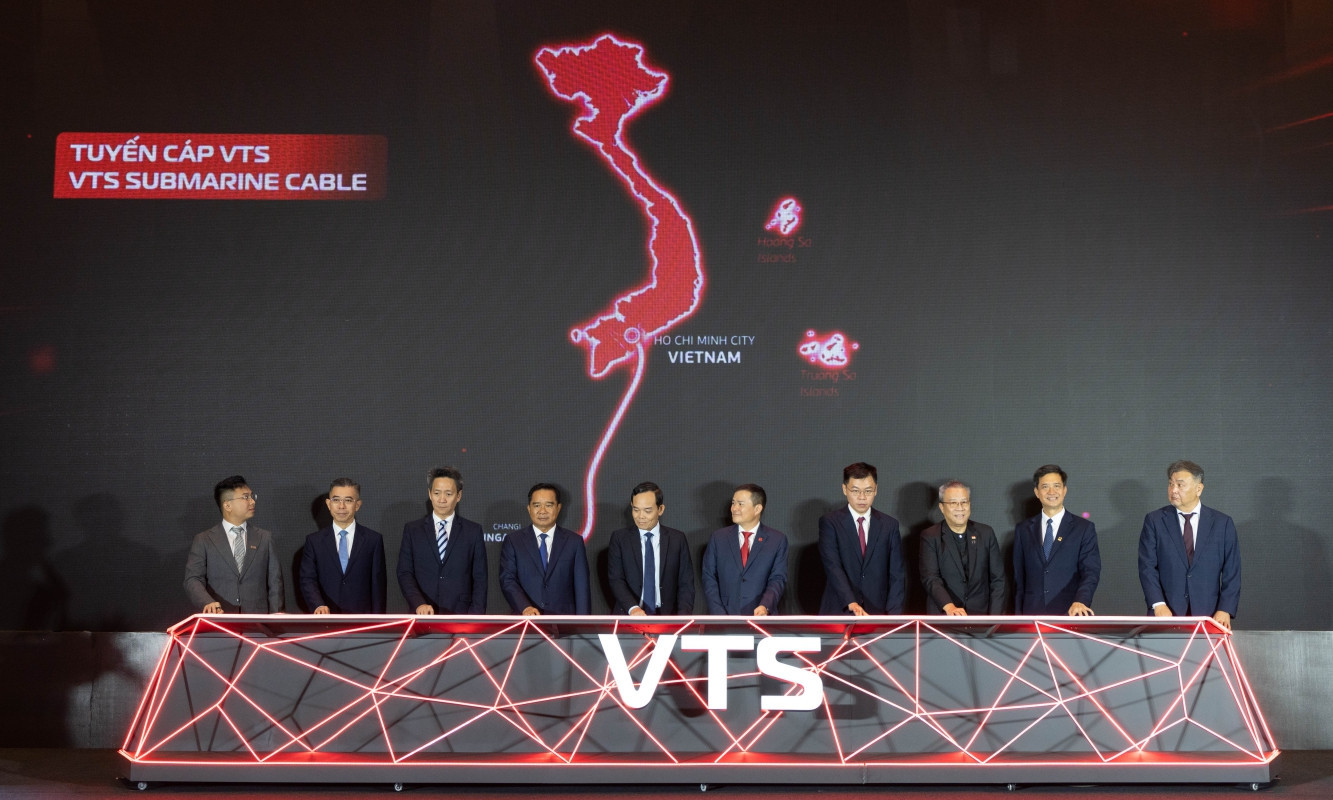
On November 26, the VTS consortium, co-led by Vietnam’s Military Industry and Telecoms Group (Viettel) and Singapore’s Singtel, held a signing and groundbreaking ceremony for the international submarine cable project in Ho Chi Minh City.
From capacity buyer to infrastructure developer
For decades, Vietnam’s international submarine cables have operated under traditional international consortium models. Vietnamese telecommunications companies have primarily contributed capital and purchased bandwidth, relying on foreign partners for system design, approval, routing and operations.
This dependence has exposed significant vulnerabilities, particularly as most existing cables run through the East Sea, an area with heavy maritime traffic and potential risks.
At one point, simultaneous cable disruptions deprived Vietnam of up to 60% of its international connectivity capacity for nearly two months, severely affecting businesses and households.
The VTS submarine cable represents a fundamental shift. For the first time, Viettel has initiated and co-founded an international submarine cable project while retaining a key decision-making role in route planning, engineering design, technology selection and landing station investment.
Speaking at the ceremony, Lieutenant General Tao Duc Thang, Chairman and CEO of Viettel, said the rapid expansion of artificial intelligence (AI), cloud computing and cross-border digital services was creating unprecedented demand for international connectivity.
“In the digital era, the ability to store, process and transmit data will increasingly determine a nation’s competitiveness,” he said.
As submarine cables take years to build, Thang stressed that Vietnam could not afford to wait until capacity shortages emerged or allow its digital economy to depend excessively on factors beyond its control.
He described VTS as a transition from participating in international cable investments to actively developing and gradually gaining control over Vietnam’s own connectivity infrastructure.
Record capacity for the AI era
Spanning approximately 2,500 kilometres, the VTS submarine cable will have a total design capacity of 600 Tbps and is scheduled to enter commercial service in the fourth quarter of 2030.
Its 1,200-kilometre main segment directly connecting Vietnam and Singapore will alone provide 240 Tbps, approximately 2.5 times the combined capacity of all international submarine cables currently serving Vietnam.
Designed as the shortest cable route between the two countries, VTS will feature eight fibre pairs and next-generation wavelength division multiplexing (WDM) technology.
The system is expected to deliver latency of around 12 milliseconds, nearly 50% lower than the average of existing cable systems.
The entire cable will be buried beneath the seabed, with its main segment reaching depths of up to three metres, compared with the conventional depth of 1-1.5 metres, reducing the risk of physical damage.
The project brings together international contractors NEC Corporation of Japan and ASEAN Cableship of Singapore, alongside major telecommunications companies including Thailand’s AIS, VNPT, FPT Telecom and Viettel IDC.
Deputy Minister of Science and Technology Pham Duc Long said the project should not only expand infrastructure capacity but also enable Vietnamese engineers to gradually master submarine cable technology, operations, maintenance, emergency response and repairs.
“We are not simply building another submarine cable. We are building the connectivity, technological autonomy and resilience of our national digital infrastructure,” he said.
The project also supports the implementation of the National Assembly’s Resolution No. 193/2025/QH15 on special mechanisms and policies to accelerate scientific and technological development, as well as the Government’s submarine cable development strategy through 2030.
A new international data gateway for Ho Chi Minh City
Beyond strengthening telecommunications resilience by opening a strategic southward connectivity corridor, VTS will establish a cable landing station directly in Ho Chi Minh City, Vietnam’s economic powerhouse.
Most of Vietnam’s existing submarine cable landing points are concentrated in the central and northern regions.
A direct connection to Singapore, Southeast Asia’s leading data and financial hub, is expected to position Ho Chi Minh City as a major international data gateway.
The infrastructure could help attract global technology corporations and hyperscale cloud service providers to establish data centres, supporting the city’s ambitions to become a regional data hub and international financial centre.
Truong Minh Huy Vu, Vice Chairman of the Ho Chi Minh City People’s Committee, emphasised the project’s strategic importance to the city’s development.
“If roads, railways and seaports are physical arteries, submarine cables are the digital arteries connecting Vietnam with the world,” he said.
Vu noted that modern international connectivity infrastructure was essential to implementing the Politburo’s Resolution No. 57-NQ/TW and transforming Ho Chi Minh City into a regional financial and digital economy hub.
He also highlighted Viettel’s leadership in initiating and developing Vietnam’s first Vietnamese-led submarine cable, with Singtel participating in key decisions on technology, routing and connectivity configuration.
Le My

