 Vietnamnet.vn

 Podcast



Vietnamese enterprises are calling for a fundamental shift in cooperation with South Korea, moving beyond traditional trade and investment toward jointly developing and mastering strategic technologies such as artificial intelligence, semiconductors and cybersecurity.
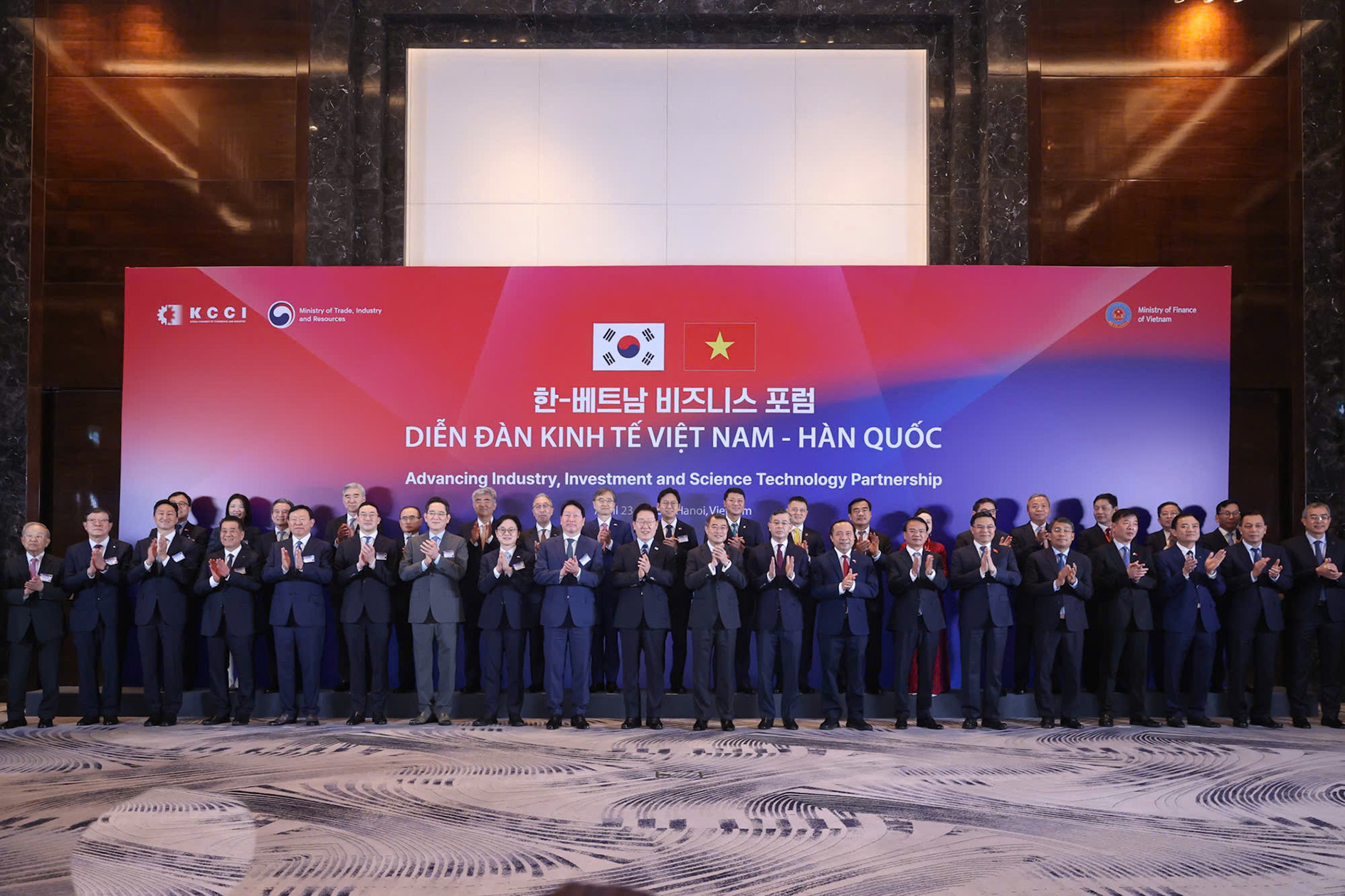
The Vietnam - Korea Economic Forum reflects a new phase in bilateral cooperation after nearly 35 years of diplomatic relations.
The proposal emerged during a roundtable and the Vietnam - Korea Economic Forum, held as part of the state visit to Vietnam by South Korean President Lee Jae Myung. The discussions highlighted a notable evolution in bilateral relations after nearly 35 years of diplomatic ties.
Since the two countries elevated their relationship to a Comprehensive Strategic Partnership in late 2022, cooperation has expanded significantly into high-tech sectors, innovation and digital transformation.
South Korea is currently the largest foreign investor in Vietnam, with more than 10,000 enterprises operating in the country. At the same time, both nations rank among each other’s leading trading partners.
Yet businesses argue that the changing global landscape demands a new approach. As supply chains are reshaped and technology becomes the central driver of competitiveness, while green development and the digital economy set new standards, cooperation must move from breadth to depth.
Representing this shift, CMC Corporation proposed a series of strategic initiatives aimed at redefining bilateral collaboration.
Nguyen Trung Chinh, Chairman of CMC, said the Vietnam - Korea business relationship has reached a point where it can transition into a new phase. In this phase, companies would no longer act merely as commercial partners but as strategic technology partners.
He stressed that future cooperation should go beyond service provision or capital investment, focusing instead on joint transfer, development and ownership of foundational technologies, including AI, semiconductors and cybersecurity. Businesses, he added, must play a central role in driving innovation and linking the entire value chain, from research to commercialization.
Building an AI ecosystem and going global
Vietnamese firms have also begun outlining concrete components for a new cooperative ecosystem.
According to Nguyen Trung Chinh, future collaboration could revolve around five pillars: AI infrastructure and computing capacity, the data economy, AI platforms and models, AI applications in governance, and AI deployment across industries.
To make this vision viable, three foundational conditions are essential: a high-quality workforce, a governance framework for AI built on trust and ethics, and a supportive financial and institutional system. Without addressing these bottlenecks, deeper cooperation would be difficult to achieve.
These proposals align closely with CMC’s own development strategy. The company is pursuing its “AI-X” approach, aiming to become a global AI transformation enterprise based on three pillars: AI infrastructure, cybersecurity and AI solutions. Alongside this is its “Go Global” strategy, designed to bring Vietnamese technology products and services to international markets.
Within this broader vision, South Korea is seen not only as a market but as a strategic partner in expanding technological capabilities and building a global ecosystem.
CMC also revealed plans to develop a hyperscale data center in Ho Chi Minh City with a capacity of up to 150 MW, requiring an estimated investment of US$1-2 billion.
From a wider perspective, FPT Corporation Chairman Truong Gia Binh emphasized that Vietnam - Korea cooperation goes beyond economics, representing a shared journey toward development aspirations.
He pointed out that the world is facing three major challenges: high uncertainty, the transformative wave of AI reshaping entire economies, and intensifying competition as products are created faster and more cost-effectively.
In this context, he proposed establishing a strategic cooperation mechanism between the two countries, focused on tackling major challenges where both sides can act together and share benefits.
“Vietnam and South Korea once started from similar positions. South Korea has risen to become an advanced industrial nation, and Vietnam can achieve the same if it effectively leverages cooperation opportunities,” Binh said.
Thai Khang
.svg)
