 Vietnamnet.vn

 Podcast



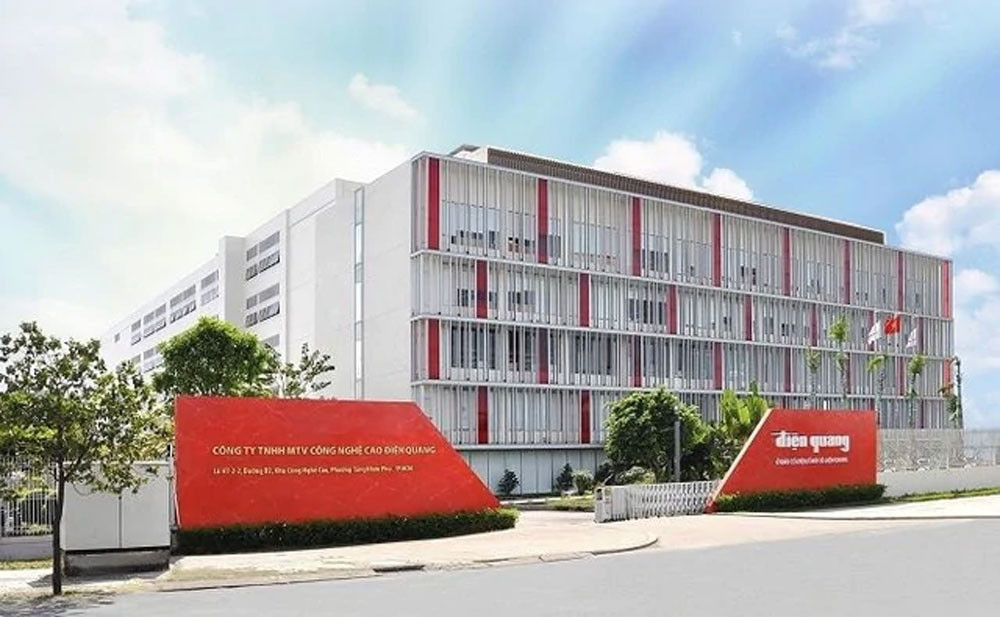
Revenue rebounds as the picture gradually brightens
Dien Quang Group JSC (DQC) recently explained why its consolidated after-tax profit for 2025 fell by nearly 60% following an audit. The final figure came in at just VND4.9 billion ($186,000), about 58% below the pre-audit figure.
According to the company’s explanation, its subsidiary Dien Quang High-Tech Co. made a 100% provision for its VND21.25 billion ($806,000) investment in Xelex.
Following the audit, the provision was not accepted as a deductible expense for corporate income tax purposes, requiring DQC to recognize an additional VND4.25 billion ($161,000) in tax expenses. There was also an adjustment related to financial income from dividends.
DQC shares have been under trading supervision since April 8, 2026, after the company’s audited financial statements received qualified opinions for two consecutive years, 2024 and 2025.
As of Sept. 21, DQC shares were trading at VND9,980 ($0.38) apiece, less than one-fifth of their level a decade earlier, in mid-2016.
The figures reflect a turbulent period for Dien Quang’s business in recent years.
In 2023, DQC’s net revenue fell 13% to VND871 billion ($33.0 million), while its after-tax result swung from a profit of nearly VND15 billion ($569,000) in 2022 to a loss of more than VND33 billion ($1.25 million). Rising promotional expenses, provisions for financial investments and interest costs weighed heavily on its performance.
In 2024, DQC reported an after-tax loss of about VND121.9 billion ($4.62 million), taking accumulated losses to more than VND122 billion ($4.63 million). The company generated about VND184 billion ($6.98 million) in gross profit during the year, but its bottom line remained significantly affected by expenses.
The picture began to brighten in 2025. Revenue recovered to about VND920 billion ($34.9 million), up 13%. In the first six months of 2026, revenue reached approximately VND565 billion ($21.4 million), up nearly 59%, while after-tax profit came in at VND14.2 billion ($539,000).
Profit margins, however, remain low relative to the company’s revenue and the results it achieved in earlier periods.
Notably, undistributed after-tax profit shifted from a negative VND83.7 billion ($3.18 million) at the beginning of 2026 to a positive VND125.9 billion ($4.78 million) by the end of June.
That does not mean DQC generated more than VND200 billion ($7.59 million) in profit. Most of the change resulted from the transfer of nearly VND200 billion from the company’s development investment fund to undistributed after-tax profit, under a plan presented at its 2026 annual general meeting.
Overall, Dien Quang’s business has shown signs of improvement, but whether it can sustain profitability and improve operating efficiency will take more time to assess.
New challenges in a technological transition
Dien Quang was once one of Vietnam’s most prominent industrial brands. Founded in 1973, the company developed manufacturing capabilities and technological expertise early on, drawing on a technical foundation from Japan.
At one point, Dien Quang controlled about 40% of Vietnam’s domestic lighting market and, during some periods, surpassed competitors including Rang Dong and Philips. In 2016, DQC was named by Forbes Vietnam as one of the country’s 50 best listed companies.
Its competitive formula at the time was relatively straightforward: light bulbs were technologically difficult to manufacture, the number of competitors was limited, factories required substantial investment, and Dien Quang had both an extensive distribution network and a strong brand.
Together, these factors created barriers to competition and helped the company maintain its position.
Then the technology changed.
LEDs rapidly replaced incandescent, fluorescent and compact fluorescent lamps. As global supply chains developed, LED components became increasingly accessible, while China gained a major advantage in manufacturing scale and cost.
The technological barriers to entering the lighting market consequently began to fall.
In the past, competing with Dien Quang required factories, technology and substantial manufacturing capabilities. In the LED era, a growing number of companies have been able to enter the market. Prices have fallen, competition has intensified and profit margins have come under pressure.
The technological shift has therefore created opportunities while also forcing Dien Quang to adapt. Advantages once derived from traditional manufacturing and technological capabilities no longer provide the same competitive distance from rivals.
DQC has invested in LEDs and high technology, but the transition has required significant capital without a corresponding increase in business efficiency.
During this period, the company was also affected by volatility in some export markets, changes in Vietnam’s domestic project market and the impact of Covid-19, while costs and capital requirements for its transition continued to rise.
Against this backdrop, DQC is expanding its focus toward products and solutions with greater technological content.
The global lighting industry is no longer simply about selling LED bulbs. The International Energy Agency (IEA) sees the next generation of lighting as increasingly tied to energy efficiency, smart controls, sensors and connectivity.
This could provide room for Dien Quang to shift away from competing primarily in mass-market products toward lighting solutions with greater technological and service value.
Dien Quang still retains important assets: a long-established brand, manufacturing capabilities, technical expertise and a customer network. Its ability to translate these advantages into revenue growth, cash flow and stronger margins will be a key factor to watch.
DQC’s biggest challenge, therefore, is not simply returning revenue to VND1 trillion ($38.0 million) or maintaining positive earnings. The longer-term task is to increase the value added of its products, expand its smart solutions and strengthen its competitive position in a market with an ever-growing number of suppliers.
Manh Ha
.svg)
