 Vietnamnet.vn

 Podcast



Many speakers at the recent Vietnam Logistics Forum 2025 noted that logistics is the “lifeblood” of the economy and plays a key role in national competitiveness. However, logistics’ costs remain high, accounting for about 16 percent of GDP, above the global average of 11-12 percent.
In 2023, Vietnam ranked 43rd out of 139 countries in logistics performance, down four places from 2018 and behind Singapore, Malaysia and Thailand.
Meanwhile, the sector’s potential is very large, forecast to reach $65 billion by 2029. The Government, the Ministry of Industry and Trade, and the Vietnam Logistics hAssociation (VLA) all point to a major bottleneck caused by weak regional linkages and underdeveloped, uncoordinated infrastructure.
In addition, Vietnam’s logistics’ business structure remains fragmented: 95 percent of firms are micro-sized, making it difficult to invest in technology, warehousing or distribution centers.
Typical interprovincial delivery times are two to three days, with a high rate of failed deliveries, especially in suburban and rural areas. Vietnam’s e-commerce sector therefore bears shipping costs that are 30-40 percent higher than those of directly competing markets.
International experience shows that the difference lies not in the number of companies but in infrastructure coverage. China, which handles 120 billion parcels each year, only reached this scale after building hundreds of thousands of pickup points, smart lockers and a fully digitized delivery network down to every residential quarter.
In Europe, InPost operates more than 50,000 lockers, and Poland includes "out-of-home" logistics into urban planning, turning lockers into an infrastructure utility.
In Vietnam, by 2029, the demand for smart lockers could reach 24,200 devices, increasing nearly 10 times compared to now. Meanwhile, in large cities, delivery by motorbike causes traffic jams, increases emissions, and increases the cost of logistics.
These realities show that the Vietnam logistics problem is far beyond the capacity of a single enterprise, including leading "giants".
Expanding the network deeply and cheaply enough, reaching every street and ward, requires mobilizing different resources in the society.
Among many approaches, Viettel Post is testing a new type of logistics infrastructure model to add implementation capacity at the last mile.
Phung Van Cuong, CEO of Viettel Post, said: "If we only rely on one business, it will be very difficult to achieve the desired development speed. Society must participate together in building national logistics infrastructure."
Instead of trying to "do it all", Viettel Post chose a platform model based on the idea that of "to go far, go together": the enterprise invests in core technology, operation centers, and main transport routes, while last-mile links, from post offices, kiosks, smart lockers, to small trucks, are opened for local people and businesses to join.
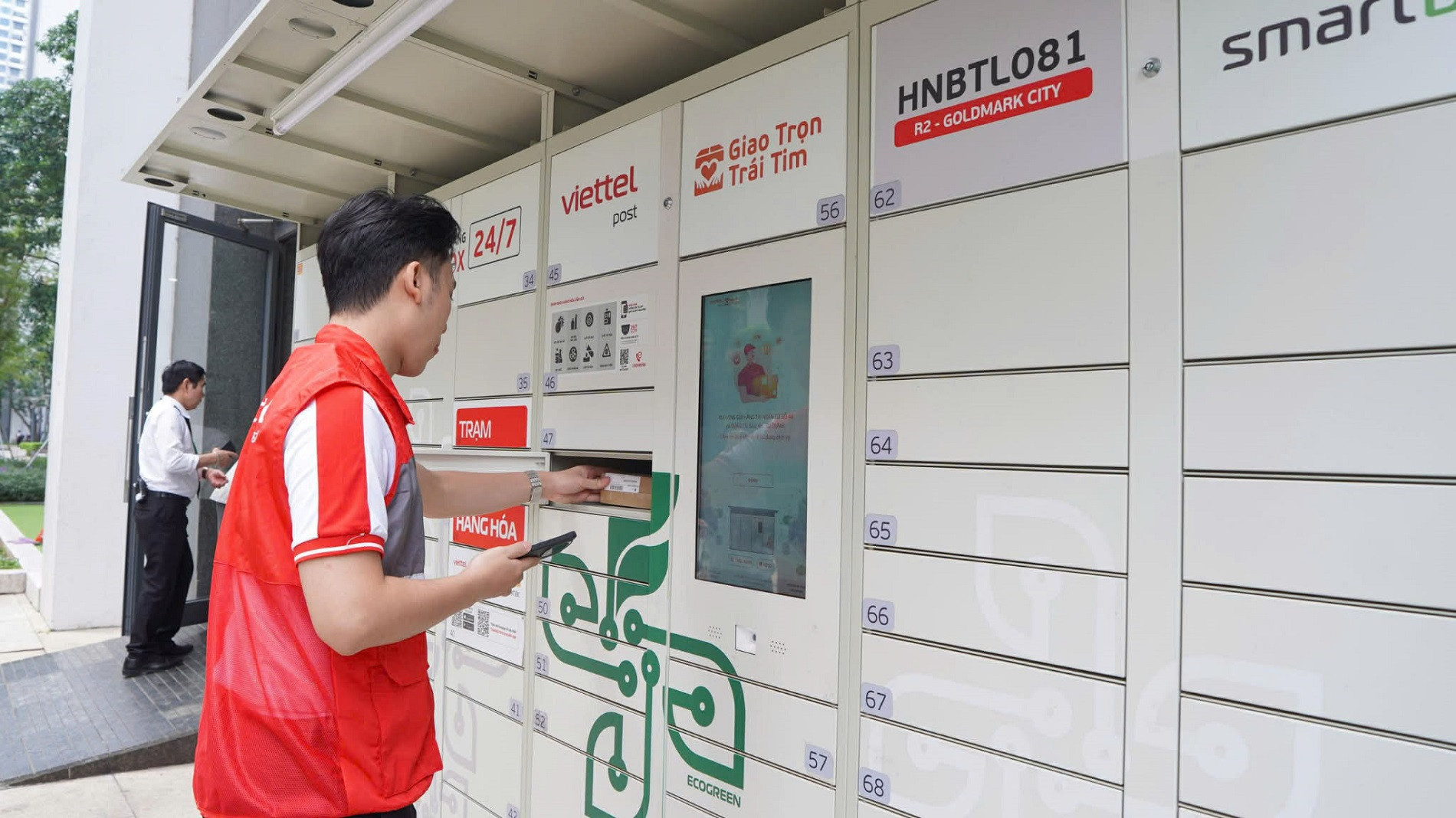
This approach enables faster expansion and aligns with international logistics trends. Viettel Post’s smart lockers are no longer just delivery devices but urban utilities: enabling 24/7 delivery, e-commerce returns, personal item storage, support for public services, and even connections with other digital ecosystems.
A single locker installed in an apartment building can handle thousands of deliveries each month without adding traffic volume or infrastructure pressure.
When the community participates, the network can expand exponentially. Within the program, the model has already delivered notable results.
In just one year, Viettel Post added 700 post offices, nearly half the number over the previous 28 years.
Speed alone is not the only factor. Viettel Post’s nonpublic network operates under strict technological discipline: every post office and pickup–drop-off locker is monitored in real time, with automatic alerts for delays and traffic adjustments if service standards are not met.
This model aligns with Vietnam’s Logistics Development Strategy for 2035–2050: reducing logistics costs to about 11-12 percent of GDP within the next 5–10 years (from the current 16-18 percent).
The state will invest in major infrastructure corridors, while businesses will lead technology deployment and integrated services, and society will participate in building a nationwide distribution network. With trade turnover of $900 billion, a 5 percent cost reduction could save $45 billion.
Thai Khang
.svg)
