 Vietnamnet.vn

 Podcast



Vietnam Maritime Corporation is set to contribute nearly VND7 trillion (US$285 million) to the Can Gio international transshipment port project, following its selection as part of the investor consortium for the nearly VND128 trillion (US$5 billion) mega development.
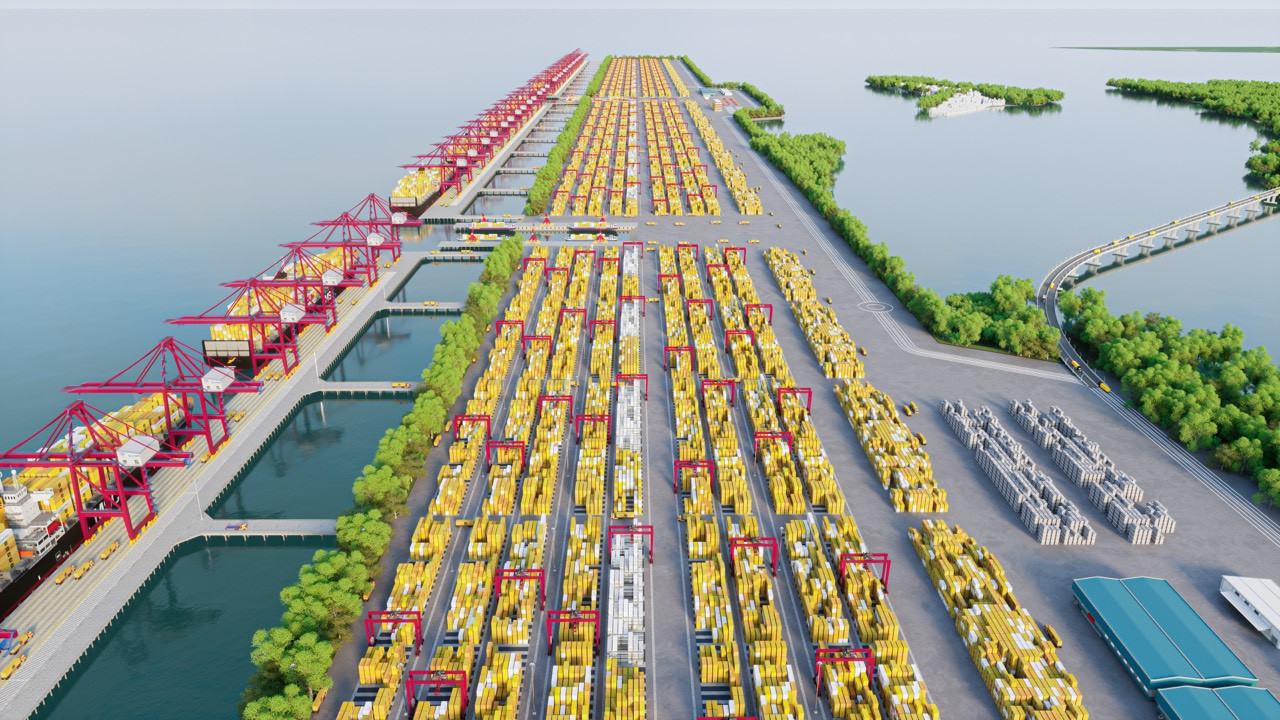
The announcement was made by VIMC Chairman Nguyen Canh Tinh at the company’s 2026 annual general meeting on April 15. The project will be located on Go Con Cho islet in Thanh An commune, Ho Chi Minh City, and is designed to become a large-scale international transshipment hub providing container handling and logistics services.
The port is expected to accommodate vessels of up to 250,000 DWT, with a total berth length of approximately 7.2 kilometers. Once fully completed, it will have a designed capacity of 16.9 million TEU per year, spanning an area of about 571 hectares.
The investment consortium includes VIMC, Saigon Port JSC and Terminal Investment Limited, a partner within the ecosystem of global shipping giant MSC. Under the agreed structure, VIMC will hold a 36 percent stake (around VND6.959 trillion, approximately US$283 million), Saigon Port 15 percent, and Terminal Investment Limited 49 percent. Total contributed capital is estimated at about VND19.3 trillion (US$785 million), with the remainder to be mobilized from other sources.
The project is planned in two phases. By 2030, at least two berths are expected to be completed, while the full development is scheduled to be finalized by 2050. Construction is projected to take around 20 years from the time land is handed over.
The operating entity is expected to be Saigon Gateway International Transshipment Port Co., Ltd., maintaining the same ownership structure as the investor consortium.
According to Nguyen Canh Tinh, the Can Gio port carries significant importance for Vietnam’s socio-economic development, helping enhance national competitiveness and strengthen the country’s logistics infrastructure.
VIMC CEO Le Anh Son emphasized that the project aims to establish a “true transshipment center,” noting that Vietnam currently lacks such a facility. “With Can Gio, we aim to compete directly with leading hubs like Singapore, not just within the region,” he said.
He added that in this competition, scale alone will not be enough. Shipping lines base their decisions on multiple factors, including safety, operational efficiency, cost, and increasingly, environmental standards.
As a result, the Can Gio project is being developed as a modern, environmentally friendly port aligned with stringent international standards, positioning it as a key link in global supply chains.
Vu Diep
.svg)
