 Vietnamnet.vn

 Podcast



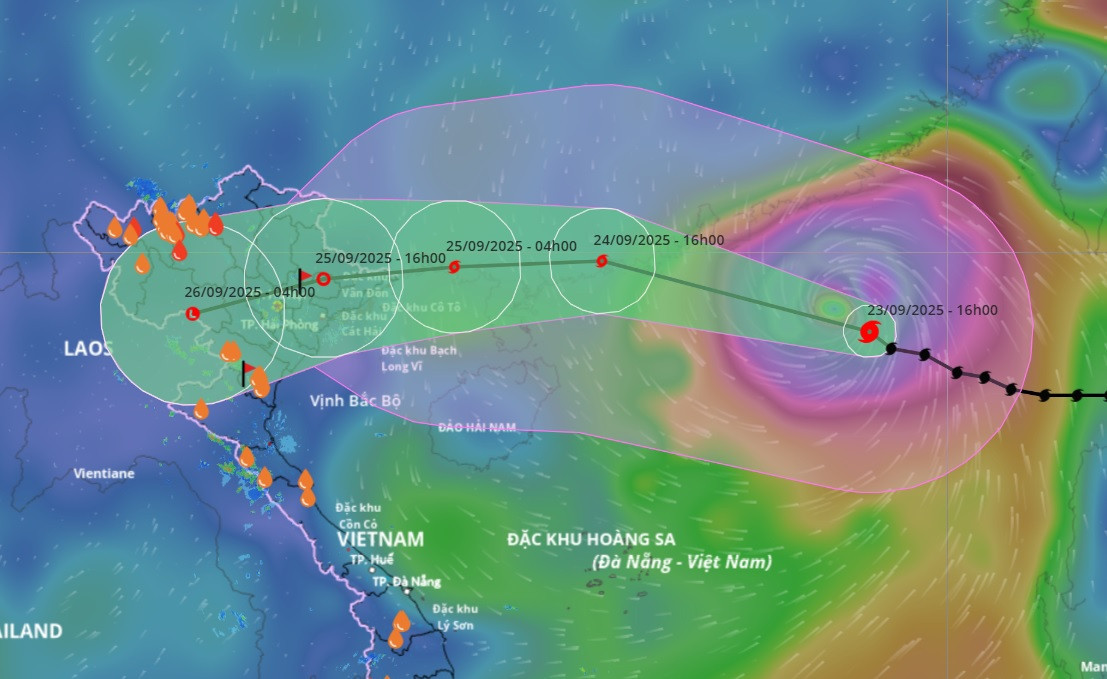
According to the National Center for Hydro-Meteorological Forecasting, the typhoon is currently maintaining maximum intensity levels (Category 16-17), with gusts exceeding Category 17. It is expected to weaken slightly by the morning of September 24 but will still remain extremely dangerous.
By early September 25, the storm is forecast to move into the Gulf of Tonkin, where it will maintain high intensity at Category 11-12, with gusts reaching 14-15. As it makes landfall across northern Vietnam, coastal areas are expected to face Category 10-11 winds, with gusts reaching above Category 12-13, while inland areas will see winds at Category 8-9.
Super Typhoon Ragasa brings a wide zone of intense winds and dangerous sea conditions, with waves exceeding 10 meters and violent seas that pose severe risks to vessels operating in the northern East Sea.
The typhoon is expected to bring heavy rainfall to the northern provinces and the north-central regions of Thanh Hoa and Nghe An, with precipitation ranging from 150-250mm and localized areas receiving over 400mm. This increases the risk of flash floods, landslides, dam safety breaches, and urban flooding in low-lying areas.
Adding to the concern, another tropical depression is forming and could develop into Storm No. 10, entering the East Sea shortly after Ragasa makes landfall.
The Prime Minister has instructed ministers and provincial leaders from Quang Ngai northward to remain on high alert, avoid complacency, and actively monitor and direct storm response efforts. Authorities are urged to prepare for worst-case scenarios and ensure safety above all else.
Leaders will be held accountable before the Government and the Prime Minister if lapses in preparedness or leadership result in loss of life or property.
Particular attention is required from local leaders in coastal provinces from Quang Ninh to Thanh Hoa - regions forecast to experience strong winds. These areas must ensure the safety of vulnerable groups such as the elderly, children, and students, as well as protect boats, coastal communities, and inland infrastructure.
The directive emphasizes safeguarding homes, warehouses, factories, offices, schools, hospitals, dikes, reservoirs, and essential infrastructure. It also calls for protecting agricultural production, aquaculture, and fisheries, following the principle: “Better to evacuate than to regret.”
Local authorities must review evacuation plans and be ready to relocate residents before the storm hits. They must also be prepared for emergency rescue operations should adverse situations arise.
The Prime Minister assigned the Minister of Agriculture and Environment to direct accurate forecasting and timely updates on storm progression and potential risks, including the possibility of a second storm forming in the East Sea.
Ministers of Construction, Industry and Trade, Culture-Sports-Tourism, Science and Technology, Education and Training, and Health are instructed to coordinate measures appropriate to their mandates to respond effectively to the super typhoon.
The Ministers of National Defense and Public Security are tasked with ensuring the safety of military and police personnel, equipment, and facilities. Units in at-risk areas must prepare resources to assist local response efforts.
The Chief of the National Civil Defense Steering Committee Office is to coordinate closely with the Ministry of Agriculture and Environment to monitor developments, refine response scenarios, and mobilize forces and equipment to support local governments during the storm and potential floods.
Tran Thuong
.svg)
